Akita · Winter
Oga’s Namahage: Why the Frightening Visitor Is Welcomed
Warnings, hospitality, and blessings meet in a New Year custom on Akita’s Oga Peninsula.
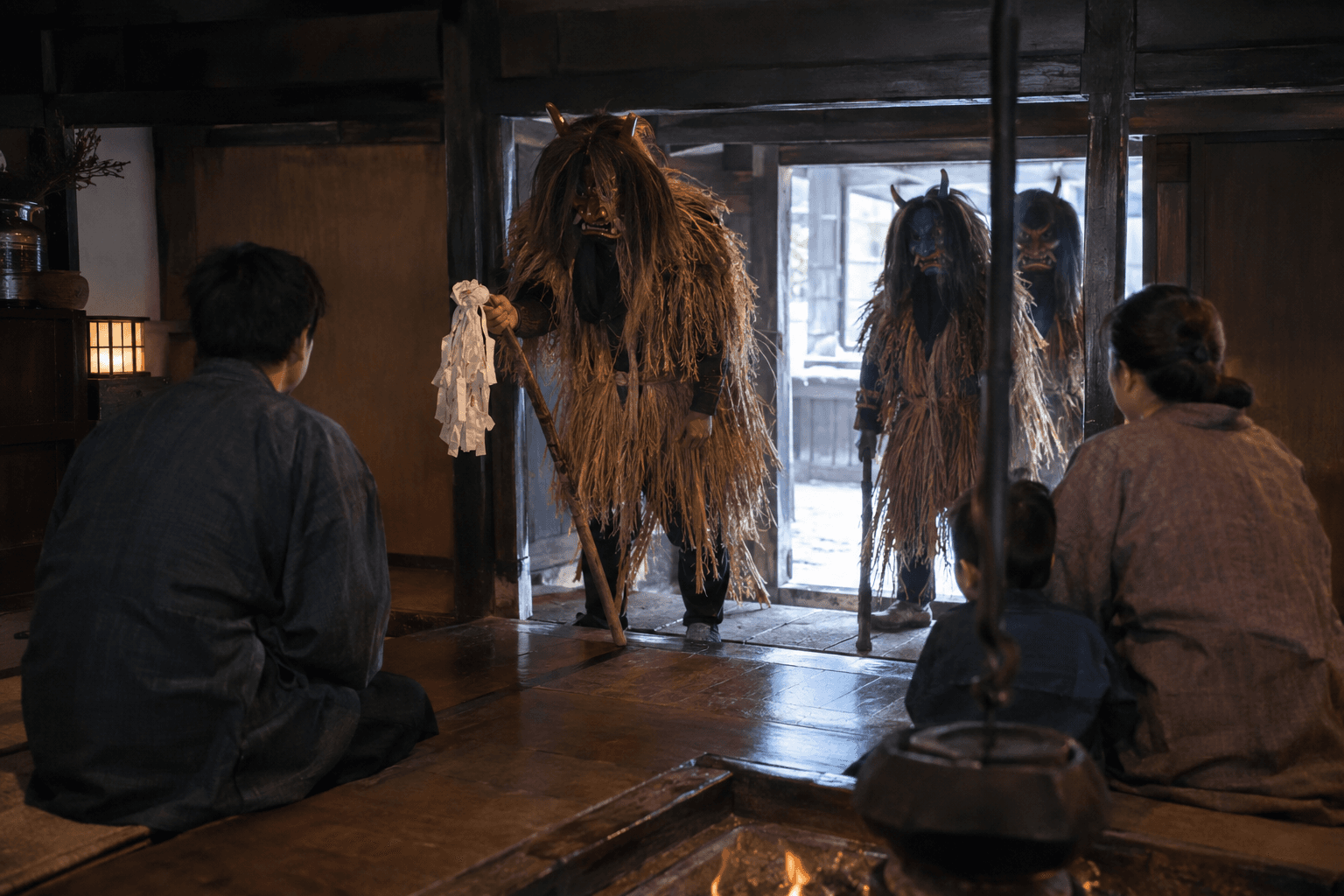
Guests who arrive with a warning
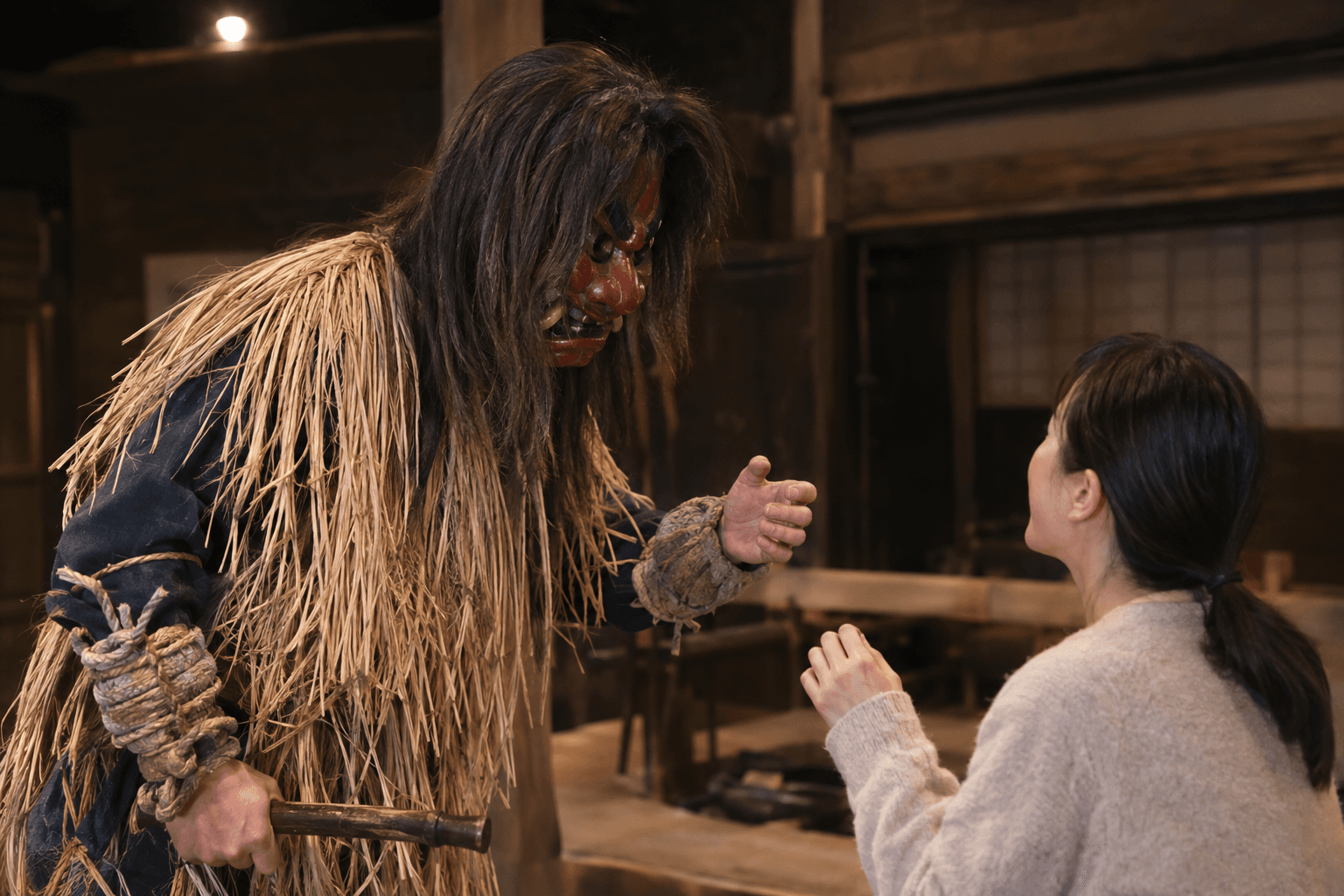
On the Oga Peninsula in Akita Prefecture, local young people put on fierce masks and kede—cape-like straw garments—to visit homes on New Year’s Eve. They call out against idleness and disobedience, while households prepare food and sake to receive them. These are the Namahage: intimidating visitors welcomed with hospitality.
The sequence becomes clearer through one local example. In Shinzan, two Namahage travel with a messenger called the sakidachi, who goes ahead to ask whether the household will receive them. The pair wear hornless masks and carry neither tools nor weapons. Other communities have different appearances and arrangements; Shinzan’s version is not a template for the entire peninsula.
After permission is given, the Namahage enter and move through the house, calling for idle people. The host calms them and offers refreshments. Questions about the family and the year’s crops follow. Before leaving for the next house, the visitors pray for the household’s health and a good harvest. The encounter progresses from a challenging entrance through an exchange with the host to wishes for the year ahead.
The Namahage Museum describes them as raihōshin, visiting deities, and as messengers of the gods of Mount Shinzan and Mount Honzan. In this local religious understanding, they dispel misfortune and bring abundant crops, good fishing catches, and other blessings. Their frightening appearance is only part of their role; the household receives protection as well as admonition.
The name itself contains a warning. The museum connects it with namomi, heat marks associated with spending too long beside the hearth. In the customary explanation, these marks betray idleness. Namomi-hagi, the peeling away of such signs, is said to have become Namahage. The explanation carries an expectation of work rather than indefinite leisure by the fire.
A household’s welfare, and a changing tradition
In Shinzan, the house visits belong to a larger sequence involving the shrine. Oga City’s account describes participants putting on their straw garments, receiving masks, and being offered sacred sake. They then go to Shinzan Shrine for a rite understood to invest them with the deity’s presence. After their rounds, they return to the shrine precincts and wrap the straw garments around pillars of the Kankitendō hall. The household encounter sits between these acts of preparation and return.
What happens during the conversation matters as much as the entrance. Interpretive texts prepared in 2019 for the Oga Shinzan Folklore Museum explain its public reenactment through a Namahage logbook. In the performance, the visitors claim to have watched village life from Mount Shinzan and recorded people’s conduct throughout the year. They question the host about a grandson who plays games instead of doing homework. The grandfather first defends him, then promises to attend to his schoolwork in the coming year. This is the museum’s enacted example, not a report about an identifiable local family.
The questions are not confined to children. In another part of the same performance, the Namahage criticize the host’s daughter-in-law for failing to rise early and prepare breakfast. He answers that his elderly mother makes the morning meal so that she has an occupation and remains active. As the accusations continue, he stands up for his family and urges the visitors to put away their book and accept more sake. The exchange gives the host an active role: he does not merely listen to a reprimand but answers, explains, and protects the people of his house.
The custom’s beginnings are less certain than its surviving descriptions. Oga City identifies the traveler Sugae Masumi’s illustrated account of Namahage at Miyazawa in 1811 as the earliest record. Its entry concerns the fifteenth day of the first month in the old calendar. This records an existing practice, not its invention.
Historically, the visits belonged to Koshōgatsu, the Little New Year associated with the fifteenth day of the first lunar month. Today’s December 31 observance is a different calendar arrangement. Keeping those dates distinct avoids treating the present New Year’s Eve custom as an unchanged schedule stretching back through the surviving record.
Public celebrations have their own, more recent histories. According to its organizers, the Namahage Sedo Festival began in 1964 at Hoshitsuji Shrine in the Oga hot-spring district. It combined Namahage with elements of Shinzan Shrine’s Saitōsai, a religious observance held on January 3. After its first three editions, the festival moved to Shinzan Shrine. That history belongs to the February public festival, not to the origins of household visits.
The festival’s drumming also has a documented modern development. Its organizers trace the combination of Namahage and Japanese drums to experiments in the hot-spring district during the 1970s, followed by the formation of a local transmission group and development of the performance in the 1980s. A Namahage drum performance and a household visit are related uses of the figure, but they do different things.
Alongside these public forms, the household custom continues: the city records its observance in 71 districts on December 31, 2025.
Local accounts also describe what continuation requires. In his February 2024 bulletin, Oga’s mayor reported an understanding in Anzenji of Namahage as a rice-field deity protecting descendants. Reflecting on his visits to several communities, he called for instruction in voice, walking, exchanges with hosts, and manners on both sides of the encounter, as well as the passing on of local masks. The task he described involves not only people who wear the costume but also people who know how to receive them.
Three details that deepen the encounter
The counted footsteps
Shinzan’s movements are regulated rather than simply boisterous. The local museum describes seven shiko, deliberate stamping steps, at entry; five before sitting before the offered refreshments; and three when rising again. It explains the stamping as a wish that the household’s children should avoid illness and injury and live happily. These counted transitions give an intimidating action a protective intention.
What a mask is made from
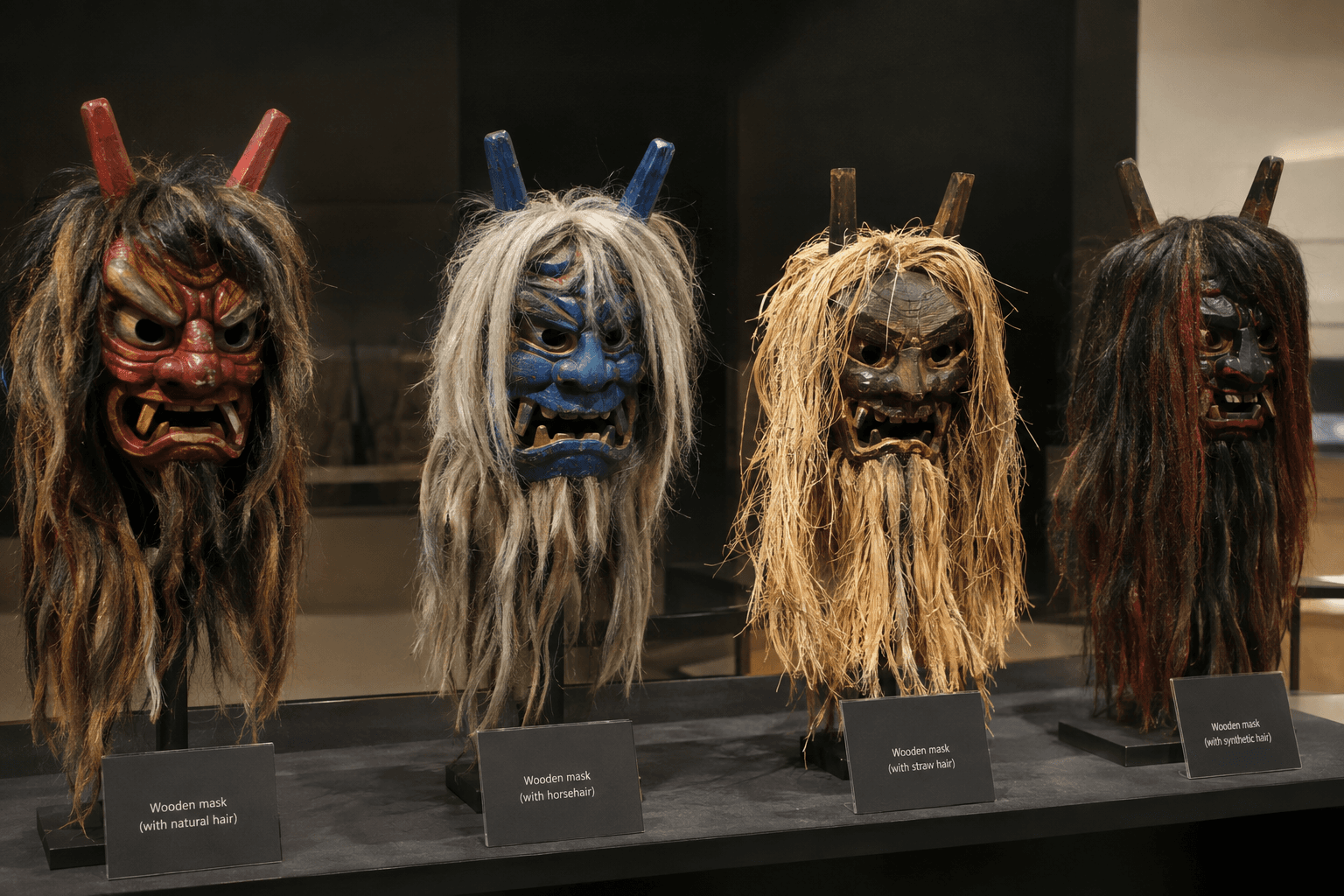
A single polished wooden face cannot represent all Namahage masks. A 2019 interpretive account for the museum describes masks made from wood, bark, paper clay, plywood, tin, and plastic. It links their construction to available materials: coastal communities sometimes used seaweed for hair, while other masks used horsehair or hemp fiber. These are practical connections between an object and the place where it was made, not merely decorative differences.
The same account notes that elaborately carved wooden masks developed for tourism have also been adopted for actual New Year’s Eve visits in some villages because of their durability. Masks can strike door frames as their wearers move between rooms and houses. This documented exchange complicates a simple division between an old ritual object and a modern souvenir: some objects have crossed between those settings.
The straw left behind
Straw falling from a costume is not necessarily treated as rubbish. The Folklore Museum’s explanatory text describes it as sacred and says it is left on the floor overnight. Long pieces wrapped around the head are traditionally said to protect against colds or improve the mind. These are beliefs, not medical claims. The detail extends the visit’s meaning beyond departure: something associated with the visitors’ protection remains in the house.
Visiting the performances and collections
Two neighboring institutions in Shinzan offer different ways to understand the custom. The Namahage Museum displays more than 150 masks previously used in communities around Oga and screens a film about the New Year’s Eve visits. It is the place to examine the range of faces and see the custom’s household setting on screen.
The Oga Shinzan Folklore Museum, next door in a traditional local farmhouse, presents live learning sessions based on Shinzan’s custom. The collection and film are one experience; the enacted visit is another. These presentations introduce a household observance that outsiders otherwise have few opportunities to see. They are not an invitation to enter private homes.
The reenactment is described in its interpretive text as representing a Shinzan visit of decades ago. Its published guidance permits photography but says visitors must not enter the performers’ room. Fallen straw may be collected after the performance; it should not be pulled from a costume. Follow the guide’s directions rather than interrupting the exchange for a photograph or souvenir.
For an outdoor public celebration, the Namahage Sedo Festival takes place at Shinzan Shrine. Its programme includes the ritual presentation of masks, a reenactment of household visiting, drumming, and Namahage descending with torches. In the concluding offering, a priest presents a large rice cake roasted over the festival fire to the Namahage as messengers of the gods. This is a shrine festival programme, not a procession of actual household calls.
Advance admission registration is required. The shrine venue is unpaved and can be affected by snow, so plan clothing and footwear for an outdoor winter evening. Organizers prohibit umbrellas, tripods, monopods, and selfie sticks, and visitors must remain outside restricted areas.
When to go: daily demonstrations or the winter festival
For a December visit, the museums offer the most straightforward public opportunity. The Namahage Museum lists year-round opening from 8:30 a.m. to 5 p.m. The Folklore Museum’s current December–March timetable lists daily sessions at 9:30, 10:30, and 11:30 a.m., then 1:30, 2:30, and 3:30 p.m. A combined admission ticket covers both institutions.
The household custom’s customary date is December 31. The Sedo Festival is separate: it normally takes place on the Friday, Saturday, and Sunday surrounding February’s second Saturday. Its 2026 dates were February 13–15 and are now past. Organizers have announced the next edition for February 12, 13, and 14, 2027, from 6 to 8:30 p.m. each evening.
Check the operators’ current notices for holiday timetable changes and Oga’s tourism office for any additional public events around December 31, 2026.
Around the visit: Oga’s fishing culture
For a second stop on the peninsula, Oga Aquarium GAO, in Toga Shiohama, provides a useful counterpart to the wishes for plentiful catches. Its main Oga-sea tank presents creatures found locally from spring into summer. A dedicated hatahata gallery introduces Akita’s prefectural fish through its biology, fishing history, and place in regional food culture. This makes the aquarium more than a display of marine animals: it offers another way into the relationship between local waters and daily life.
Place and region
Namahage Museum, Akita
Oga occupies a rocky peninsula on the Sea of Japan coast of northern Honshū. The peninsula’s weathered cliffs, fishing coves, and small settlements shape a maritime livelihood and the local Namahage ritual, which is closely linked to mountain shrines, the sea’s bounty, and household visits. Oga City administers the peninsula and the museums and shrines most closely tied to the ritual; the Namahage Museum and the Oga Shinzan Folklore Museum present the practice both as a household rite and as an interpreted public performance.
From Tokyo
By rail (recommended): take the Akita Shinkansen (Komachi) / JR services from Tokyo to Akita Station, then change to the JR Oga Line (often shown as the “Oga Namahage Line”) for Oga Station. Check current Komachi connections and Oga Line timetables before travel. By air: fly Tokyo–Akita Airport, then use the airport limousine, regional bus, taxi, or rental car to reach Akita Station or drive toward the peninsula; the Namahage Museum’s access guidance notes routes from Akita Airport. By highway bus: overnight and day highway buses serve Akita (Akita Station / Akita city); from Akita Station transfer to the Oga Line or local shuttle services. Local access on the peninsula: public transport is limited—Oga tourism and the Namahage Museum publish a “Namahage Shuttle”/temporary buses for festival and museum access in winter, and taxis or rental cars are commonly used; contact the museum or Oga City tourism office for current schedules and any seasonal buses.
Food of this place
- Kiritanpo. Pounded rice formed on skewers, grilled and commonly served in kiritanpo‑nabe with local chicken and root vegetables; strongly associated with Akita’s winter food culture.
- Inaniwa udon. A thin, hand‑finished udon noodle originating in Yuzawa and celebrated across Akita Prefecture.
- Iburigakko (smoked daikon). Smoked daikon pickles commonly listed among Akita specialities; coastal Oga restaurants and market stalls also emphasise peninsula seafood.
The marker shows the municipality, not an exact event venue. Map data © OpenStreetMap contributors.
Explore more stories from AkitaSources and current information
- 男鹿のナマハゲ|「重要無形民俗文化財」男鹿のナマハゲ
- 地域の行事|「重要無形民俗文化財」男鹿のナマハゲ
- 男鹿真山伝承館|なまはげ館
- 男鹿のナマハゲ|なまはげ館
- Namahage Performance, Part 1: Introduction
- Namahage Performance, Part 2: Introduction (2)
- 男鹿真山伝承館:なまはげ台帳の話:孫
- Namahage Performance, Part 8: The Namahage Log and the Daughter-in-Law
- Namahage Museum: About the Masks
- 市長だより 令和6年2月
- なまはげ柴灯まつりについて
- 行事内容|なまはげ柴灯まつり
- 事前申込と入場料について
- なまはげ柴灯まつり公式サイト
- 来訪神、勇壮かつ幻想的に 男鹿市・なまはげ柴灯まつり開幕
- なまはげ館館内紹介
- 料金・開館時間
- Guide Map – 男鹿水族館GAO