Tokyo ·
Asakusa’s Tori-no-Ichi: Raking In a Good Year
A decorated bamboo rake is the beginning of the story. At Ōtori Shrine, choosing it, paying for it and taking it home turn a November market into an annual expression of hope.
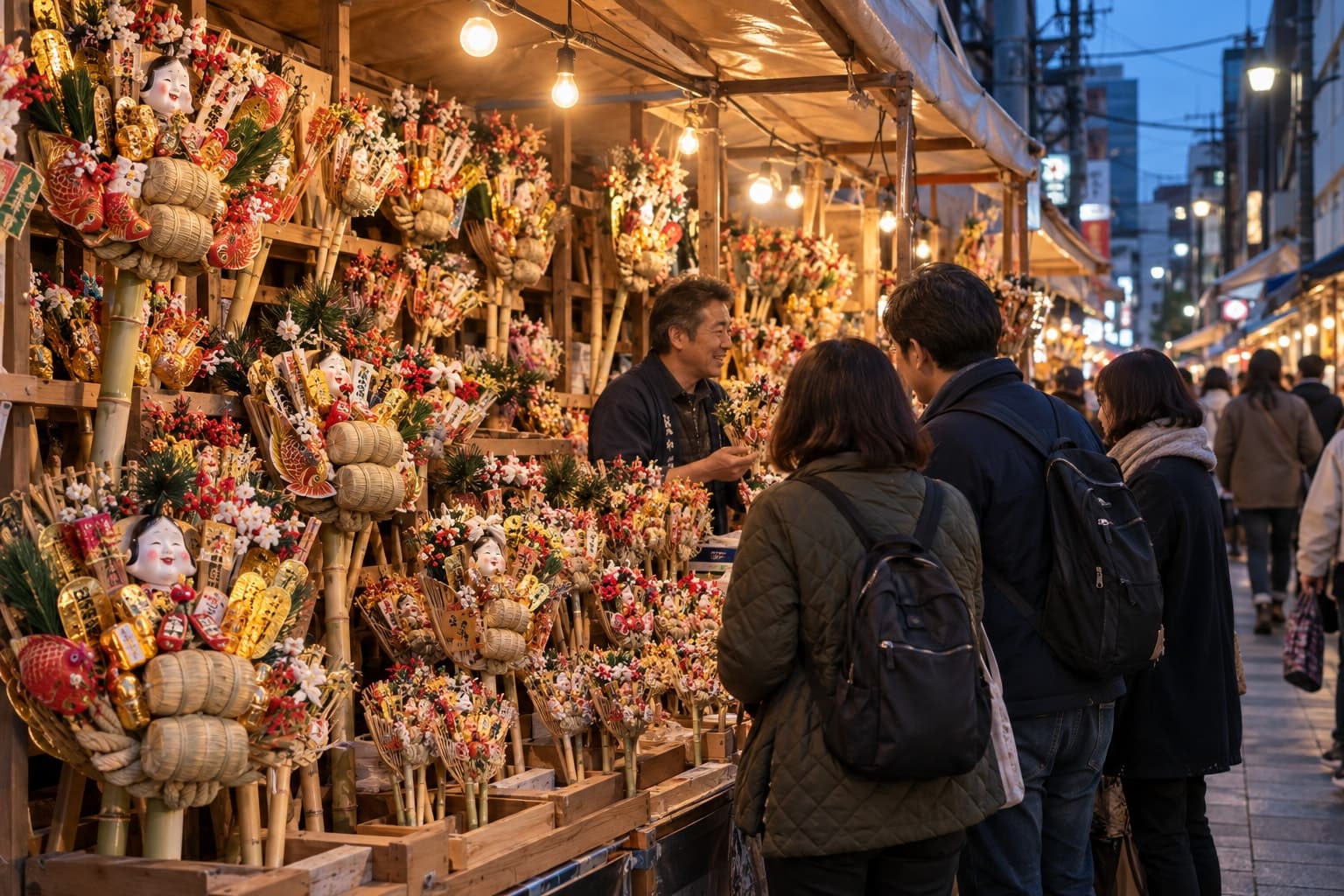
A market with something more to sell
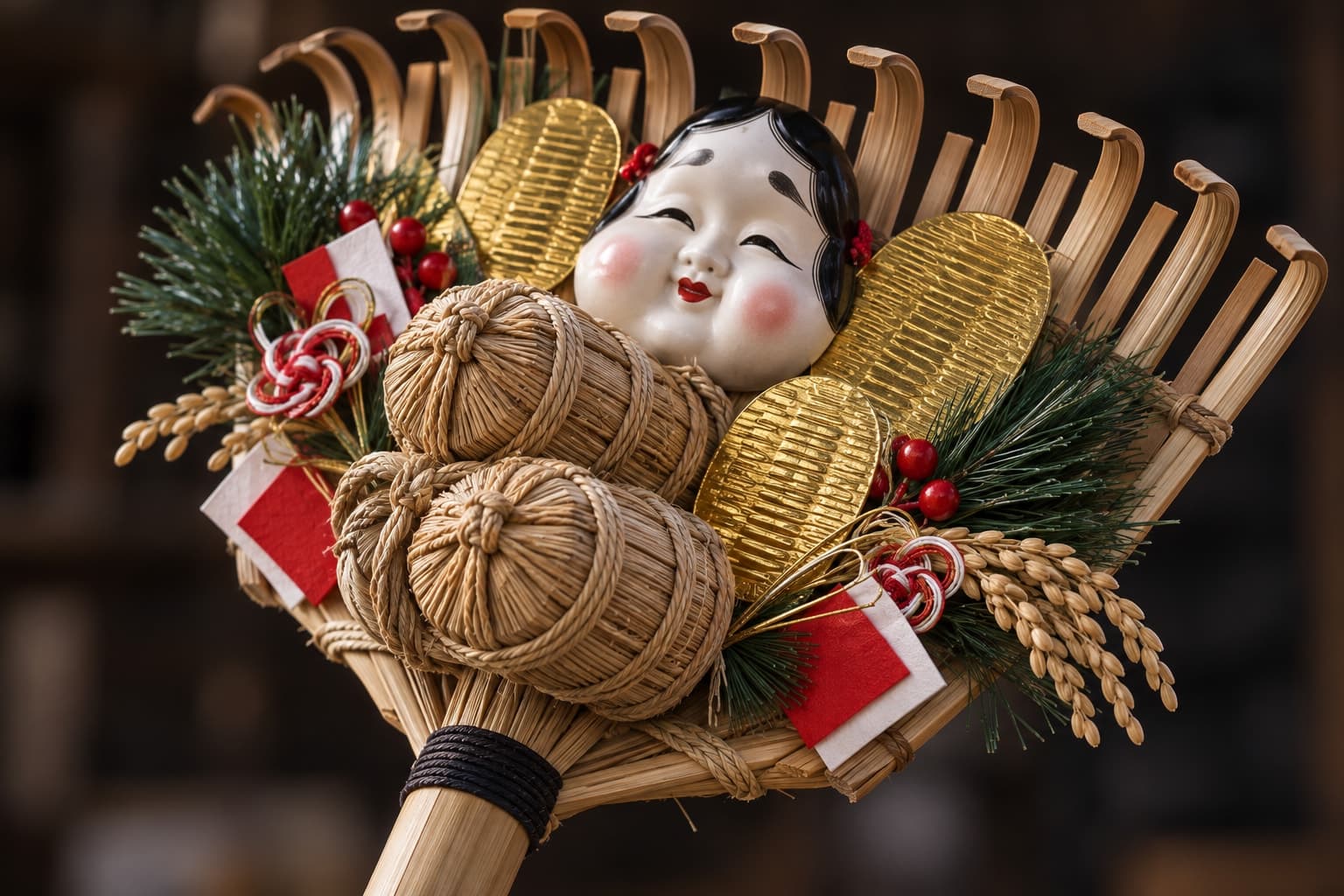
At Asakusa’s Tori-no-Ichi, stalls display bamboo rakes so thickly decorated that the tool can almost disappear beneath its ornaments. Visitors compare them, speak with sellers and carry their purchases away. Some arrangements resemble treasure ships; others gather smiling faces, coins and rice bales into a bright cluster. These are kumade, transformed from implements for gathering things into auspicious objects for gathering good fortune. Asakusa Tori-no-Ichi: types of kumade
The market takes place at Ōtori Shrine and neighbouring Chōkokuji Temple in Senzoku, in Tokyo’s Taitō ward. People come to pray for prosperity and good fortune, as well as to buy the decorated rakes. The ward’s description connects the familiar action of raking things towards oneself with the wish to draw in wealth and luck. Buying a kumade gives that wish a shape that can be carried home. Taitō ward
The name Tori-no-Ichi means a market on the day of the Rooster. Here, the animal belongs to a repeating calendar cycle, not to the merchandise. Rooster days recur twelve days apart, giving November either two or three occasions. The first is Ichi-no-Tori, the second Ni-no-Tori, and, when the calendar allows it, the third is San-no-Tori. National Diet Library
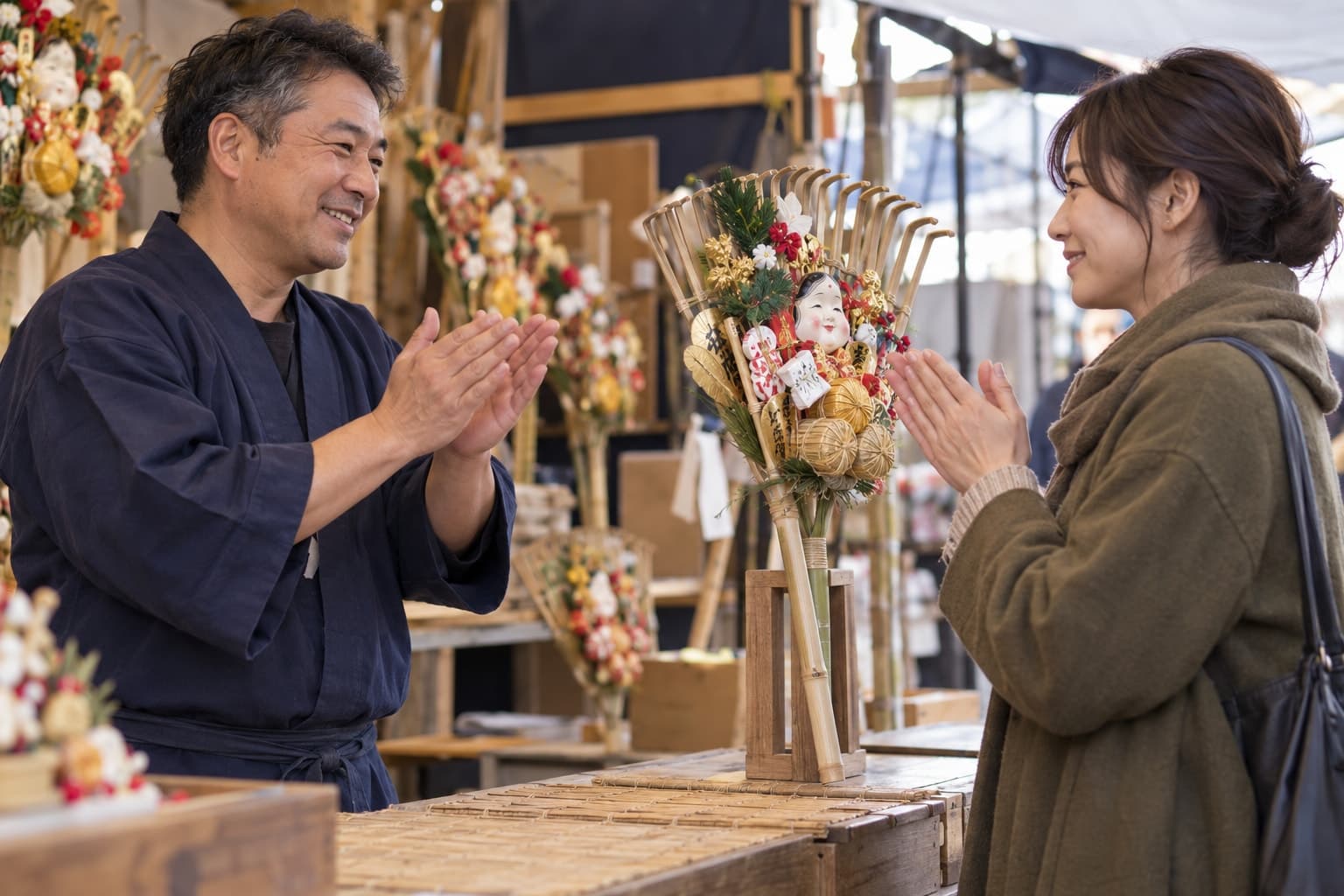
A purchase may finish with tejime, rhythmic handclapping that marks the completed transaction and a wish for the buyer’s household or business to prosper. This makes the exchange visible and audible to the people around it. The rake is an object, but the custom includes the interaction that accompanies its sale: choosing, talking, agreeing and celebrating. Ōtori Shrine’s guide
How a harvest market became an urban occasion
There is more than one account of the market’s beginnings. The National Diet Library sets out traditions associated with Ōtori Shrine, Chōkokuji and the festival at Hanamata, now Hanahata in Adachi ward. Their coexistence is more useful than choosing a single ancient founding story. They explain different religious and local connections to an occasion that developed across several places. National Diet Library
Ōtori Shrine’s own account centres on Yamato Takeru. It relates that the legendary figure offered thanks after a military expedition on a Rooster day in November. This is a shrine tradition explaining the sacred date, rather than contemporary documentation of the market’s establishment. National Diet Library’s account of the shrine tradition
Chōkokuji’s festival history describes a rural thanksgiving occasion at Hanamata, where worshippers honoured a local deity after the harvest. It then traces the increasing prominence of Asakusa, particularly around 1771, when the temple’s account places the arrival of its Washi Myōken deity. It also notes the neighbouring Yoshiwara district as part of the area’s historical setting. This presents the market as an urban development with religious and commercial connections, not simply an unchanged country rite transplanted intact. Chōkokuji’s history of Tori-no-Ichi
The rake supplies a particularly clear link between work and symbolism. Chōkokuji’s explanation describes farm tools and produce sold at the older harvest market. A tool that gathered fallen material could, by a playful shift of meaning, gather fortune. As visitors from Edo increased, more elaborate auspicious forms emerged. Its account places large, decorative Asakusa rakes alongside smaller variations, including rake-shaped hair ornaments. The origins of kumade
Ōtori Shrine likewise describes a change in appearance. Earlier long-handled practical rakes bore an Okame face and paper streamers; later makers added a growing range of auspicious motifs. Its explanation also distinguishes the shrine’s ritual festival from the market that developed around it. The shared occasion accommodates worship and trade, but one should not mistake a stall selling decorated rakes for the shrine itself issuing an amulet. Ōtori Shrine: the festival and its rakes
The market also looked forward. Chōkokuji describes it as an early step towards welcoming the New Year. In that setting, prosperity is not only a wish for one successful transaction. A November purchase anticipates the life of a household or business in the year ahead. The timing gives an ordinary shopping decision a longer horizon. Chōkokuji’s festival history
Recent organiser records show the practice continuing. Chōkokuji’s notice of 15 November 2025 thanked visitors after that year’s first fair and announced the second. For 2026, both the shrine and Taitō ward have published dates. The historical accounts lead to an occasion that is still organised around actual visits, purchases and worship. 2025 organiser notice, 2026 ward announcement
The details that make a rake auspicious
The first distinction is between a religious amulet and a merchant’s decorated kumade. Ōtori Shrine calls its small rake amulet kakkome and describes it as an expression of the deity’s presence, bestowed during Tori-no-Ichi. The large arrangements in the stalls belong to a related but different practice of buying auspicious decorations. Both may enter a home or workplace, but they are not interchangeable products with identical religious status. Ōtori Shrine
Nor are all decorated rakes versions of one standard design. Chōkokuji’s guide distinguishes treasure-ship arrangements, with lucky gods, coins and account books, from designs featuring an Okame face, pine, bamboo, plum, cranes, turtles or rice bales. Some leave thick, darkened claws clearly visible. These differences give the buyer choices of form and emphasis. Looking for what remains of the original rake is one way to appreciate how far a maker has transformed it. Kumade varieties
There are also several explanations for the rake’s power to gather fortune. Alongside the agricultural tool, the temple’s account offers an eagle’s grasping claws and a story about a military fan whose surviving frame resembled a rake. These should remain attributed explanations, rather than being joined into one literal sequence of invention. Their common movement is the act of catching or drawing something towards oneself. The origins of kumade
The negotiation can make the same wish social. A celebrated way of buying is to bargain over the price, then give the reduction back as a congratulatory gratuity. The temple’s explanation treats this as a gracious exchange: appreciation for the seller’s willingness to negotiate, together with a wish that the seller also has a good year. It explicitly says that the gratuity is a custom, not a requirement, and that modern transactions differ from stall to stall. Organiser’s questions and answers
Seen this way, the apparent contradiction is the point. The buyer has negotiated a reduction but need not keep it; generosity completes what bargaining began. That does not make every purchase a scripted performance. It gives one documented style of exchange a meaning beyond getting the lowest price. The ensuing handclapping acknowledges both the concluded sale and the prosperity being wished for. Ōtori Shrine’s buying guide
Taking the rake home is another stage. The shrine’s guidance recommends placing it high, preferably facing south or east, while allowing for the practical limits of the room. It says a replacement can be displayed immediately and advises returning old charms and rakes to the religious institution from which they were obtained. The object thus belongs to a cycle of receiving, keeping and returning, rather than being only a souvenir of a crowded evening. Ōtori Shrine: displaying and returning charms
A final detail sits alongside the rakes: auspicious food. The shrine describes yatsugashira taro as associated with getting ahead and with abundant offspring, and kirizanshō as a sweet made with rice flour, sugar and Japanese pepper. These foods show the same habit of connecting an everyday thing’s name, appearance or qualities with a desired outcome. Luck at this market has texture and form; it can be displayed, carried or eaten. Ōtori Shrine’s festival guide
Visiting Ōtori Shrine and its neighbouring market
The public destination is the shrine and Chōkokuji area in Senzoku, north of the best-known central Asakusa sights. Taitō ward lists both institutions as festival venues. Allow time for worship as well as browsing: the market grows around a religious occasion, and the two institutions should not be treated as a single undifferentiated attraction. Taitō ward’s event information
If you want a rake, decide what you can comfortably carry and display before choosing it. The important practical distinction is between the shrine’s amulet counter and the merchants’ decorated arrangements. For a purchase, asking the seller about the price and what is included is more useful than trying to reproduce an imagined obligatory bargaining ritual. The organiser expressly describes gratuities as optional. Organiser’s Q&A
Keep space for people who are praying, buying and passing through, and ask before photographing a seller at close range. These are sensible courtesies for sharing a busy working market, not a claim that there is a blanket photography ban. Ōtori Shrine also offers particular festival services with advance reservations; ordinary attendance should not be confused with a reserved place in those ceremonies. Shrine’s 2026 arrangements
When to go
For 2026, the confirmed dates are Saturday 7 November and Thursday 19 November. The published festival period is midnight to midnight on each date. There is no third fair this year, and the twelve days between the two dates are not a continuous market. These are the shrine’s and ward’s current announcements, not dates inferred only from an annual custom. Ōtori Shrine, Taitō ward
The opening drum at midnight marks the start of the shrine festival. A late-night visit therefore means arriving as the preceding calendar day turns into the listed date. For a first visit centred on browsing, later daytime or evening is the more practical choice: the organiser notes that some rake sellers do not serve customers during the early-morning hours. A twenty-four-hour festival does not mean every counter works continuously. Shrine arrangements, Organiser’s Q&A
Choose the first date if a Saturday suits your plans, or the second for a Thursday visit. Before travelling, consult the organisers for any updated entry or crowd arrangements; neither date guarantees a particular level of congestion.
Around the visit: tools for a different kind of prosperity
Kappabashi Kitchenware Town makes a complementary daytime stop. Its shops supply cooking equipment, tableware and the realistic food models displayed by restaurants. Tokyo’s official visitor guide describes a district serving professional and amateur cooks, with many businesses also selling individual items to ordinary shoppers. GO TOKYO: Kappabashi
The connection is a useful one without requiring a shared ritual history. At Tori-no-Ichi, a tool becomes a wish for commercial success; in Kappabashi, tools help people perform the everyday work of preparing and serving food. Browsing both gives the visit two views of making a livelihood: the equipment needed to do it, and the good fortune people hope will accompany it.
Plan Kappabashi for the daytime rather than after a late-night market visit. GO TOKYO lists general daytime shopping hours, with individual businesses varying. That keeps the evening free for the shrine and the rakes, instead of arriving at a second district whose working day has already ended. GO TOKYO
Place and region
Taitō City, Tokyo
Asakusa’s Tori-no-Ichi is held at Ōtori Shrine and Chōkokuji Temple in Senzoku, Taitō City. The district has a long history of religious and urban life, in a low-lying part of eastern Tokyo shaped in part by river-borne soil and waterways.
From Tokyo
From Tokyo Station, take the JR Yamanote Line to Ueno, then the Tokyo Metro Hibiya Line to Iriya. The venues are about a nine-minute walk from Iriya Station. Alternatively, take the JR Yamanote Line to Kanda and transfer to the Tokyo Metro Ginza Line to Asakusa; the walk from Asakusa Station is longer. Check rail operators and event organizers for current service and event information before travelling.
Food of this place
- Dojō-nabe. A loach hot pot associated with Asakusa.
- Tempura. One of the foods highlighted at long-running eateries in Asakusa.
- Soba. A food highlighted at long-running eateries in Asakusa.
- Kaminari-okoshi. A crisp rice snack sold near Kaminarimon Gate from around the middle of the Edo period.
The marker shows the municipality, not an exact event venue. Map data © OpenStreetMap contributors.
Explore more stories from Tokyo