Shiga ·
Omi Narezushi: The Season Inside a Fermentation Tub
How Lake Biwa's fish, rice, and household work become a food for sharing.
Fish, rice, and a season of waiting
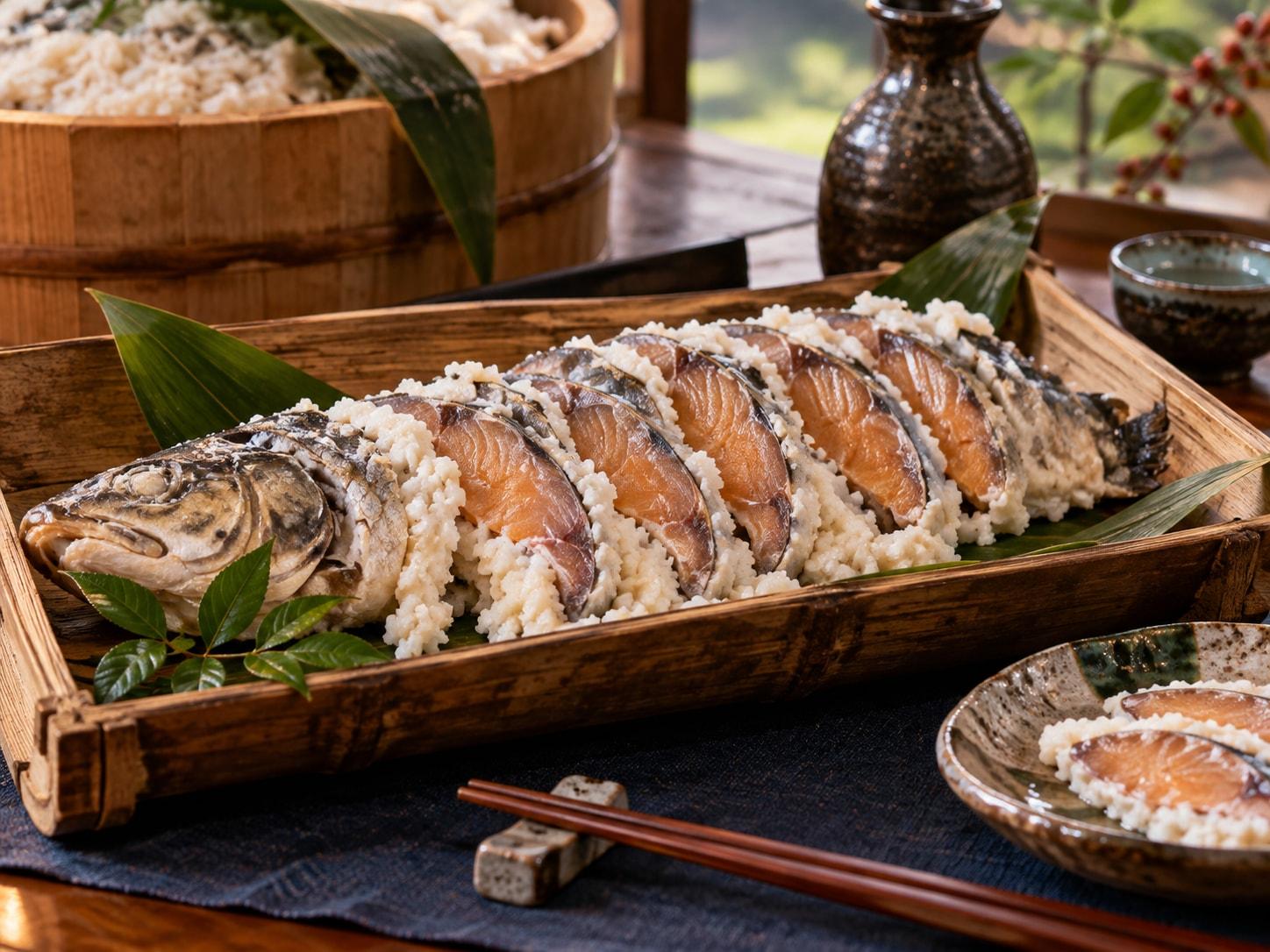
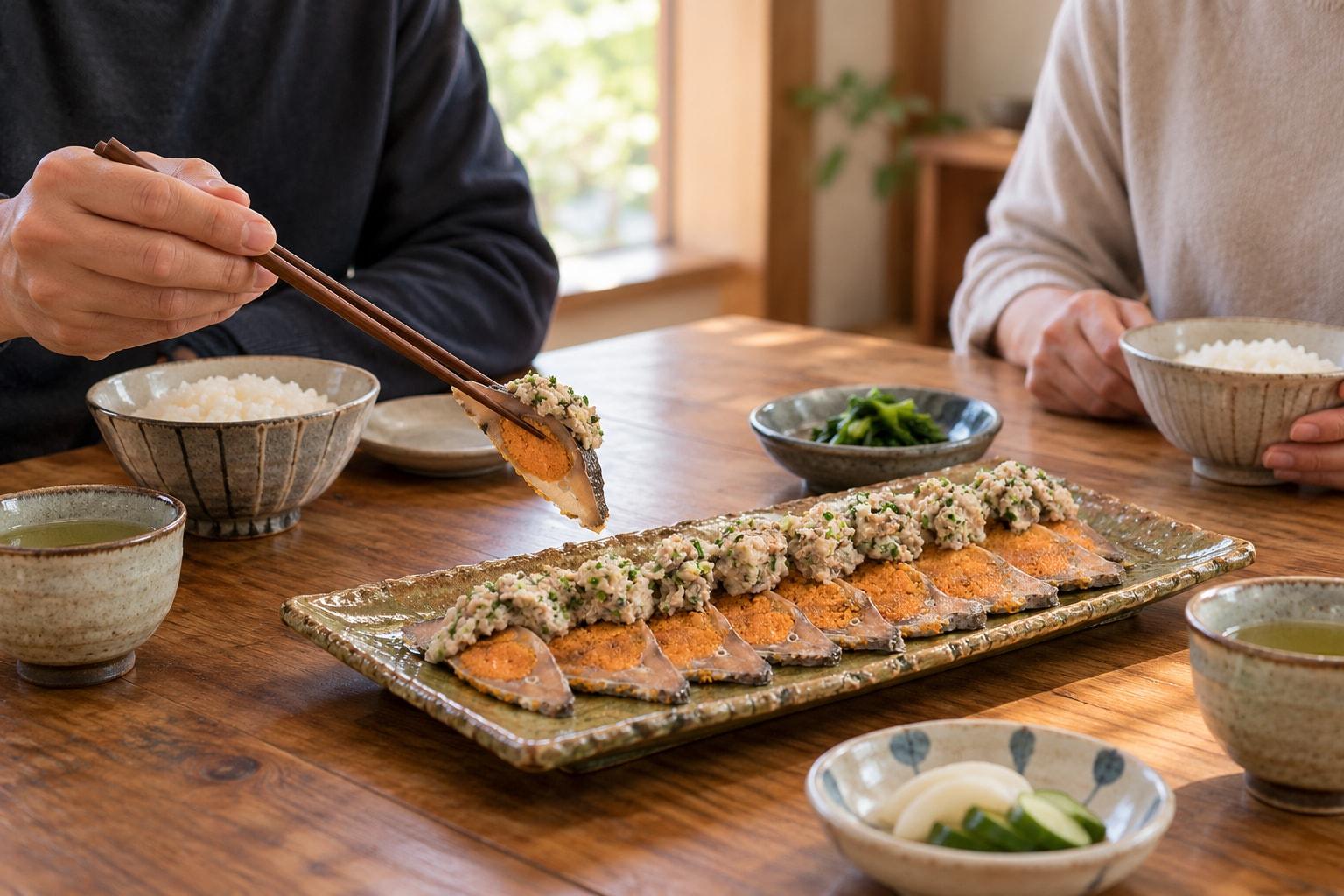
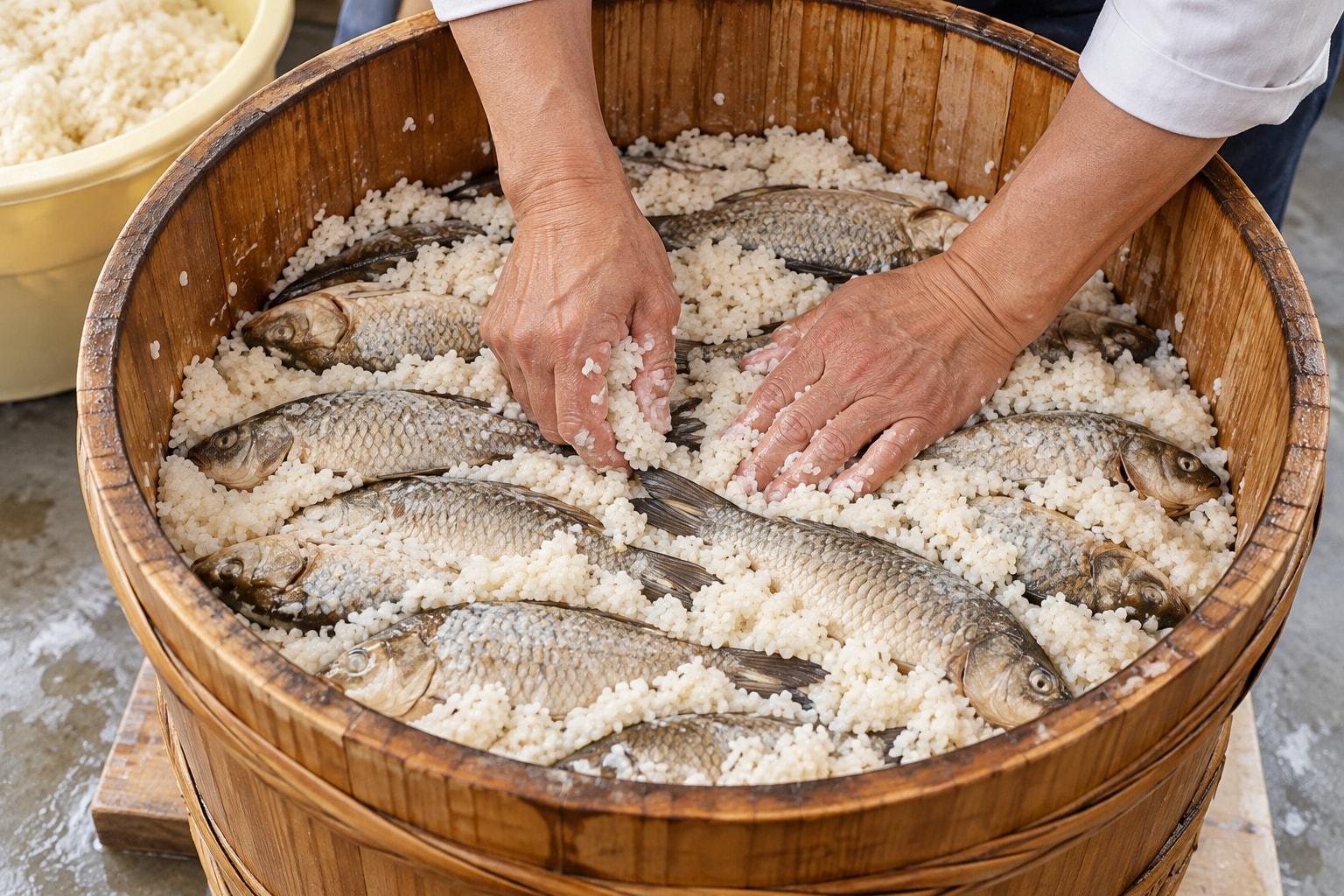
The fish go into the tub whole. After an earlier period in salt, they are washed and prepared for another stage: packing with cooked rice. Rice fills the spaces inside and around them; successive layers bring fish and rice into close contact. A lid and weights complete the arrangement. Months later, a fish can be lifted out, cleared of some of its fermented rice and sliced, revealing flesh and, in a roe-bearing specimen, a densely coloured centre.
This is funazushi, the best-known member of Shiga's family of narezushi. The crucial transformation takes place during fermentation. The Agriculture Ministry's account connects the name with ripening and describes a familiar seasonal pattern: salting fish in spring, packing them in rice in summer and allowing the second stage to continue towards New Year. The finished food brings that long preparation to a small serving on the table.
Funazushi takes its name from funa, crucian carp. Roe-bearing nigorobuna, a fish associated with Lake Biwa, is especially well known in this preparation. But Omi narezushi is a broader tradition. Omi is the historical regional name used here for Shiga, and the cultural-property category embraces freshwater fish from the lake and its surrounding rivers. The national record includes hasu, moroko, ayu and loach alongside carp.
That range matters. Small fish can be fermented for shorter periods; larger fish may require different preparation, including removal of substantial bones. A tub of funazushi is one expression of a wider body of knowledge about how particular fish behave when prepared with salt and rice. The shared principle is lactic fermentation. The craft lies partly in adjusting it to the material at hand.
A history still being re-examined
It is tempting to describe a food made this way as an unchanged survival from ancient Japan. The historical evidence is more interesting than that. In 2025, Lake Biwa Museum announced results from a project reconstructing a preparation recorded in the 1689 cookbook Gōrui Nichiyō Ryōrishō. Its starting point differed markedly from the spring-to-summer sequence familiar today: winter fish were put into a rice preparation without the separate preliminary salting stage.
The research examined whether that historical method could work and investigated the microorganisms involved. The museum's project announcement describes a collaboration running from 2019 to 2024 and a public presentation of its findings. The cookbook is evidence of a particular written method; it does not establish the invention date of funazushi, or a recipe shared by every household of its time.
What this changes is the way we understand continuity. The name of a food may persist while ingredients, timing and handling develop. A tradition can have a long history without every present-day step having been performed in the same way throughout that history. For narezushi, careful attention to the method makes the past more tangible and less uniform.
Its social significance is equally concrete. Sakamotoya, a specialist maker in Otsu, describes opening household batches when relatives gather at New Year and treating the food as a form of hospitality. Its account of its own practice specifies Lake Biwa nigorobuna and local Omi rice, with the owner responsible for the main rice-packing stage. This is one producer's account, but it helps explain how an apparently simple food can carry personal responsibility: someone selected the fish, did the work and waited for the result before sharing it.
There is recent evidence that this remains a participatory food culture. On 23 March 2026, people brought sixteen homemade examples to a tasting competition at the former Otsu Public Hall. A prefectural report describes individuals and groups comparing their preparations, with participants drawn from several organisations. The gathering had resumed after a pandemic interruption; its roots lay in a voluntary initiative among fisheries-section staff.
The report's organiser emphasised the affection makers retain for their own batch, even after a formal ranking. That is a useful glimpse of continuity in practice: making, comparing, disagreeing about taste and wanting other people to enjoy the result. National registration of Omi's narezushi-making technique in March 2023 recognises the knowledge behind such work, rather than prescribing one correct taste for the entire prefecture. Cultural-property record
What happens between the fish and the table
The first detail worth understanding is that salting and rice-packing are separate operations in the commonly described modern funazushi method. The Shiga Food Culture Research Association calls the first stage shiokiri. Its description keeps the roe intact while removing unwanted internal parts, then explains a period under salt before the fish are washed and moved into rice. The later packing is followed by continued attention to the weights and water above the lid. Waiting is part of the work, but so is tending the batch. Shiga Food Culture Research Association
The association also distinguishes long-fermented honnarezushi, including funazushi, from shorter-fermented namanarezushi, in which the rice is eaten along with the fish. This gives the word “narezushi” useful internal variety. It is a family of preparations with different relationships between fish, rice and time, rather than a single unusual dish standing outside the rest of Japanese food.
Second, notice the care involved in fitting irregular bodies into a round container. A Nagahama guide to the process describes alternating heads and tails and pressing fish and rice together without gaps. It also emphasises washing residual salt from the fish and drying them before the main packing. These ordinary-looking operations make the sequence intelligible: the earlier salted fish must be prepared for the next environment, and the contents of the tub must be arranged deliberately.
The same guide calls the fermented rice ii and suggests removing it according to preference before slicing the fish. Rice has therefore done more than accompany a serving. It has surrounded the fish during the transformation, and some of it can remain part of what is eaten. For a newcomer, this is a more useful starting point than judging the food solely by the appearance of the finished slices.
Third, consider how the work can be divided today. Shiga's fisheries department describes households buying already-salted fish from fishmongers or fishers and carrying out the rice-packing themselves. Its account also recognises variation between makers. Participation can begin partway through the process, without making the earlier work unnecessary. Shiga fisheries department
It makes sense, then, to ask who prepared a serving and how that maker describes it. Those questions lead back from an unfamiliar taste to decisions made by people. They also resist the idea that a visitor's first sample must represent every narezushi around the lake.
Visiting a public shop
For a straightforward introduction in Otsu, Sakamotoya is a public specialist retailer at Nagara 1-5-21. Its website explicitly states that it is a sales shop and does not provide meals inside. Plan to buy a product rather than arrive expecting a restaurant, tasting counter or production tour. Sakamotoya shop information
A shop purchase is also distinct from entering the household settings where the tradition is practised. Private kitchens and family gatherings are not visitor attractions. A publicly advertised class can provide a different way to learn, but it should have its own booking information; the March competition described above was evidence of current making, not an invitation to attend a recurring public event.
Ask the retailer about a suitable portion and follow the storage instructions for the particular product you buy. That makes more sense than treating all fermented fish as interchangeable travel souvenirs. This article explains a cultural process rather than supplying a home-fermentation recipe.
When to go
There is no single festival day on which visitors must encounter funazushi. The shop visit can fit an ordinary stay in Otsu, while the approach to New Year offers a particularly good moment to think about the work behind a celebratory food. Sakamotoya lists daytime opening and a regular Sunday closure; confirm the shop's current opening information before travelling specifically for it. Official shop website
November should not be mistaken for the universal start of production. In the seasonal sequence described above, much of the active preparation has already taken place. What the winter table reveals is the result of decisions made in earlier months. Commercial products and individual household batches need not share an identical calendar.
Around the visit
In the same part of Otsu, the Lake Biwa Canal offers another way to understand how this region has used its water. The canal was built between 1885 and 1890 to connect the lake with Kyoto, serving purposes including transport, water supply and power generation. Its Otsu entrance lies in the Kannonji–Miidera area, making it a useful companion to time in the city's older streets. Biwako Otsu Tourism Association
The food and the canal belong to different histories, but seeing both broadens the view beyond a single local speciality. One begins with fish and rice in a container; the other with water carried through an engineered landscape. Each makes a familiar resource visible through the human work applied to it.
Place and region
Otsu, Shiga
Otsu lies along the southwestern shore of Lake Biwa, with mountains nearby and Kyoto to the west. Once a post town on the Tokaido, the historic road between Edo (now Tokyo) and Kyoto, it is a useful base for exploring Omi narezushi: the tradition spans Shiga Prefecture, and Otsu is home to the maker Sakamotoya.
From Tokyo
By rail, take the Shinkansen from Tokyo Station to Kyoto Station, then continue to Otsu Station on the JR Biwako Line. The Shinkansen portion takes approximately 2 hours 18 minutes, followed by about 10 minutes from Kyoto to Otsu. Alternatively, take a highway bus from Tokyo to Kyoto and continue to Otsu by train; routes and stops vary, so check the operator’s current schedule and arrival point.
Food of this place
- Funazushi. A Shiga Prefecture specialty made by fermenting Lake Biwa crucian carp with rice. Shiga’s account associates it with New Year and celebratory meals.
- Omi beef. A regional wagyu brand raised in Shiga Prefecture.
- Omi rice. Rice grown in Shiga Prefecture, identified by the prefecture as a regional specialty and also used in funazushi.
- Stewed red konjac. A dish chiefly associated with the Omihachiman area of Shiga Prefecture.
The marker shows the municipality, not an exact event venue. Map data © OpenStreetMap contributors.
Explore more stories from Shiga