Saga ·
Takezaki's Oni Festival: Children, Oak and a New Year's Prayer
Inside a Buddhist observance where children's dances and consecrated sticks reveal more than the name suggests.
A New Year carried by children and oak
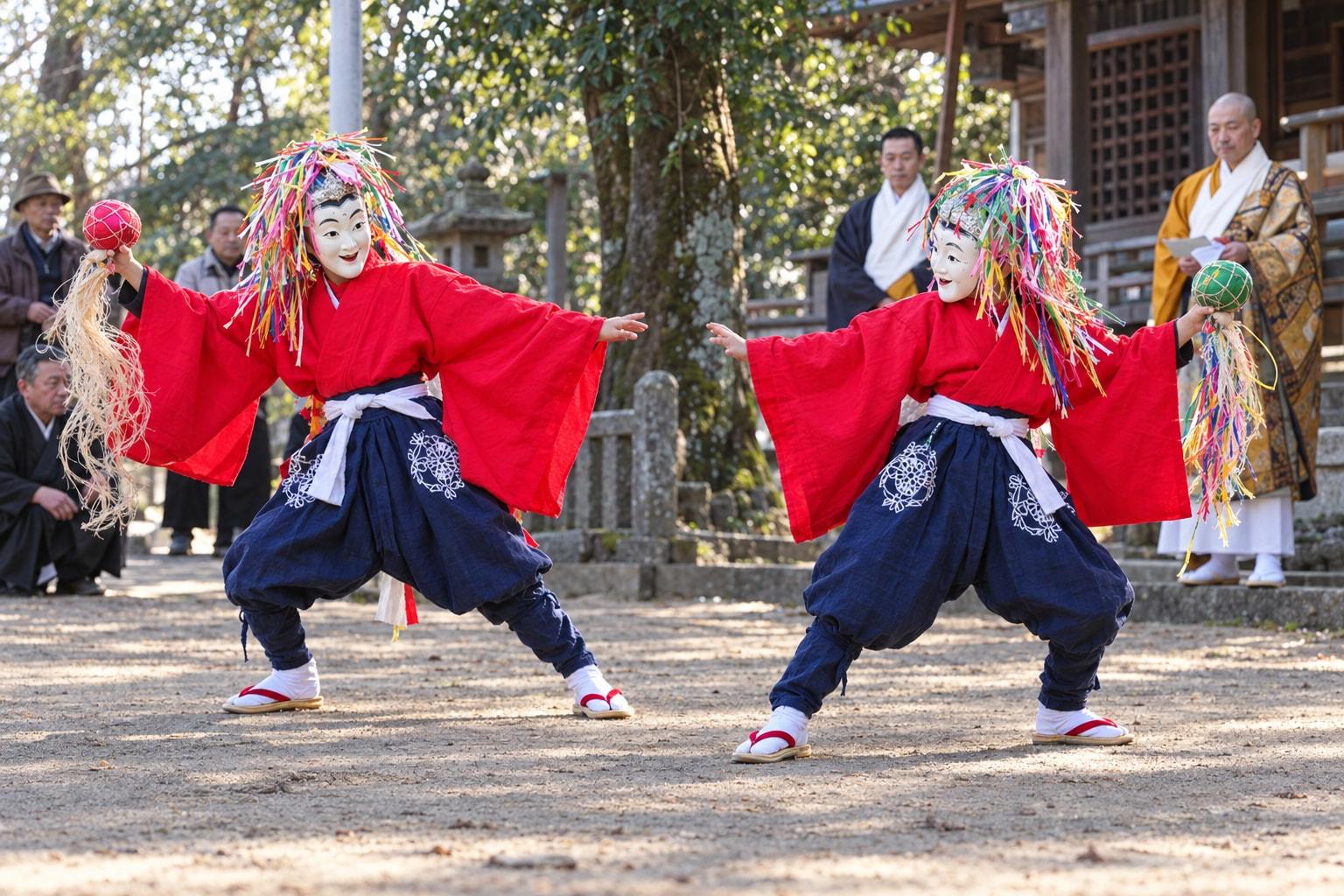
At Takezaki Kanzeonji, a Buddhist temple in Tara, Saga Prefecture, two children dance while adults attend them. Photographs accompanying the town's accounts show pale masks, bright red jackets and dark blue trousers; fine streamers hang from the dancers' headwear. Their lowered stances and outstretched arms give the movements a deliberate weight. These are the dōji-mai, the children's dances that form part of the temple's New Year observance. Tara Town's dance introduction
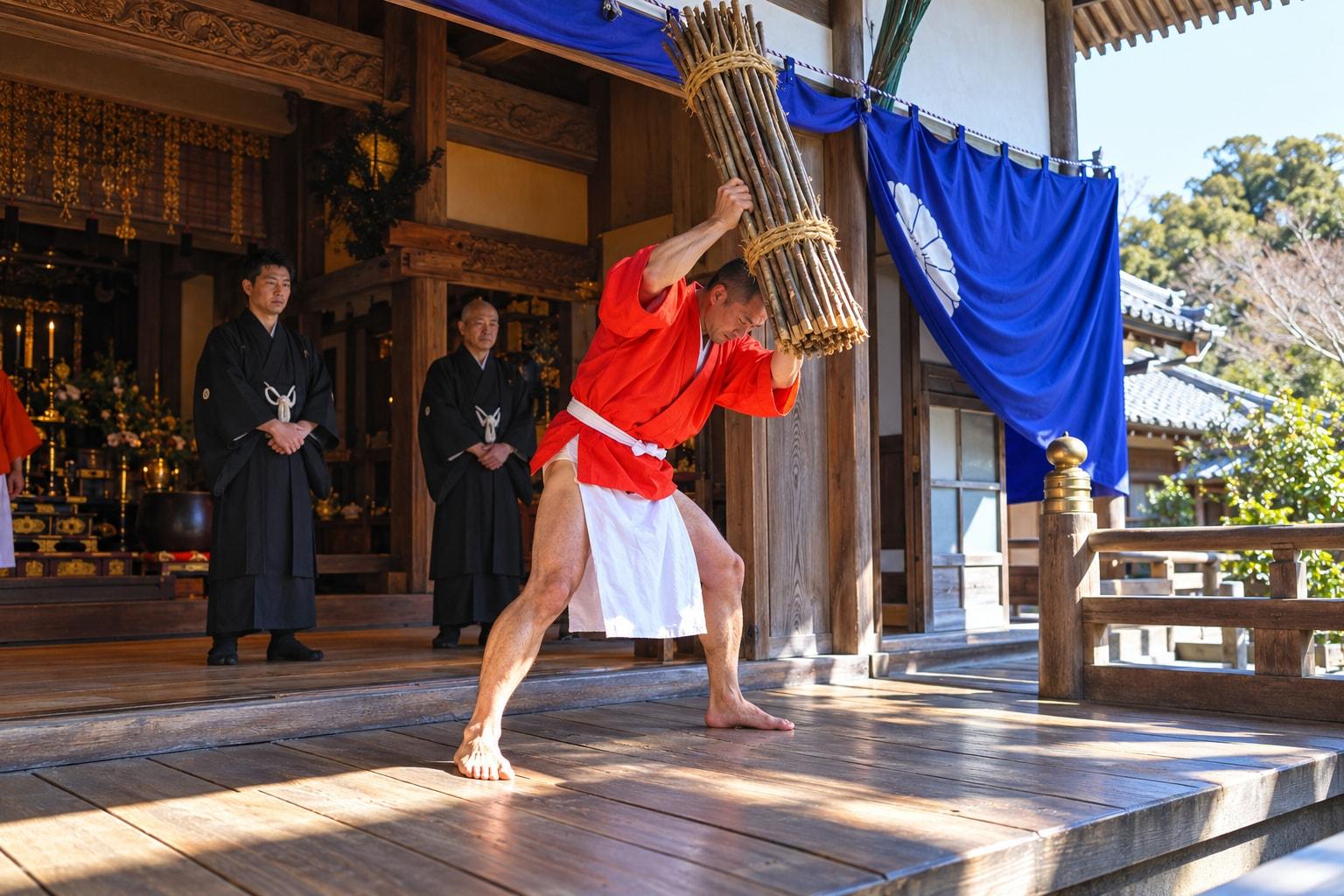
Another action involves a bundle of long oak sticks. In the town's report of the January 2026 festival, attendants in red clothing and white loincloths raise the consecrated bundle overhead and strike it against the Kannon hall's floor. Spectators reach for the resulting pieces as auspicious objects. The report places this after services in the hall on January 3, including chanting and a ritual called Furei-kyō. Tara's February 2026 bulletin, page 19
The event is called the Takezaki Kanzeonji Shujōe Oni Matsuri. Shujōe identifies a Buddhist New Year observance; oni matsuri means an oni festival. Yet the children's dances, the service and the breaking of the oak bundle are central to understanding what that name encompasses. Tara describes the observance as a time to repent the previous year's wrongs and pray for a plentiful harvest in the year ahead. Tara's cultural introduction
An account focused only on men struggling over a box containing an oni mask would miss much of this. The festival brings prayer into actions: bodies lowered and lifted, wood consecrated and broken, objects sought by spectators. Those actions deserve attention before the story of the oni is told.
A temple observance and a story of two oni
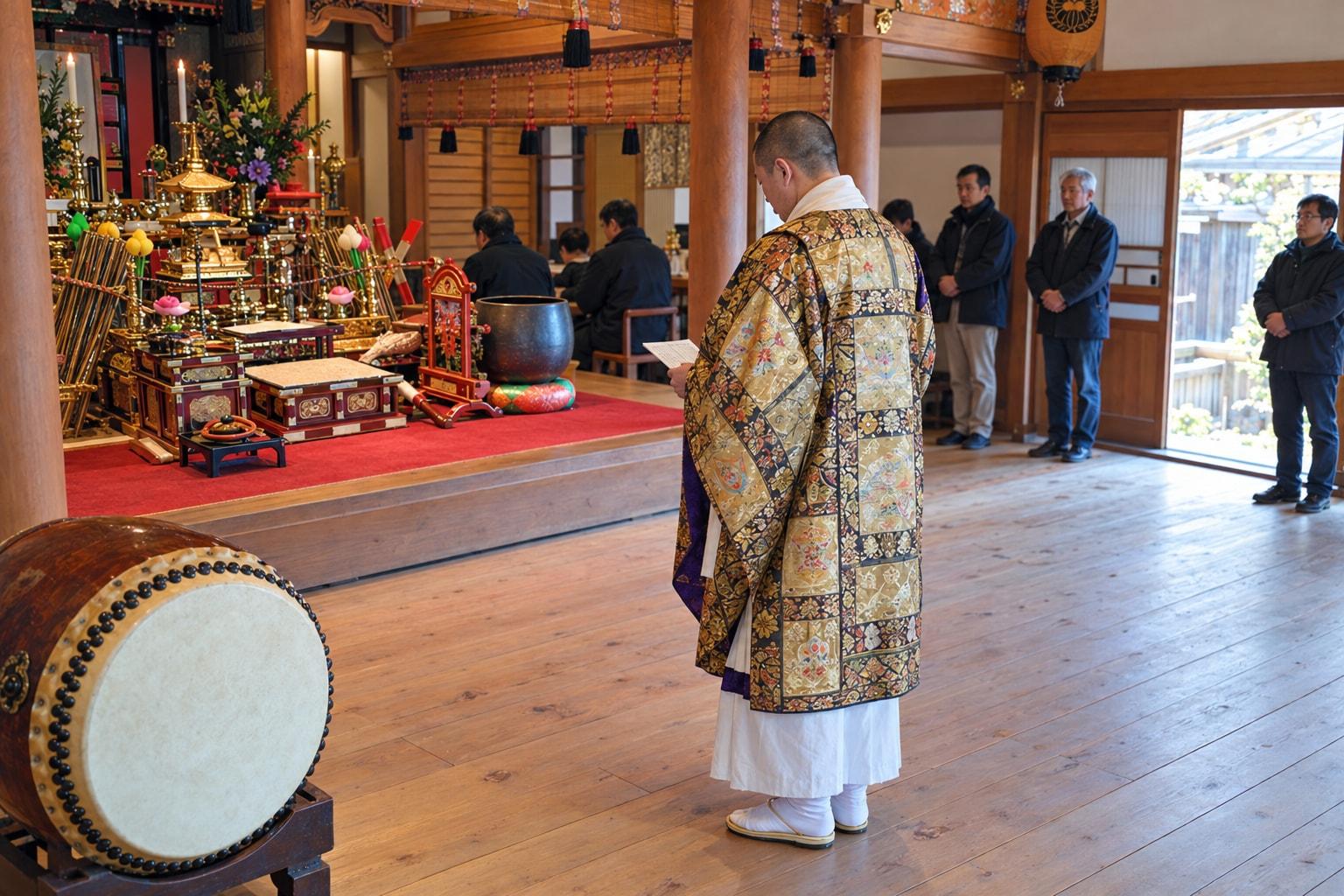
The national heritage description places Takezaki within Buddhist New Year rites that may conclude with an oni-oi, or oni-chasing observance. It records a sequence of evening, late-night and daytime services, with dances and other actions within that sequence. The temple ritual provides the setting in which the other performances make sense. Agency for Cultural Affairs
Tara's own cultural account is cautious about beginnings: it says the festival's origin is uncertain. It cites an older written account, the Hizen no Kuni Koseki Engi, describing a person enclosed in white cloth and wearing an oni mask, pulled about on a rope while children struck at the figure with bamboo branches. That description offers evidence of an earlier form without establishing a founding year.
The town also preserves a local legend about two married oni: one offshore near Yatobana, the other confined in a box in the Kannon hall. Their reunion would overturn Takezaki island. In the described oni-chasing episode, four attendants carry the mask's box out, while other men prevent its escape and it is returned to the hall. The landscape, the box and the struggle thus belong to a particular local story, not merely a generic image of chasing a monster away. Tara's account of the festival
The recent record also matters. The festival took place on January 2 and 3, 2026, and the municipal bulletin documented the children's performance and the oak-stick rite. It explicitly said that the oni-chasing episode was cancelled again that year. That cancellation should neither be hidden nor mistaken for the disappearance of the entire observance. The reported services and dances continued to give the gathering its form. February 2026 report
The meaning inside the movements
The children's treatment is one particularly revealing detail. They are carried between parts of the performance rather than simply walking from place to place. Tara interprets this handling as treating the children as sacred beings and their emergence from the hall as a passage from a spiritual realm. This is the town's interpretation of the ritual, rather than a claim about supernatural events.
The dancing itself includes stamping and kneeling. Being carried therefore does not mean that the children's feet never touch the ground during the dance. Movement within a performance and movement between its places are different. The distinction helps explain why an apparently practical action by an attendant can be as meaningful as the more conspicuous dancing. Tara's explanation of dōji-mai
A second detail is the combination of prayer with an agricultural substance. The national description records the children scattering seed rice from conch shells at the conclusion of a recitation. It also describes the oak-stick breaking as an action repeated within the ritual sequence, with people competing for the pieces. National heritage description
Seed rice makes the wish for a productive year tangible. The sticks connect the rite to those watching: a consecrated object becomes pieces that people seek to obtain. These actions offer a way to understand the prayer without assigning an elaborate symbolism to every gesture.
Finally, the children's dance is itself a repertoire. The town lists seven pieces rather than one continuous, unnamed performance, and discusses stamping and kneeling as elements retaining older ritual forms. A newcomer need not memorise their titles to appreciate the consequence. The two dancers are carrying out a learned sequence, with distinctions between its parts. Watching for changes of stance and action can make the performance more intelligible than waiting only for the most dramatic moment. Dance repertoire
The festival's depth lies partly in these changes of scale: a temple service, two small figures dancing, a bundle of wood broken before a gathering. Attention moves between spoken prayer, controlled movement and vigorous physical action. The oni story gives one route into the occasion; the other actions show why it remains worth understanding even when the chase is not performed.
Visiting the temple observance
The place to see the festival is Takezaki Kanzeonji during its publicly held New Year observance. The town's recent reporting documents spectators at the oak-stick rite. Watching the event does not, however, make a visitor a participant in the ritual actions. Give the attendants and dancers room to move, and follow guidance at the site rather than stepping into a scramble for a keepsake or moving closer for a photograph. These are practical recommendations for watching respectfully, not a claim that a particular published photography policy exists.
For learning about the tradition on a different day, Tara Town's History and Folklore Museum offers panels on local cultural properties, including this festival. Its collections also include masks and instruments from local performing traditions, alongside materials relating to fishing and household life. That wider context can help place a temple festival within the working lives of the surrounding district. It is an exhibition visit, not a scheduled performance of the rite. Museum information
The museum lists free admission and opening hours of 9 a.m. to 5 p.m., but closes on Sundays, Mondays, public holidays and December 29–January 3. It therefore cannot simply be added to a festival-day itinerary on the assumption that its doors will be open.
When to go
The town's present annual calendar gives January 2–3 as the customary festival period. For a visit centred on this observance, early January is the relevant window. The afternoon of January 3 featured prominently in the 2026 report, but that does not confirm an identical timetable for 2027. Tara's annual calendar
The older national record gives January 5–6. Those dates should not be combined with the town's current listing into a January 2–6 festival: they describe different schedules. Nor does an annual calendar by itself confirm the next year's programme. For January 2027, confirm the dates, viewing arrangements and which elements will take place with Tara's tourism office before booking specifically for the festival.
Around Takezaki: the sea beyond the temple
Takezaki Castle Lookout provides a wider view of the island and the Ariake Sea. The castle-style structure is a modern lookout on an older castle site, not a surviving medieval keep. The town describes panoramic views from it. After an encounter with the temple's enclosed ritual spaces, the outlook gives a sense of the coastal setting around them. Takezaki Castle Lookout
Yatobana, which appears in the oni legend, also has a documented maritime history. The town records a lighthouse there in the mid-eighteenth century, its destruction by a typhoon in 1828, and a later replacement in 1869. The lighthouse no longer stands; a memorial inscription remains at the site. Yatobana lighthouse site
The story of offshore oni and the history of a navigational light are different ways this place has been understood. There is no need to claim that one caused the other. Seeing the shore makes the geographical reference in the legend concrete, while the lighthouse history introduces the practical importance of finding a safe way through the surrounding sea.
Place and region
Tara Town, Saga
Takezaki Kanzeonji is in Tara Town on Kyushu’s Ariake Sea coast. Tara’s shoreline is shaped by pronounced tides, while the Takedake Mountains rise inland.
From Tokyo
By rail, take the Shinkansen to Hakata, then continue by JR trains toward Hizen-Kashima and Tara Station. Arrange local transport from Tara Station to Takezaki Kanzeonji; the final leg is beyond the rail journey. Alternatively, fly from Haneda to Saga Airport, take a bus to Saga Station, and continue by JR trains toward Hizen-Kashima and Tara. Connections and schedules may change.
Food of this place
- Takezaki oysters. A winter specialty; the town lists the season as November to March.
- Takezaki crab. Caught off the Takezaki area; the town lists different seasons for male and female crabs.
- Tara mikan. Locally grown mandarins that color from autumn into early winter.
- Seaweed (nori). Produced along Tara’s Ariake Sea coast, with peak production in midwinter.
The marker shows the municipality, not an exact event venue. Map data © OpenStreetMap contributors.
Explore more stories from Saga