Shimane ·
Mihonoseki’s Morotabune: Two Boats Carrying a Divine Message
At Miho Shrine, a harbour journey, carefully prepared vessels and an exchange ashore give a story of the gods a local form.
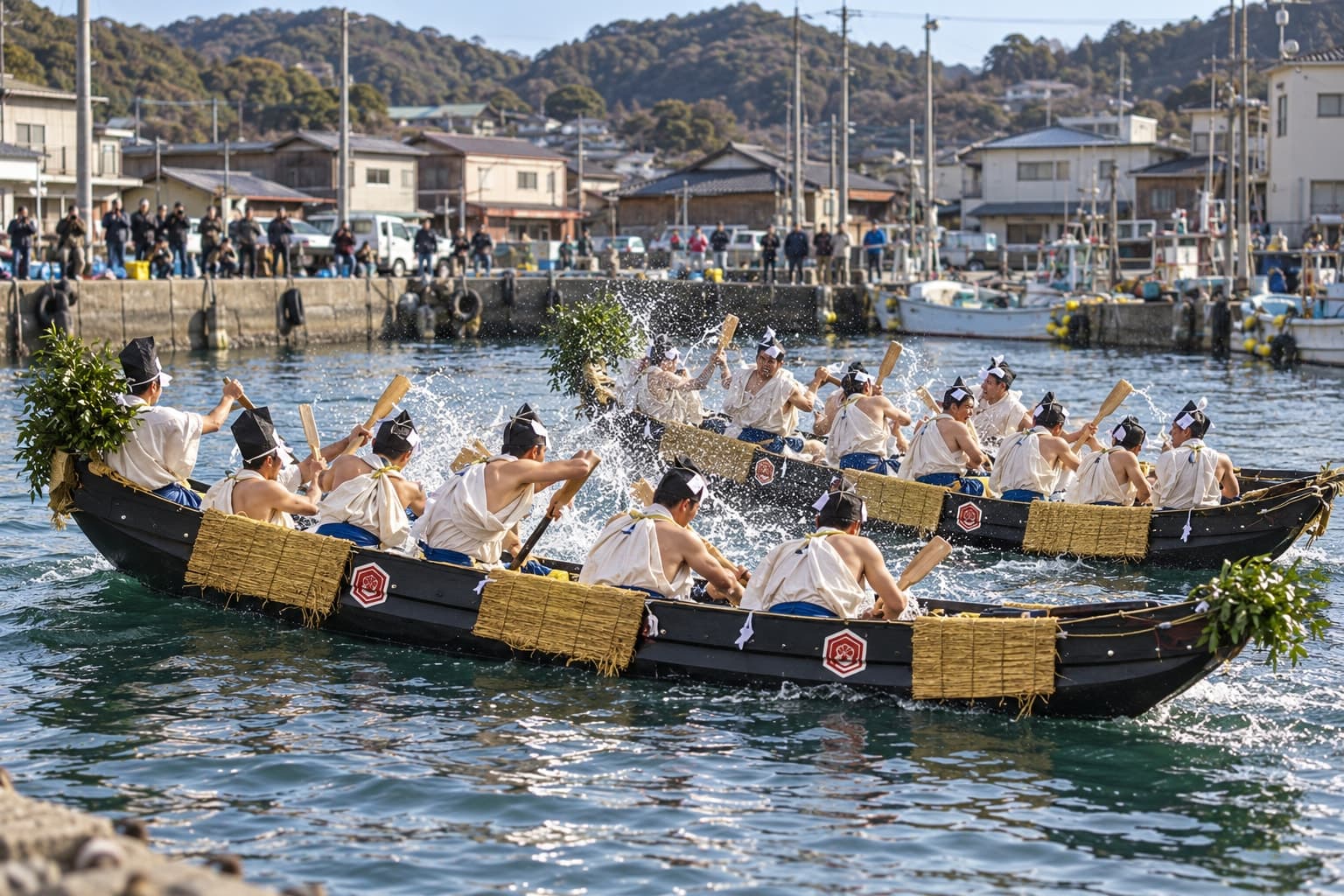
Two boats carrying a question
At Mihonoseki, a harbour town in Matsue, Shimane Prefecture, two narrow wooden boats carry white-clad crews out onto the water. There are nine men in each. They propel the boats with wooden paddles, draw alongside one another and send seawater flying across the gap. This is the most conspicuous part of Morotabune Shinji, Miho Shrine’s December boat ritual: a vigorous encounter performed by the shrine’s local parishioners, or ujiko. Mihonoseki’s official guide describes both the competing crews and the divine journey they represent.
The boats belong to a longer sequence. The prefectural tourism account places the beginning of the observances on December 1. Offerings and dances follow on the evening of the 2nd; the next morning brings a harvest thanksgiving rite. The boating takes place in the afternoon, after worship at the smaller Maroudo Shrine. Later, an emblem carried at each boat’s bow is taken ashore and brought before the deity, with the bearers competing to present it first. A formal exchange with the chief priest completes the sequence. The movement therefore runs through shrine, harbour and shrine again. The splashing is a striking middle passage, not the whole ceremony. Shimane Tourism Federation
Shinji means a rite performed for the gods. Morotabune is the name of the vessel associated with a messenger in the mythology behind this one. The question carried by that messenger concerns kuniyuzuri, the handing over of the land: will the god Kotoshironushi agree to the transfer requested of his father, Ōkuninushi? The Shimane Museum of Ancient Izumo explains that the messenger’s boat is called the Kumano Morotabune. The modern vessels and their crews give that journey a visible local form.
Seen with that question in mind, the harbour activity has a destination beyond winning a race. A message must reach a god, an answer must be given, and the participants must return to the shrine. Each stage changes how the next one reads.
A divine journey in a working port
In the account presented by Matsue City, Kotoshironushi is fishing near Mihonoseki when he is asked about the proposed transfer. He agrees that the land should be offered to the heavenly deities. The December observance recalls the approach to him; another major Miho Shrine rite, Aofushigaki in April, concerns his subsequent withdrawal behind an enclosure of green branches. These are connected episodes, enacted through different ceremonies. December’s boats should not be confused with the branch-decorated vessels of the spring rite. Matsue City
The shrine’s history reaches beyond a single story. The ancient provincial account Izumo Fudoki names Miho Shrine, while the growth of maritime traffic from the medieval into the early modern period helped Mihonoseki prosper. The museum describes the spread of devotion through this movement of people and goods, and Kotoshironushi’s association with Ebisu, the familiar deity of good fortune. The harbour was a place where religious relationships and journeys by sea met in everyday life. That historical setting helps explain why a maritime rite belongs here without requiring us to imagine that every part of today’s ceremony has remained unchanged since antiquity. Shimane Museum of Ancient Izumo
Even the calendar has a history. Shimane’s account records an earlier observance on the middle Horse day of the eleventh lunar month. Its modern place on December 3 is therefore one stage in the practice’s development. The date of the shrine’s appearance in an ancient text, the age of a myth and the beginning of a particular ceremonial sequence are different questions; the available records do not establish a single founding year for the rite in its present form. Shimane Tourism Federation
There is, however, unusually concrete evidence for the renewal of its boats. In a 1979 maritime research paper, Yokoyama and Matsuki reported that the two vessels then in use had been built in 1940. A ceremony for a new pair was held on November 18, 1979. Their investigation treated the boats as examples of surviving hollowed-timber construction and recorded this replacement. An old form could continue through newly worked wood; longevity did not depend on using the same hull forever. These dates describe that documented replacement, not the age of the vessels a visitor will necessarily see today. “Dugout Boats Surviving in Japan,” Kobe University repository
Recent participation is also recorded outside heritage catalogues. On December 3, 2024, a walking group from Matsue’s Ikuma Community Centre went to watch the ritual. Its report describes members seeing the cold-water encounter in person after previously knowing it from television. That small account places actual spectators beside actual crews, rather than leaving the practice suspended in an undated description. Ikuma Community Centre
The harbour, the hull and the answer
Three details make the action easier to understand. The first is the use of the harbour itself. A detailed account published on Izumoru describes the boats approaching the water below Maroudo Shrine, which is treated within the rite as Inasa Beach, the place associated with the negotiations over the land. They then head towards Miyanada, representing the Mihonoseki where Kotoshironushi waits. The boats travel through an ordinary, bounded harbour while their route evokes a much larger mythical geography. Izumoru
The same account distinguishes the work aboard each vessel: six paddlers, a steersman, an assistant and the bearer of the bow emblem. Nine participants do not mean nine identical jobs. The division matters because carrying the emblem and navigating the boat are both necessary to complete the journey. Following the vessel’s direction and noticing the person at its bow reveal more than watching only the spray.
The second detail is the boat as a made object. The national cultural-property record identifies its hollowed-fir construction and lists the pair of boats as an Important Tangible Folk Cultural Property, designated in 1955. This recognition concerns the vessels themselves. The craft used in a living ceremony can receive protection as an object, alongside the continuing actions and knowledge that make it meaningful. National cultural-property database
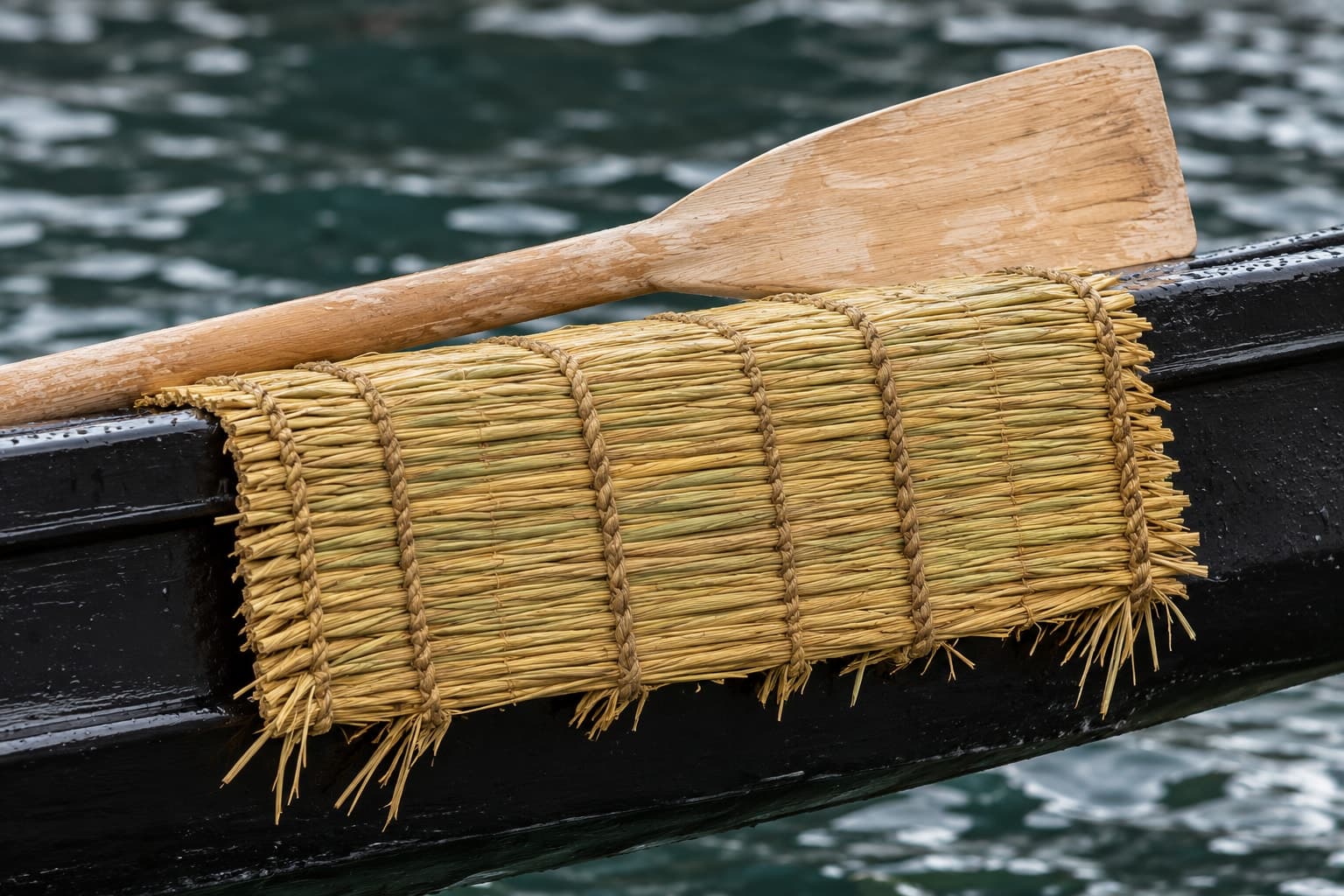
Their dark exterior is also worked, not simply left to weather. The festival documentation project Matsurito describes the use of ink on the outside and camellia oil to polish the surface, together with shrine emblems carved at particular points. It identifies the bow emblem as a protection against evil entering the vessel. These details bring the boat’s material care into the religious account: preparing a hull involves a finish and sacred signs as well as a form capable of carrying a crew. Matsurito
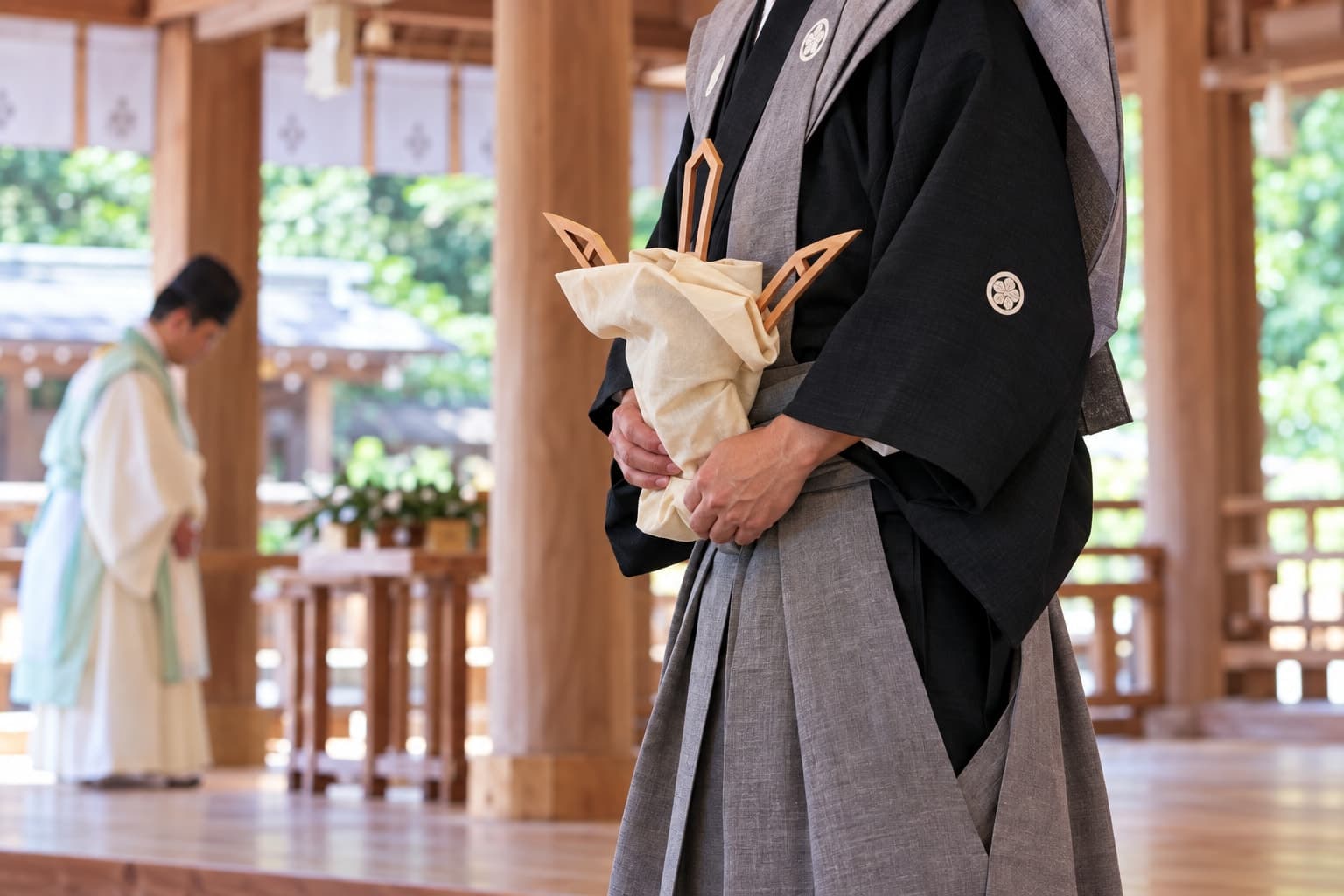
The third detail comes after the return to land. Matsue City highlights an exchange between a lay ritual office-holder taking the messenger’s part and the chief priest taking Kotoshironushi’s, followed by coordinated clapping. The answer is thus embodied in people as well as represented by boats. A visitor who follows the action back towards the shrine can understand why the race does not supply the ceremony’s final meaning: the journey has brought the messenger to someone who must respond. Matsue City
Together, the mapped route, prepared vessels and exchange ashore offer three ways into the same story. They ask for attention at different scales: the harbour as a whole, the surface of a boat, and the gestures of the people carrying the rite.
Visiting the ritual
The public occasion to aim for is the December observance around Miho Shrine and Mihonoseki harbour. The local tourism guide advertises it to visitors, and the community-centre account records a group watching from the town. The paddling is undertaken by shrine parishioners; it is not a boat activity offered to spectators. Mihonoseki guide, Ikuma Community Centre
Allow time to orient yourself between the shrine approach and the waterfront before the boats move. As practical visitor advice, keep the landing areas and the participants’ route clear, follow directions on site, and choose your view from the public shore. The 2024 group specifically recalled the cold; warm clothing is a sensible choice for a harbour-side wait. Avoid assuming that visibility of a shrine ceremony makes every part of its interior accessible.
When to go
The customary date is December 3, with the boat rite in the afternoon. For the coming season, that points to Thursday, December 3, 2026. This is the customary window, not a confirmed 2026 timetable; confirm the day’s arrangements with Miho Shrine or the Mihonoseki tourism office before making a dedicated journey. Matsurito’s festival guide, Shimane Tourism Federation
Around Mihonoseki
Spend some time on Aoishi-datami, the narrow stone-paved street linking the shrine area with Bukkokuji Temple. Its name refers to the bluish appearance of the paving when wet. The official multilingual account explains that the stones were laid in the late eighteenth century to make moving goods easier. Wholesalers and inns stood along the street, with passages connecting the waterfront and the road behind it. Japan Tourism Agency’s destination account
That makes the street more than an attractive setting for a walk. Looking at its relationship to the water reveals another kind of movement through Mihonoseki: cargo, merchants, sailors and pilgrims, alongside the divine messenger recalled by the ritual. A short walk here gives the harbour a history beyond the day’s boats.
Place and region
Matsue City, Shimane
Mihonoseki is a port district at the eastern end of the Shimane Peninsula. Its sheltered harbour and Sea of Japan coast form a maritime setting where vessels long waited for favourable sailing winds. Miho Shrine and the harbour stand within this landscape, giving Morotabune a local setting in which the boats are part of the port’s maritime character.
From Tokyo
By rail, take the Tokaido/Sanyo Shinkansen from Tokyo Station to Okayama, then the Limited Express Yakumo to Matsue. From Matsue Station, take an Ichibata bus towards Mihonoseki Bus Terminal and transfer to the Mihonoseki Community Bus. By air, fly from Haneda Airport to Izumo or Yonago Airport, then take an airport bus to Matsue Station and continue by local bus with a transfer. An overnight highway bus also connects Tokyo, departing from Yaesu or Shibuya; from Matsue, continue by local bus with a transfer. Plan the onward connections and check current schedules with the transport operators.
Food of this place
- Izumo soba. Associated with the wider Izumo region, including Matsue, these buckwheat noodles are known for their darker colour and are commonly served cold in tiered bowls or hot with broth.
- Lake Shinji shijimi clams. A Matsue-area specialty, these clams from the lake’s brackish water are known for their large, meaty texture and are often served in soup.
- Tsuda turnip. A Matsue specialty traditionally eaten pickled; its season is autumn and winter.
The marker shows the municipality, not an exact event venue. Map data © OpenStreetMap contributors.
Explore more stories from Shimane