Nagano ·
Onbashira: What It Takes to Raise a Sacred Pillar
Sixteen fir trees, four shrines, and the voices and hands that sustain Suwa’s cycle of renewal.
From a mountain tree to a shrine pillar
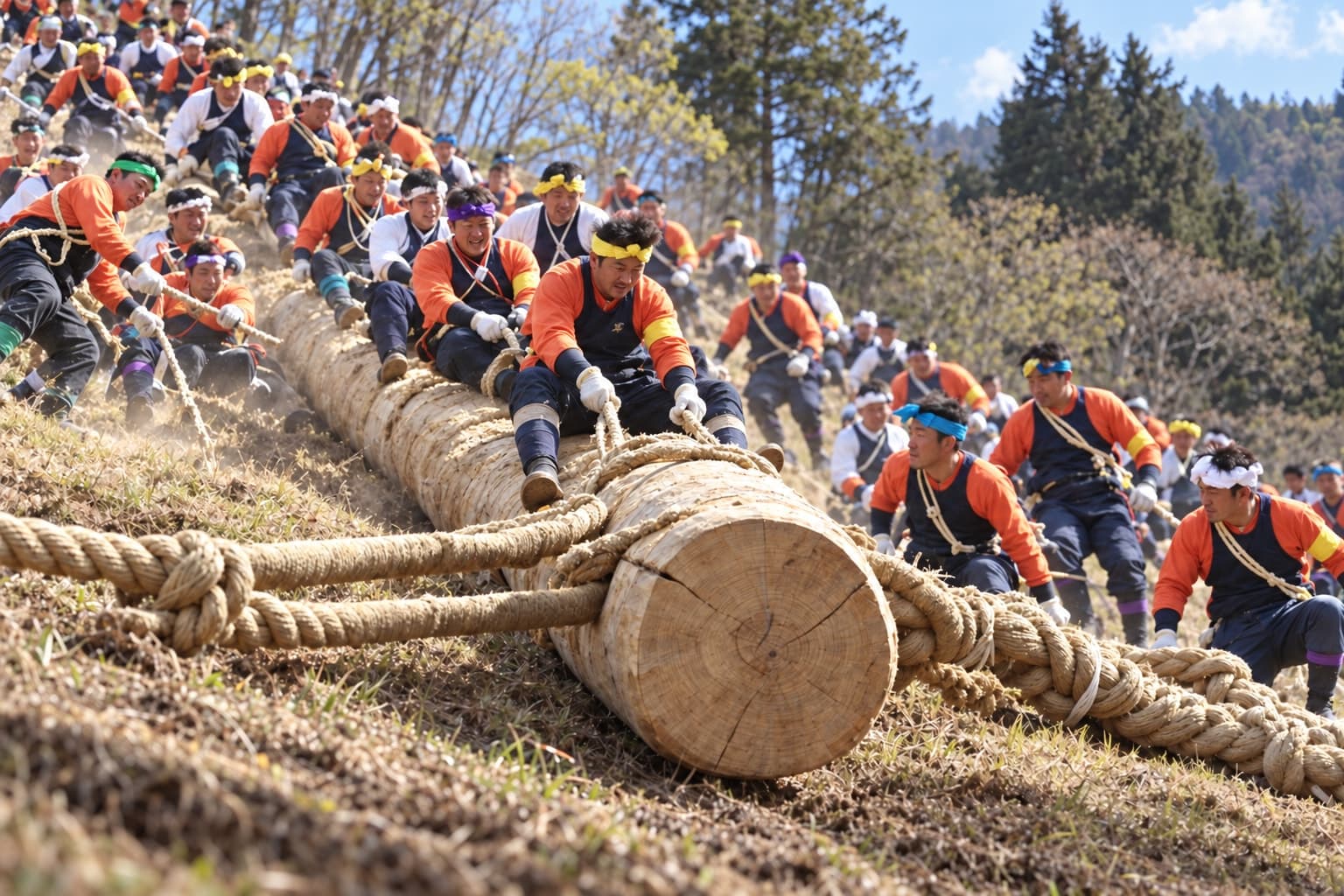
Long ropes extend from a stripped fir trunk. The people holding them wear festival coats or work aprons, often in matching district colours; others ride the timber. A high-pitched call gives the signal, and the pulling begins. In Suwa, Nagano Prefecture, moving a tree is a coordinated undertaking involving voices, ropes and bodies along an entire route. At the Upper Shrines, projecting wooden spars called medodeko rise from the log in pairs, with riders perched on them. Negotiating a bend requires more than pulling harder: the direction of the timber must change while the people on and around it move together. The regional festival guide describes these manoeuvres as part of yamadashi, the mountain-hauling stage. Yamadashi guide
This is Onbashira, the festival in which communities bring sixteen fir trees to Suwa Taisha and raise four as freestanding pillars at each of its four shrines. Suwa Taisha comprises two Upper Shrines, Honmiya and Maemiya, and two Lower Shrines, Harumiya and Akimiya. Its parish communities extend across six municipalities. The work belongs to this particular network of places and people, rather than to a single town staging a procession. Shimosuwa Town’s cultural-property account
The name refers to the honoured or sacred pillars. Their journey has two principal public stages. April’s yamadashi brings them down from the mountains to temporary resting places. In May, satobiki brings them through the settlements to their shrines. Riders descending a steep slope during kiotoshi, or log-dropping, make a striking image, but that descent happens within a much longer task. At the Lower Shrines, the logs have no medodeko; their steep descent and route differ from those of the Upper Shrines. The two traditions should not be combined into one imaginary procession. Yamadashi guide
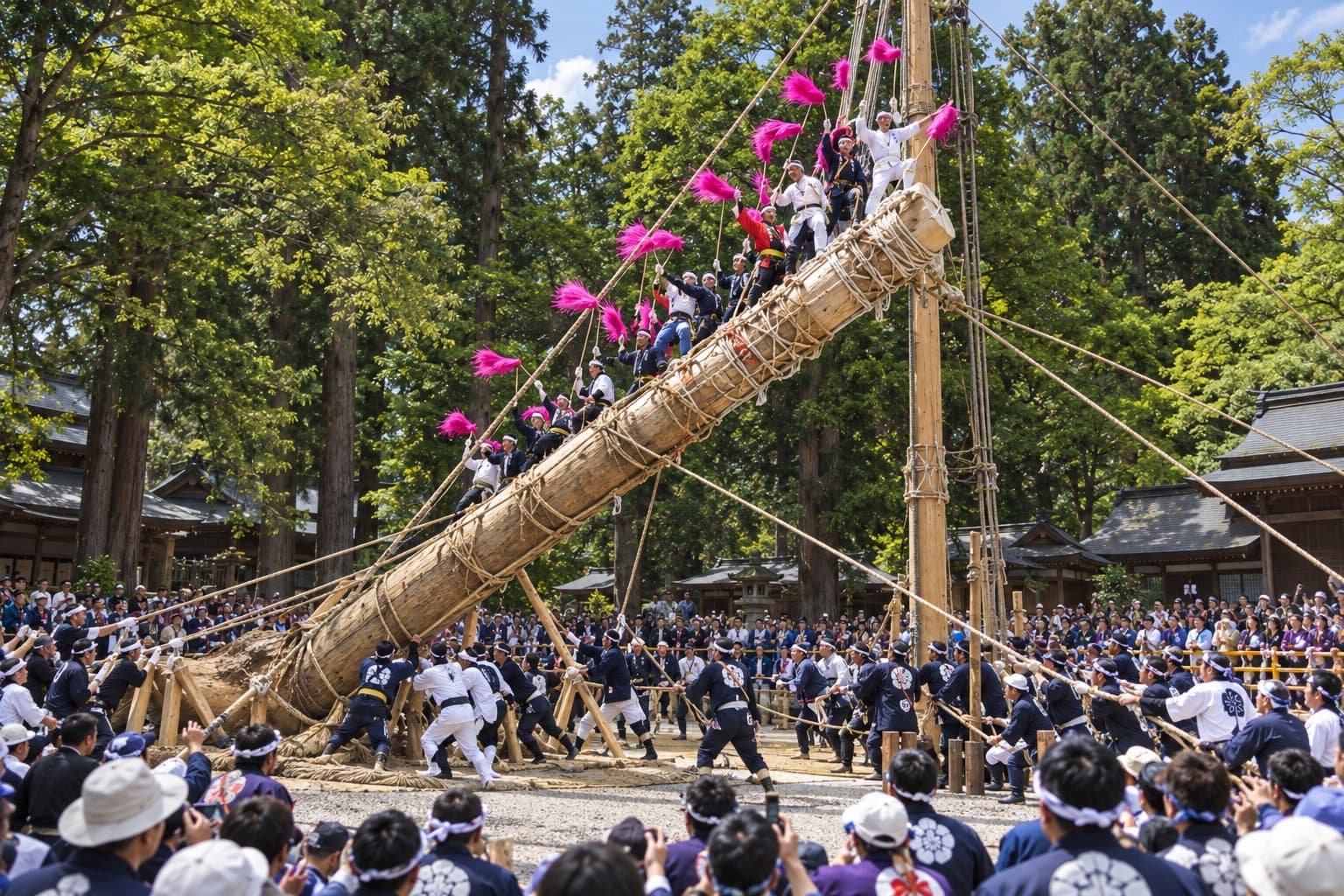
The destination becomes clearest during tateonbashira, the raising of the pillars. Before a log is erected, its end is cut into a pointed crown in a rite called kanmuriotoshi. Ropes, cables and a winding mechanism then help bring the enormous timber upright. The horizontal object that required so many people to move now stands above them. Satobiki also includes accompanying performances and processions, such as flower-hat dancing and the carrying of long ceremonial chests. Its rhythm and purpose extend beyond the moment when a log moves. Satobiki guide
Suwa Taisha places this work within a larger cycle of renewal. The formal festival also includes rebuilding the hōden, sacred buildings associated with the enshrined deities, and renewing their furnishings. Replacing the pillars and renewing the sacred buildings belong to the same observance. Understanding that connection changes the question a viewer might ask: not simply how people manage to move such large trees, but what they are renewing by doing so. Suwa Taisha’s account
A renewal with a long, changing history
The festival’s exact beginnings are uncertain. The regional history guide refers to the medieval Suwa Daimyōjin Ekotoba, which looks back to observances in the reign of Emperor Kanmu, in the late eighth and early ninth centuries. A later text recalling an earlier practice is valuable evidence of historical memory; it does not establish that every feature visible today existed at that earlier date. The uncertainty leaves room for a long history without requiring a precise founding year that the evidence cannot securely provide. History of Onbashira
There is also no single settled explanation for why the pillars stand around the shrines. The festival’s official FAQ presents several interpretations: a survival associated with rebuilding, markers defining sacred space, or yorishiro, objects in which a deity may be understood to dwell. These explanations are not interchangeable. One concerns construction, another a boundary, another divine presence. Keeping them distinct allows the pillars to retain the complexity found in the published accounts. Onbashira FAQ
The scale of rebuilding has itself changed. Shimosuwa Town’s account says medieval records describe periodic renewal extending to shrine buildings, gates and fences, whereas the present rebuilding centres on the hōden. Continuity therefore does not mean that every structure or procedure has remained unchanged. What survives is a recurring obligation to undertake renewal, expressed through forms that have also developed over time. Shimosuwa Town’s account
Even the most recognisable public scenes are subject to circumstances. In 2022, pandemic arrangements replaced the Lower Shrines’ mountain-hauling procession with transport by trailer, and kiotoshi did not take place there. That was a specific alteration to that festival, not the customary form described above. It is a useful reminder that an account of Onbashira must distinguish its established sequence from what happened in a particular year. The organisers’ 2022 notice
Preparation operates on a different timescale from the festival crowds. Suwa Taisha describes preliminary tree selection beginning years before the main observance, followed by further selection and felling. The Upper and Lower Shrines have different timetables and forest sources. The pillars do not simply appear when the April programme begins; choosing suitable trees is already part of the work. Suwa Taisha’s account
Looking further ahead, a Shimosuwa Town newsletter records a gathering to plant future pillar trees on 8 June 2025. In the accompanying account, the local group’s representative, Kenji Tanaka, describes surveying firs and protecting young trees from deer. Saplings planted in 2018 were still only about three metres tall in 2025. He estimates roughly 150 years for a tree to reach the scale needed for a pillar. Those planting and tending them are consequently working for festivals far beyond their own likely participation. This gives “the next generation” a physical meaning: a small tree whose usefulness depends on many years of care. Shimosuwa’s October 2025 newsletter, page 10
The voices and hands that carry the festival
A song that makes collective movement possible
The calls accompanying the timber are kiyari, songs connected with moving heavy wood. In a 2024 interview published by JR East, Akihiro Miyasaka, chair of the Shimosuwa Kiyari Preservation Society, explains their practical role: they help coordinate pulling and stopping, while also expressing a wish for safety. A voice must carry to people distributed along a long rope. What might sound to an unfamiliar listener like an exuberant accompaniment is part of how the work is organised.
Miyasaka also describes Sunday practice at Harumiya and teaching children, including through school activities. Recordings of older singers support this transmission. The interval between major festivals does not mean that the skill lies dormant until the next procession. Children can learn the voice and timing before taking on the responsibilities of adults. His account makes continuity audible and teachable, rather than an abstract quality attributed to the community. JR East’s interview with Miyasaka
The wood inside a waving ornament
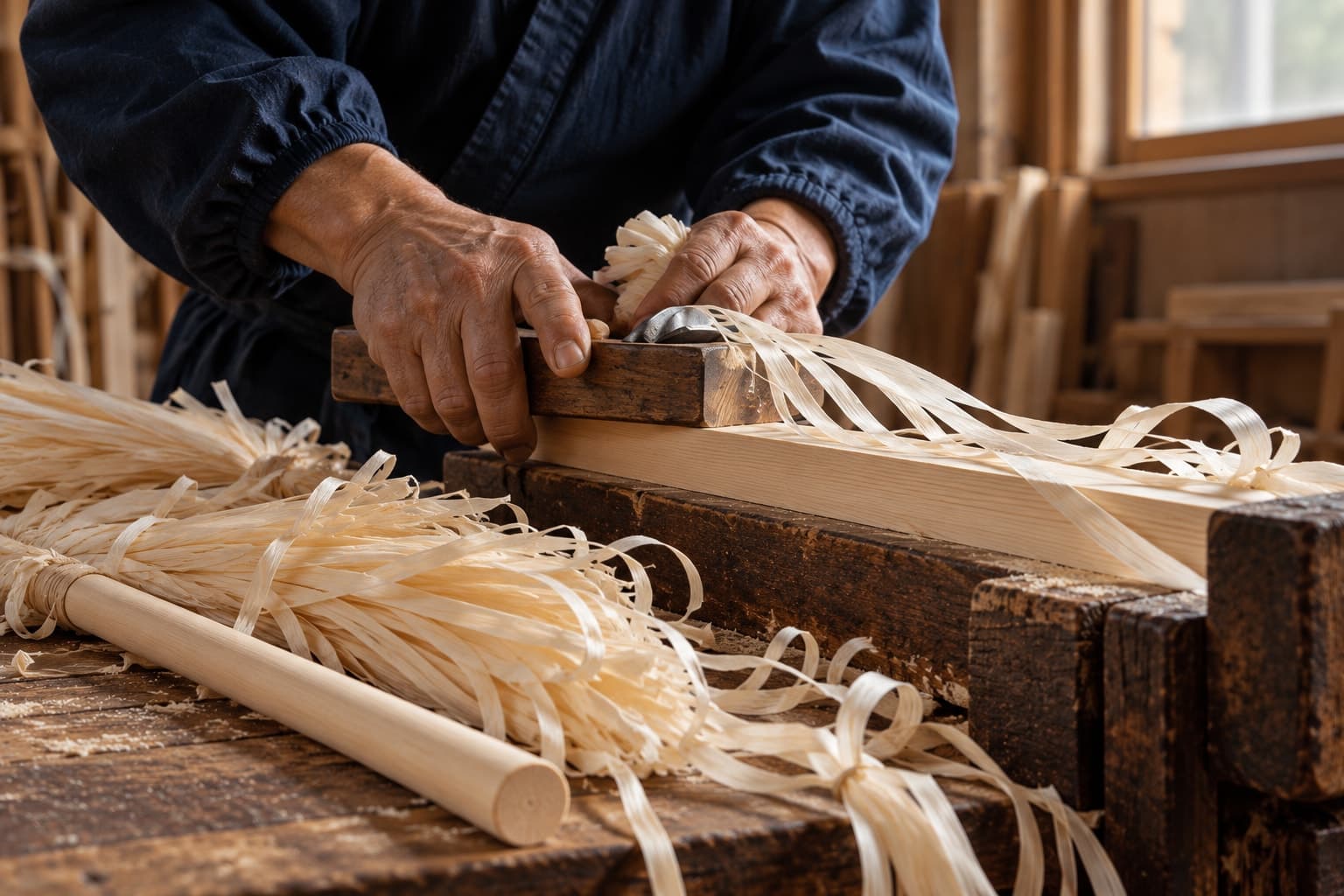
The tufted wands called onbe offer another detail worth looking at closely. Their flowing strands can resemble paper from a distance. In a published festival interview, Chino joiner Katsuya Hirose explains how he makes them from thin wood shavings, drawing them from spruce with a plane. The strands are gathered and attached to handles; his family also binds and dyes them.
Hirose’s account connects the conspicuous festival object to workshop skills and family labour. He describes tools inherited from his father and the preparation required to obtain suitable material. An onbe is therefore not merely a splash of colour beside the log. Its lightness comes from carefully worked wood—the same broad material category as the massive pillar, treated at an entirely different scale. This relationship between heavy timber and delicate shavings is something a passing photograph can easily conceal. Interview with Hirose about onbe-making
Bringing an old pillar’s service to an end
Renewal also requires dealing with the pillars already standing. In the Upper Shrines’ Nakakaneko district, this is a particular responsibility. Hiroyuki Iwanami explains in a published interview that the old pillars are taken down between yamadashi and satobiki. Honmiya’s four are brought to Hachiryū Shrine, while the sacred ornaments from Maemiya’s pillars are brought there separately. A subsequent rite brings their service as sacred pillars to an end, allowing the timber to return to other uses.
The same district helps prepare the holes for the new pillars and undertakes the rite of securing them after erection. Its work joins removal to installation. Looking only at the new pillar rising would miss the people responsible for completing the old one’s service and making its replacement possible. Interview with Iwanami about Onbashira-yasume
Visiting: see the festival, or understand it between festivals
During a festival year, yamadashi and satobiki offer different ways to encounter Onbashira. The former follows the movement of the timber from the mountains; the latter brings it into the settlements and shrine precincts. Decide which part interests you before choosing dates. Watching a procession is different from taking part in moving a pillar: the official FAQ states that general visitors cannot join the hauling, which belongs to the shrine parishioners. Visitor participation guidance
For a visit outside the main festival—including a trip in 2026—Onbashira-kan Yoisa in Shimosuwa provides a public introduction. Close to Harumiya, it has films, models and displays of festival equipment. Its kiotoshi simulation offers an interpretation of the descent within a visitor facility; it is not participation in the actual rite. This is a useful place to put the stages and objects together before visiting the nearby shrine. Onbashira-kan Yoisa
The centre also offers a way to revisit what a brief festival clip leaves unexplained. The different routes, the tools used to move timber and the relationship between the two main stages become easier to follow when they can be considered together, rather than during the pressure of a moving procession.
When to go: the next main festival is in 2028
Onbashira takes place in Tiger and Monkey years of the zodiac: six years apart, traditionally described as occurring “in the seventh year” through inclusive counting. The previous main festival was in 2022; the next is in 2028. This is not an annual April event, and this October 2026 feature is not announcing a festival taking place now.
Suwa City publishes the following 2028 dates:
- Upper Shrines, yamadashi: 1–3 April.
- Lower Shrines, yamadashi: 8–10 April.
- Upper Shrines, satobiki: 3–5 May.
- Lower Shrines, satobiki: 12–14 May.
These are separate event periods, not one continuous festival running throughout April and May. Choose April for the mountain-hauling stage or May for the movement into the settlements and raising of the pillars. The published dates establish the broad programme; consult the organisers’ visitor information nearer the time for viewing arrangements and the detailed sequence at your chosen location. Suwa City’s 2028 schedule
Around the visit: the town beyond the shrine
In Shimosuwa, the Shukuba Kaidō Museum offers a different perspective on the place carrying this tradition. Housed in an Edo-period building, it introduces the former post town and its hot-spring history. Shimosuwa stood where the Nakasendō and Kōshū Kaidō routes met, so journeys through the town long predate contemporary festival travel.
Pairing the museum with Harumiya and the Onbashira centre lets a visit move between religious life and the practical history of roads, lodging and movement. The museum’s published opening hours are 9 a.m.–5 p.m.; it normally closes on Mondays, or the following day when Monday is a public holiday. That closure matters particularly if you extend a weekend stay into Monday. Shukuba Kaidō Museum
Place and region
Suwa City, Nagano
Suwa City is part of the wider Suwa region, where Onbashira involves shrine parishioners from six municipalities: Suwa, Chino, Okaya, Shimosuwa, Fujimi and Hara. The four shrines of Suwa Taisha are located in Suwa City, Chino City and Shimosuwa Town, on both sides of Lake Suwa. The lake lies in an inland basin framed by mountains and highlands, including the Yatsugatake range and Kirigamine. Onbashira’s trees travel from mountain forests toward the shrine precincts, linking forest routes, lakeside settlements and several shrine communities.
From Tokyo
By rail, take the JR Chūō Line Limited Express Azusa from Shinjuku to Kamisuwa Station. By highway bus, services from the Shinjuku Expressway Bus Terminal serve Kamisuwa Station, Shimosuwa and Chino; choose a stop near your destination. By car, the area is accessible via the Chūō Expressway and Suwa Interchange. The area is spread out, so check onward transport for your destination and confirm current routes and schedules with the relevant operator before traveling.
Food of this place
- Shinshu soba. Buckwheat noodles associated with the Suwa region and Nagano Prefecture; local descriptions emphasize their aroma and texture.
- Unajū. A Suwa City specialty of grilled eel served over rice in a lacquered box.
- Suwa miso tendon. A Suwa City dish of tempura topped with a sauce made from local miso.
The marker shows the municipality, not an exact event venue. Map data © OpenStreetMap contributors.
Explore more stories from Nagano