Nagano ·
Somin Shōrai: Ueda’s Wooden Charms for the New Year
At Shinano Kokubunji, a story of hospitality takes shape through carving, family painting and the January Yōkadō fair.
A small wooden promise for the new year
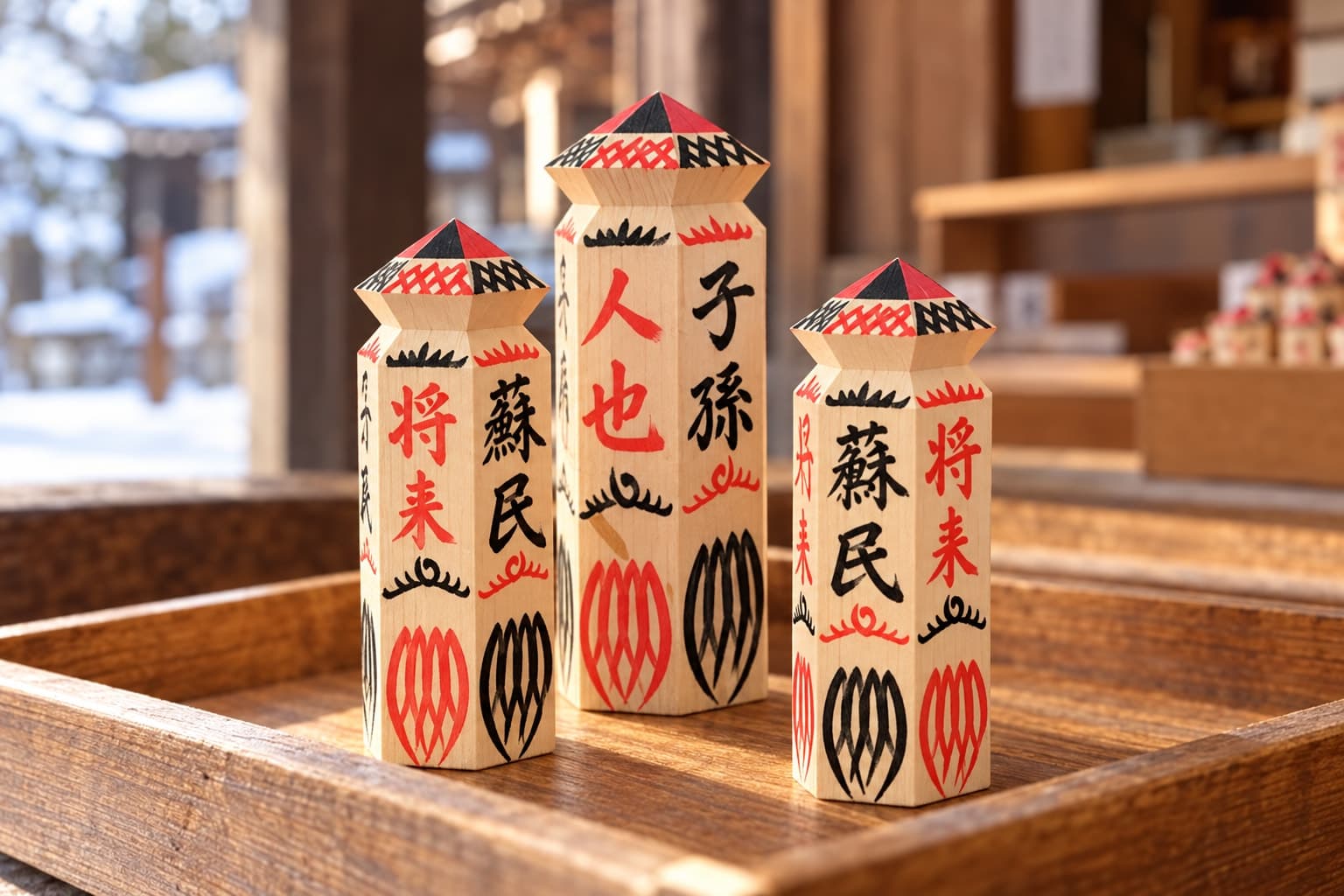
At Shinano Kokubunji in Ueda, Nagano Prefecture, visitors come at the beginning of January for wooden charms that look like small, six-sided towers. Each has a peaked, hat-like top and a body carrying characters and patterns in black and red. Some add pictures of lucky gods. The temple and members of a local association called the Somin-kō distribute them during the Yōkadō fair on January 7 and 8. People take them home to pray for protection and good fortune, placing them at an entrance or on a household altar. National cultural-property database
These are Somin Shōrai-fu: charms bearing the name of Somin Shōrai, a figure remembered for welcoming a divine traveller. The name does more than identify an object. It connects the household receiving the charm with a story in which hospitality is answered by protection.
The six faces carry pairs of characters: 大福, 長者, 蘇民, 将来, 子孫 and 人也. The last four pairs identify the bearer with the descendants of Somin Shōrai, while the opening words invoke prosperity. Reading the inscription around the wood, rather than treating each face as a separate decoration, reveals the charm’s central claim of belonging. It is a religious identification, not a statement about a family’s documented genealogy. The Hachijuni Culture Foundation records both this inscription and the family-specific painted versions made by the Somin-kō. Hachijuni Culture Foundation
The fair is only the last public stage of the work. Before a visitor receives one, wood has been selected, cut and shaped; characters and motifs have been applied; and the charm has passed through temple prayers. Following those stages explains why this practice encompasses much more than buying a seasonal ornament.
Hospitality, protection and a local history
The older story is not confined to Ueda. A version preserved in the tradition of the Bingo Fudoki, retold by Kyoto’s Ashikariyama preservation association, concerns a travelling deity who asks two brothers for shelter. The prosperous brother refuses; poor Somin Shōrai welcomes the traveller with the modest food and lodging he can provide. The deity later promises protection to Somin’s descendants, with a ring of grass serving as a sign. In that account the visitor identifies himself as Susanoo. This is a legend about a relationship between a god and a hospitable household, not a historical explanation of how epidemics spread. Ashikariyama Preservation Association
At Shinano Kokubunji, a temple manuscript of the Gozu Tennō Saimon, copied in 1480, provides evidence for the local history of the belief. Gozu Tennō is another divine figure associated with this tradition. The date tells us that the text was copied then; it does not establish the year when today’s hexagonal charms were first made. The Hachijuni Culture Foundation suggests that an earlier flat wooden form developed into a pillar-shaped one between the era of civil wars and the early Edo period. That proposed development leaves room for change within a practice often described simply as old. Hachijuni Culture Foundation
The temple’s familiar name, Yōkadō, means the hall of the eighth day. An account by Ueda’s education board explains it through the recitation of a Buddhist scripture on the eighth of each month. The January observance gives that monthly rhythm a special place at the opening of the year. The surviving Edo-period picture of the fair also depicts the buying and selling of everyday goods. Worship and exchange occupied the same gathering. Agency for Cultural Affairs
The wooden objects make that meeting tangible. Temple ritual prepares something that a person can carry away and install in a much smaller setting: a doorway, a shelf, an altar. The prayers are connected to the circumstances of individual homes, even though making and distributing the charms brings many people together.
That connection remains visible in recent reporting. On January 7, 2026, the local Tōshin Journal recorded a queue extending beyond the temple grounds after distribution began. A parent and child from Miyota told the newspaper that they came every year to pray for their family’s health. Their explanation should not be made to stand for every visitor, but it gives one precise reason for returning. The report also describes the daruma market around the hall, showing the fair’s religious and commercial activity continuing together. Tōshin Journal
What the wood and the painting reveal
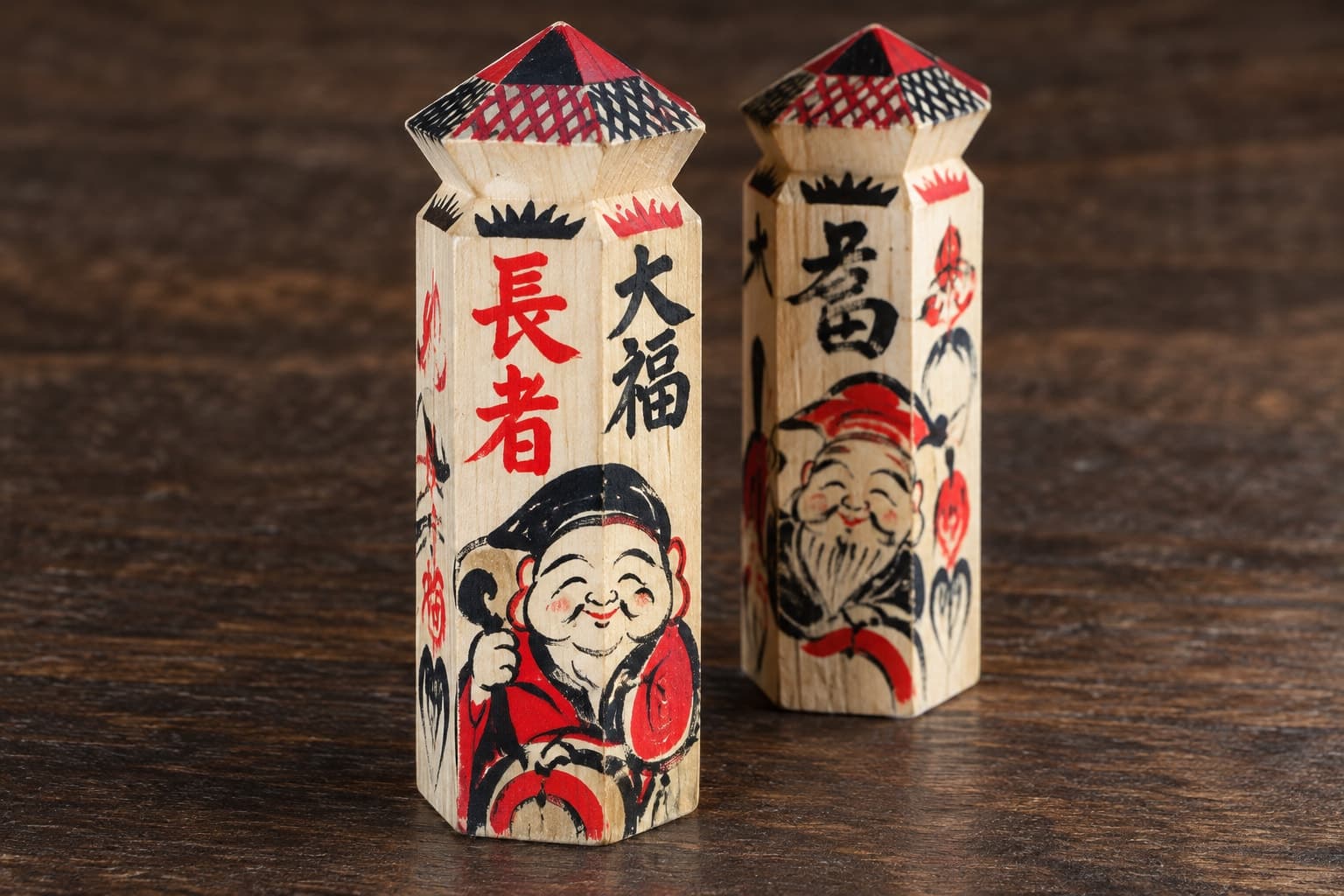
The first detail worth understanding is how the shape is made. Ueda’s cultural-property account describes wood called doroyanagi being worked with a specialised Somin cutting knife, planes and chisels. Makers use timber with the central pith running through it, rather than a split piece. The facets and the projecting top are therefore worked out of a continuous piece of wood. These are decisions about material and handling, not just an outline that could be painted onto any small object. Ueda’s cultural-property guide
The annual opening of the work is called Somin-kiri. The documented sequence begins at the temple on December 1, with prayers before cutting. Members of the Somin-kō then continue making charms at home and bring their completed work to the temple before distribution. The painted charms receive the goma prayers associated with the January gathering. The education board’s account describes this movement between a shared starting place, household work and a return to the temple. It also records a decline in the number of participating households by 2016; that historical count should not be mistaken for a current membership list. Agency for Cultural Affairs
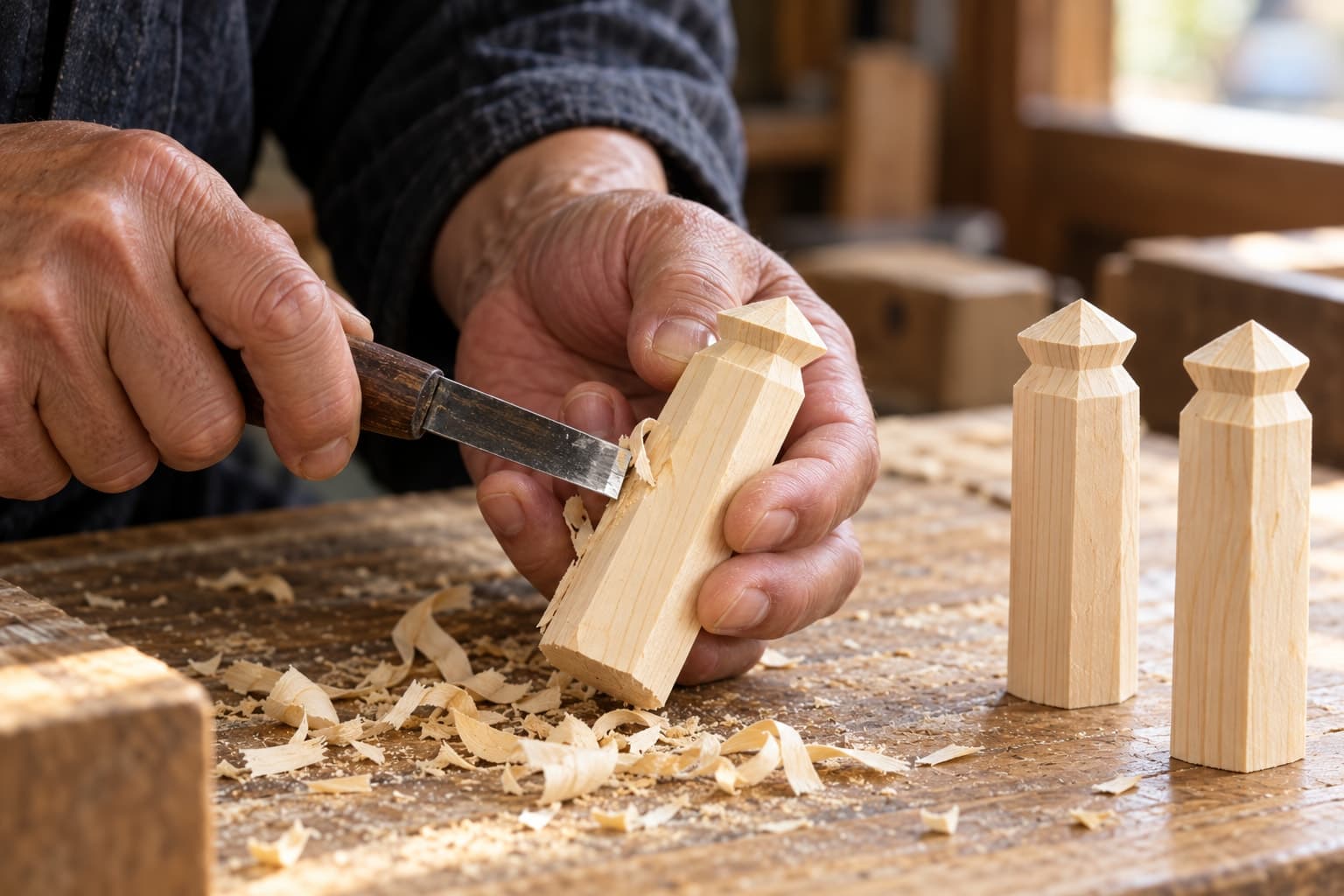
The division of work produces two recognisable kinds of charm. Those issued by the temple carry the characters and protective patterns. The Somin-kō’s e-somin, or painted Somin charms, add depictions such as Ebisu and Daikoku among the Seven Lucky Gods. Ueda’s account notes that individual households have their own characteristic paintings. Similar outlines therefore contain variations made by particular hands and family traditions. The distinction is useful at the fair: a visitor looking specifically for the painted figures is looking for the association’s offering, not merely a more colourful size of the temple’s version. Ueda’s cultural-property guide
The second detail is the patterned surface. The museum’s explanation identifies protective triangles on the hat-like top and net patterns below it. It associates the network of lines with interpretations of a rain cape, a net in the Gozu Tennō story and eyes turning harmful forces away. Around the middle, the design is read in relation to a shimenawa, the rope that marks a sacred boundary; a central semicircle is interpreted as a purifying grass ring. These are inherited interpretations of the motifs, not shapes whose meaning can be established merely by looking at them. Shinano Kokubunji Museum’s guide to the patterns
Knowing those readings changes the experience of examining a charm. The hat, lines and band are no longer incidental flourishes around the lettering. They offer several ways of expressing a protective boundary on a piece of wood small enough to hold in the hand.
The overall form has likewise invited more than one explanation. The museum records a reading of the charm as a figure in a rain cape and hat, associated with Susanoo and Gozu Tennō, alongside proposals connecting it with other older protective objects. It also documents the charm’s appreciation as folk art: Somin Shōrai appeared in an early twentieth-century ranking of regional toys reproduced in a craft publication edited by the artist Yamamoto Kanae. Religious use and interest in its carved and painted appearance have thus coexisted. Calling it a folk toy does not describe the whole reason a household might keep it. Museum guide to the shape
A third detail appears after the fair. The national record describes households retaining the charms over successive years, rather than automatically returning them after one year. Some displayed many together at an entrance or on a dedicated shelf. This is an account of a documented local way of keeping them, not a rule to assume for every owner. It suggests a different way to read a group of charms: as repeated acts of receiving and keeping, accumulated over time. The annual occasion can leave a lasting presence in the home. National cultural-property database
Visiting Yōkadō
The public place to encounter the distribution is Shinano Kokubunji in the Kokubu district of Ueda. The temple’s own guide distinguishes its regular charms from the painted e-somin offered by the Somin-kō. Aim to see the act of receiving them as well as the objects: the queue, the different offerings and their place within an active temple fair. Shinano Kokubunji
Crowding is a real part of the experience. The January 2026 report records long lines and road congestion, with public transport encouraged. Allow extra time for waiting and avoid treating the distribution counter as a place to stop a moving queue for photographs. As ordinary visitor courtesy, ask before photographing someone at close range or handling their displayed work. Tōshin Journal
The household workshops and domestic displays described above are not public attractions. The fair gives visitors a direct, publicly advertised way to encounter the custom without entering private homes.
When to go
The customary dates are January 7 and 8. For the next New Year, those are Thursday and Friday, January 7–8, 2027. The temple’s standing guide lists the start of its own distribution at 10 a.m. on the 7th and the Somin-kō’s painted charms at 8 a.m. on the 8th. Those are published customary arrangements, not a separately confirmed 2027 programme. If painted e-somin are your particular interest, the morning of the 8th is the relevant window. Confirm the 2027 arrangements with the temple before finalising travel. Temple fair guide
December’s making belongs to the preparation of the custom; it is not a substitute public distribution date. A January visit lets you see the point at which the makers’ work passes into the hands of the people who will keep it.
Around Ueda
For a separate part of the city’s history, visit Ueda Castle Park. Its surviving and restored structures, stonework and earthworks make the layout of a fortified place readable on foot. The west turret survives from the Edo period, while the south and north turrets were restored in 1949 and the eastern gate in 1994. These different dates are a useful reminder that a historical site can contain both surviving fabric and later reconstruction. Ueda Tourism Association
For a January itinerary, plan primarily around the outdoor park: the tourism association lists a winter closure for the turret interiors. The park itself offers a free walk. It makes a contrast with the temple fair—space to follow walls, edges and entrances after looking closely at an object designed for a household threshold.
Place and region
Ueda City, Nagano
Shinano Kokubunji is in Ueda, eastern Nagano, where the Chikuma River passes through a landscape of river flats, hills, and surrounding highlands. Ueda also lies on routes that have linked regional communities with the capital, bringing travelers and goods through the area.
From Tokyo
Take the Hokuriku Shinkansen from Tokyo Station to Ueda Station; the journey takes about 90 minutes, though trains and schedules vary. From Ueda, transfer to the Shinano Railway and get off at Shinano-Kokubunji Station, a five-minute walk from the temple. A bus or taxi from Ueda is another option. Chikuma Bus also operates a highway-bus route linking Ueda with Ikebukuro and Shinjuku. Check current schedules and stop information before traveling, especially for the January fair.
Food of this place
- Soba (buckwheat noodles). Presented as a local delicacy in Ueda and widely associated with Nagano Prefecture’s food culture.
- Oidare yakitori. A grilled-chicken dish listed among Ueda’s local foods.
- Oyaki. Stuffed dumplings recognized as a Nagano Prefecture specialty; fillings can include vegetables and pickled greens.
The marker shows the municipality, not an exact event venue. Map data © OpenStreetMap contributors.
Explore more stories from Nagano