Kanagawa ·
Oyama Koma: A Mountain Pilgrimage in a Spinning Top
Woodturning, coloured rings, and the wish for good fortune on the slopes of Mount Oyama.
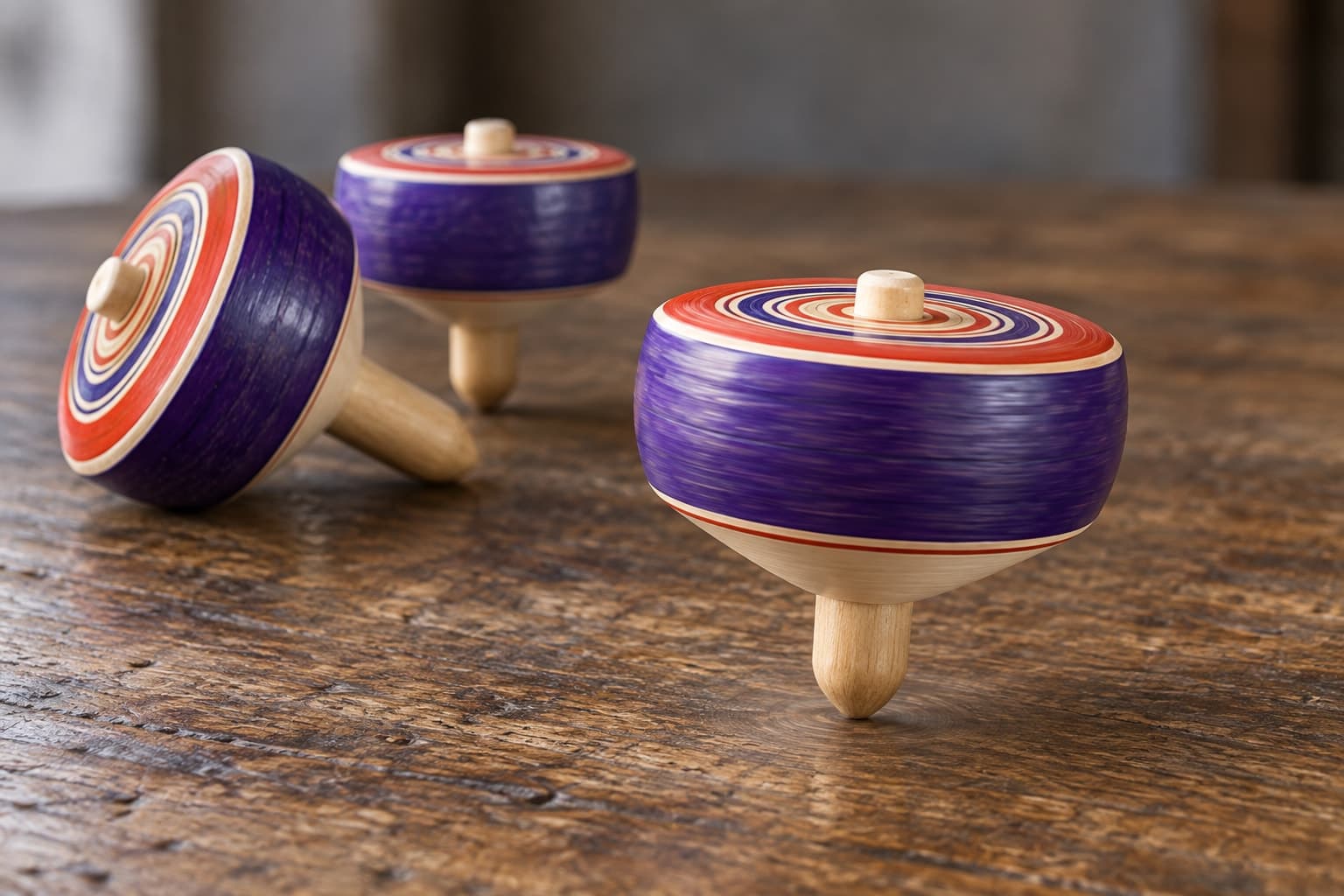
A small object made to move
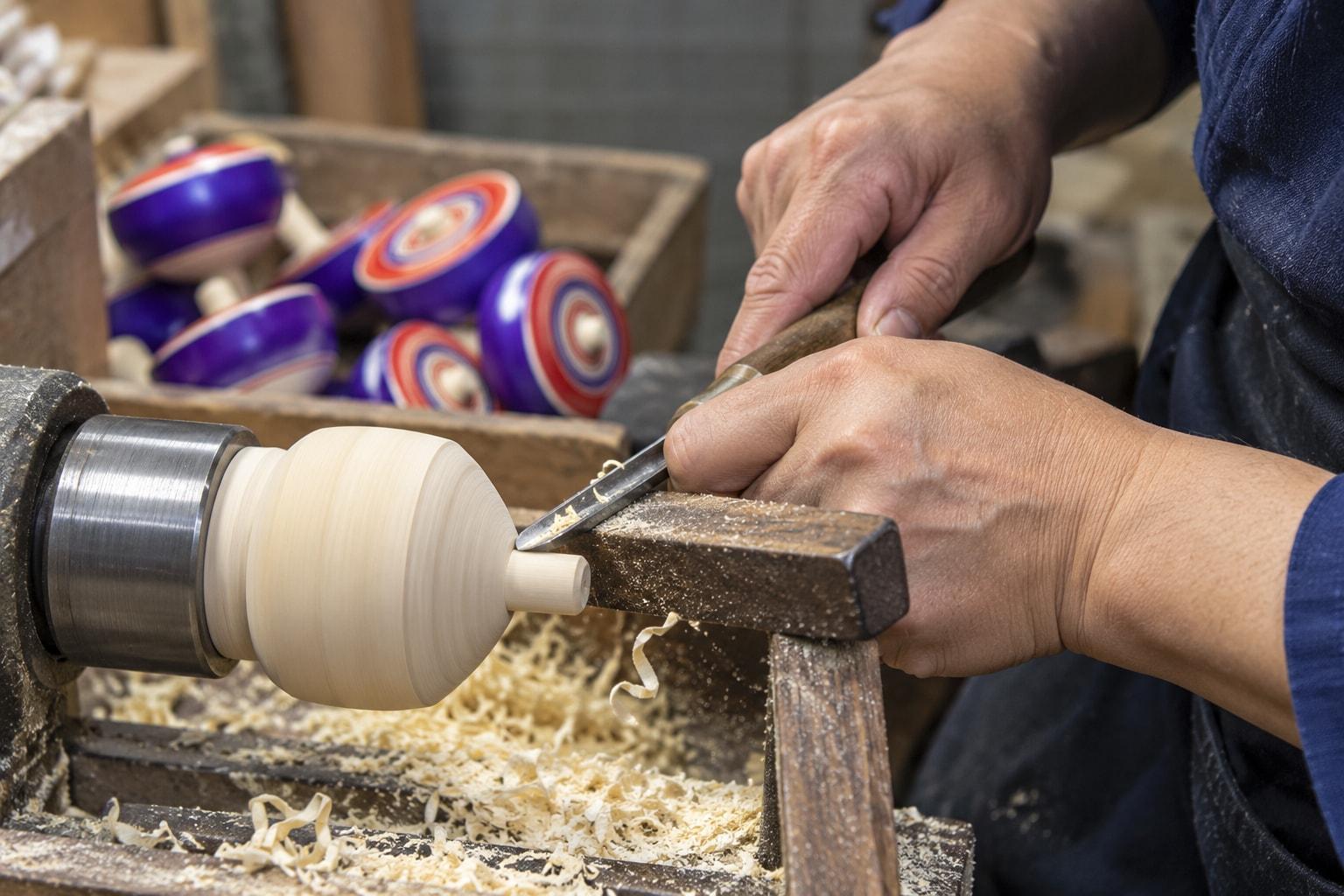
On a horizontal lathe, a maker shapes the rounded body of a wooden spinning top. Rotation also helps draw its coloured rings. A separate spindle passes through the centre; the finished object is ready for the movement a player gives it.
These are Oyama koma, the compact wooden tops associated with Mount Oyama in Isehara, Kanagawa. Their manufacture belongs to the skills of kijishi, woodturners. The national cultural-property record describes how their parts are shaped and fitted.
Koma means a spinning top. Oyama supplies the place-name, but the association goes further than a label on a souvenir. These tops accompanied a journey to a sacred mountain and returned to everyday life as objects to handle and play with. Isehara's account of the tradition explains their auspicious meaning through the idea of money circulating well. Rotation becomes a wish for things to go smoothly.
The colour also comes into its own through movement. Red, purple and indigo are set against the light wood; as the top spins, the separate bands blend. A still photograph reveals the painted pattern. Playing reveals another part of the design. Understanding the object therefore requires both views: the deliberate arrangement of its parts and what happens when someone sets them in motion.
A mountain journey brought home
Oyama pilgrimage was organised through relationships extending well beyond the mountain. Associations known as kō pooled money and sent members in turn. Religious guides and lodging hosts, historically called oshi, maintained those connections by travelling to their supporters and distributing talismans. The Japan Heritage account describes a journey that combined worship with the pleasure of an excursion. Shared finance helped make that journey possible for people who could not readily pay for an individual trip.
This context matters to a small wooden toy. A souvenir travelled back along the same social routes as the pilgrim. Its audience was larger than the people physically present on the mountain. The top's combination of play and good fortune fits a pilgrimage culture in which religious purpose, hospitality and enjoyment could occupy the same journey. It would be misleading to treat the approach-road shops as an incidental modern addition to an otherwise purely solemn tradition.
The precise origin of Oyama koma remains uncertain. There is, however, a useful historical anchor: a top from Oyama appears in the toy picture book 江都二色, published in 1773. That is evidence of recognition by the eighteenth century, rather than a date on which the craft began. The national record also notes that production, once especially associated with winter and the New Year period, now takes place throughout the year. Agency for Cultural Affairs
The heritage being passed on is a skill, including the ability to judge and alter a piece of wood while it turns. In a municipal profile published in May 2024, Kanekoya's eighth-generation maker, Yoshinobu Kaneko, described learning the fundamentals of turning and how to make the cutting tools before learning Oyama top-making from his father. He identified about two years of foundational training and said that, even after fifty years of making tops, he continued learning through courses and videos.
Kaneko also made small finger-spun tops and key-ring versions. Most revealing was the reward he described: children actually playing with his work. His account gives the craft a practical measure of success. The object must be appealing enough to pick up and usable enough to keep playing with; being recognised as heritage does not accomplish either task by itself.
What the spindle and rings reveal
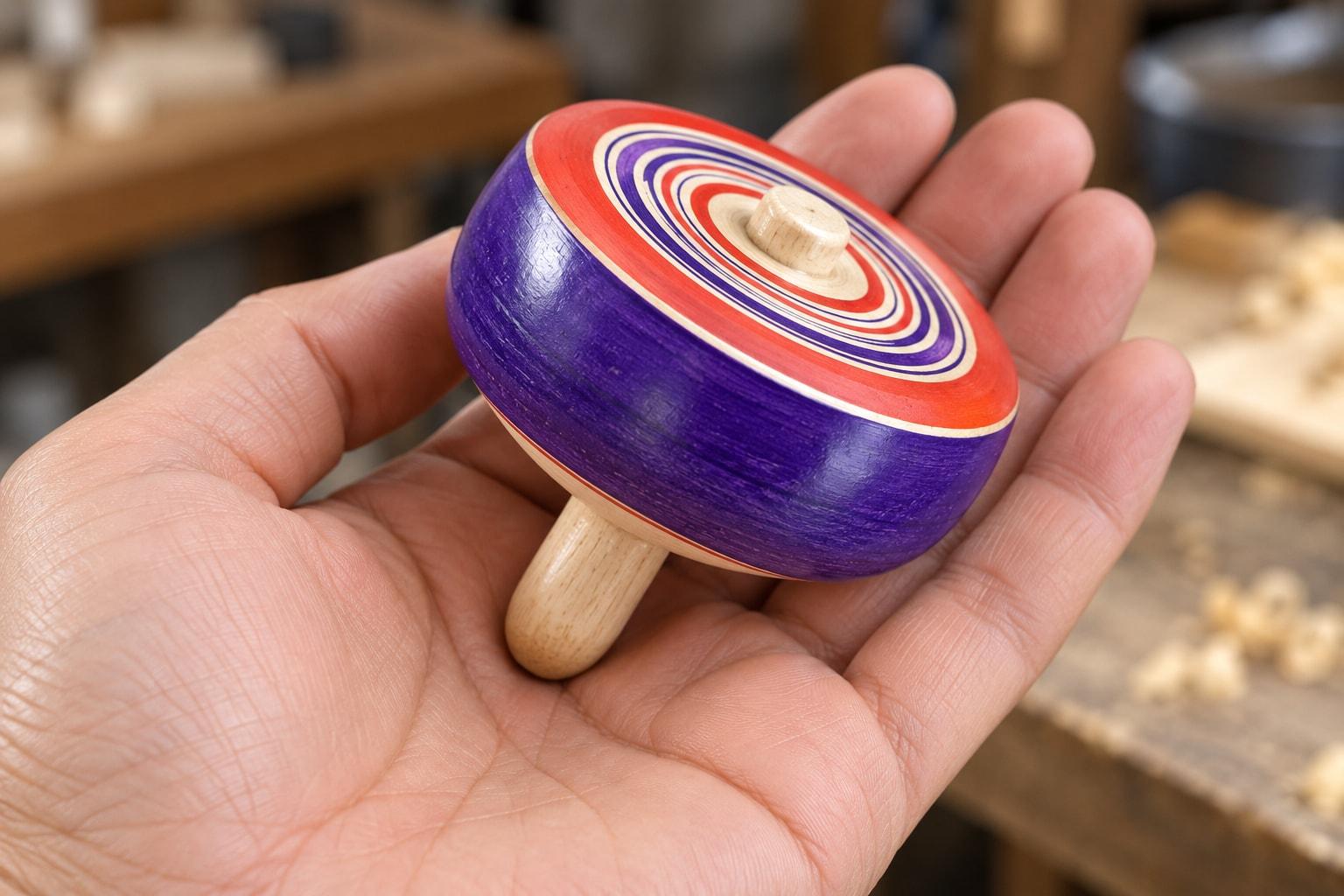
Look first at the spindle. Isehara's technical description explains that the hole through the body narrows at the upper side, while the spindle is correspondingly narrower above and thicker in the middle. This helps prevent it from being driven up through the body when tops collide in play. A feature that can look like a simple wooden peg is therefore a fitted joint designed with use in mind. Isehara's technical record
Next, look at the material. The wood traditionally associated with the craft is mizuki, a dogwood found on Oyama. Yet the city's account explicitly notes that makers now often obtain other wood from outside the prefecture. That distinction helps explain what is being transmitted: a way of working, shaping and finishing, alongside the history of a particular local material. A present-day top need not have been cut from a tree on the mountain.
The municipal record also specifies a wax-polished finish. In March 2023, the technique was selected nationally for documentation measures, amid concerns about transmission and ageing practitioners. Recognition addresses the skill of making, not simply possession of an old top.
There is also more variety behind the familiar rings than a single standard souvenir suggests. A 2019 visit documented by the top specialist behind Komagoma recorded maker Keitaro Harima discussing and demonstrating a wider repertoire. The report includes finger-spun and miniature tops, as well as recollections of making other wooden goods when demand changed. These are the experiences of one workshop at that time, rather than a description of every current maker.
That account makes an important distinction visible. A woodturner possesses a vocabulary of movements and tools that can produce more than one finished shape. Looking only for an unchanging design misses some of that adaptability. The enduring local top belongs to a working craft whose practitioners have also responded to customers, available material and the kinds of toys people wanted to buy.
Taken together, the fitted spindle, the painted surface and the maker's broader repertoire offer three different ways to read the object. Construction tells us about play; finish tells us about the use of rotation in manufacture; variations tell us about a livelihood. None requires the top to remain motionless on a shelf.
Visiting the makers' approach road
The public place to start is Koma-sando, the shop-lined approach towards the Oyama cable car. Kanekoya Shiten, at Oyama 585, is listed as a maker and retailer of Oyama tops. The regional visitor guide also lists a finger-top painting experience there. Painting a prepared top is a different activity from learning to turn its wooden body, so choose according to what you hope to do. Kanekoya Shiten visitor information
A shop visit offers a chance to examine differences in size and finish and ask which pieces were made locally. Do not assume that retail opening hours guarantee a live turning demonstration. If watching manufacture is essential to your trip, confirm that possibility with the shop in advance. Its listed closing days are irregular.
The approach is also the beginning of a mountain visit. Isehara's current walking guidance distinguishes access to the lower shrine by cable car from the more demanding mountain paths. Wear footwear and clothing suited to the route you actually intend to follow. Buying a top and walking up to the summit involve very different commitments.
When to go
The craft is not tied to a single annual performance. November is a useful time to combine the shops with the mountain's autumn colours. Isehara gives mid- to late November as the usual foliage window, varying by location. This is a seasonal guide, not a promise that the leaves will peak on a particular day in 2026. Isehara foliage guidance
For this visit, leave enough daylight to spend time at the shops as well as higher on the mountain. A top can be bought quickly; noticing its surface, asking about its maker and learning how to use it deserve a less hurried stop.
Around the visit
Oyama Afuri Shrine's lower shrine gives the pilgrimage setting a physical presence. It stands on the mountainside, while the main shrine is at the summit. The lower shrine can be reached by cable car and offers broad views; the summit requires a further steep mountain walk. Keeping those two destinations distinct makes a more realistic day. Isehara's shrine guide
For a second stop, Oyama-dera is particularly associated with the maples beside its approach steps. The city's autumn guide identifies both the temple and the lower shrine as places to see seasonal colour. Together with the workshops below, they let you encounter the mountain through worship, landscape and the small things people make to carry away.
Place and region
Isehara City, Kanagawa
Isehara stretches from the foothills of the Tanzawa mountains toward the Sagami River plain. Mount Oyama rises above the city and has long drawn pilgrims; the foothills and approach routes also developed as places to stay, eat, and find local goods such as spinning tops.
From Tokyo
Take the Odakyu Odawara Line from Shinjuku to Isehara Station. From the station’s north exit, local Kanagawa Chuo Kotsu buses depart from bus stop 4 toward Oyama Cable, with the terminus at Oyama. Check the railway and bus operators for current 2026 services, as routes and timetables can change.
Food of this place
- Oyama tofu. Tofu from the Oyama area is made with spring water from the mountain foothills. Local accounts connect its history with the area’s water, soybean offerings at Afuri Shrine, and food for pilgrims; tofu remains a feature of local meals.
- Kyarabuki. A simmered butterbur dish listed among Isehara’s local specialties. The city’s tourism association notes that a local maker continues a tradition dating to 1872.
- Oyama manju. A sweet bun sold as an Oyama-area specialty, alongside other local confections.
The marker shows the municipality, not an exact event venue. Map data © OpenStreetMap contributors.
Explore more stories from Kanagawa