Saitama ·
Chichibu Night Festival: The Town That Moves Its Stages
Silk history, a winter shrine journey, and the skills that turn wooden floats into moving theatres.
A shrine journey through a moving town
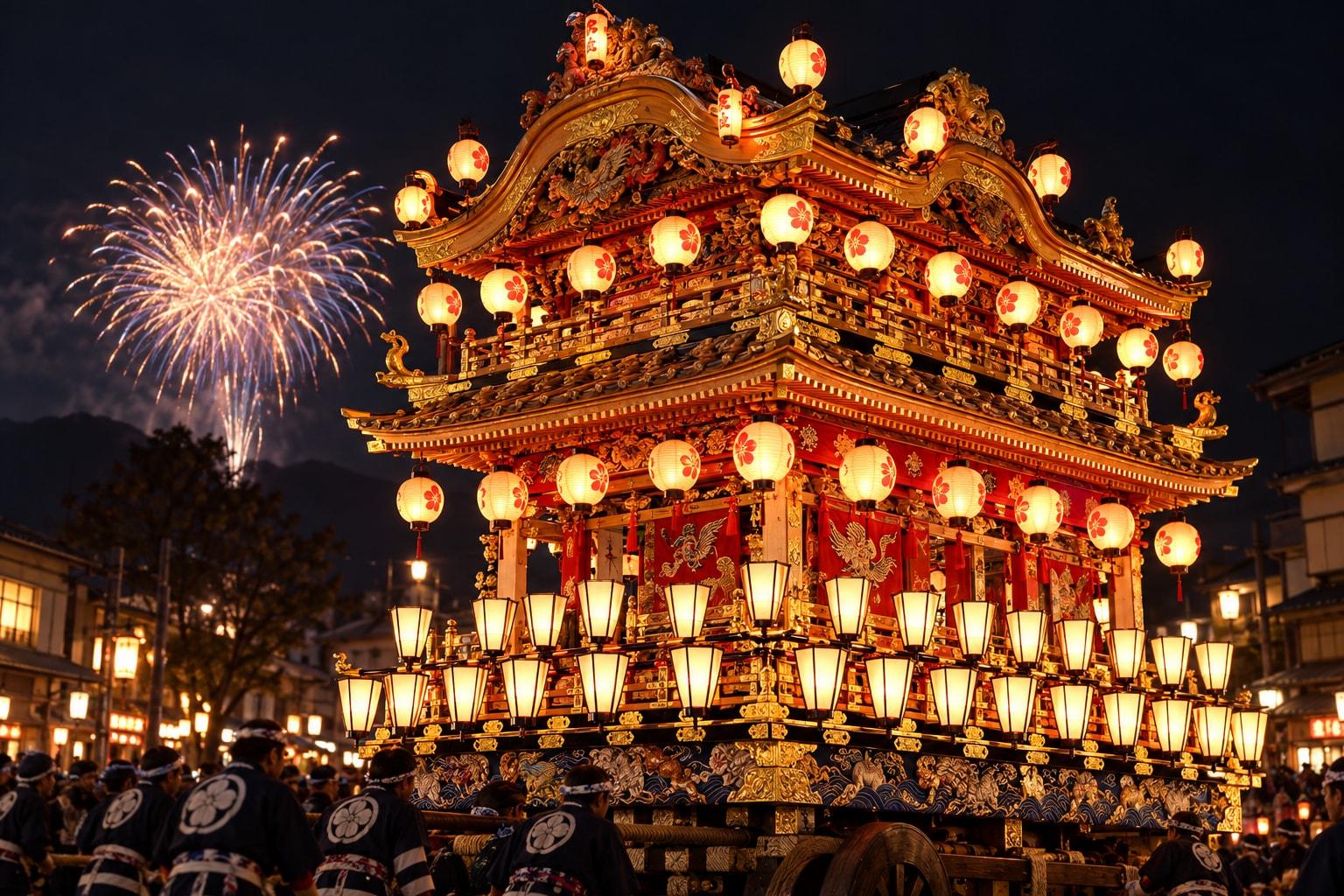
On the main night of Chichibu Yomatsuri, six great wooden floats travel through the streets towards the Otabisho, the temporary resting place of the shrine's deity. Two are kasaboko and four are yatai. Carved roofs, embroidered hangings and lanterns give them their familiar appearance, while ropes, wheels and the coordinated work of local crews make that architecture move. The procession is associated above all with 3 December, the main day of Chichibu Shrine's annual festival in Saitama.
The floats belong within a larger shrine observance. The deity's journey gives their movement a destination; the decorative and performing arts accompany it. The national cultural-property account describes the float procession, its return to the neighbourhoods and the related kagura tradition. The local tourism association also identifies the festival's kabuki and dance performances. To follow the event is to encounter several arts sharing a route and a religious occasion.
Yomatsuri simply means “night festival.” Other local names point to different aspects of the same gathering. Chichibu Shrine records names connected with winter, Myoken worship, silkworms and a great market. The festival was meaningful to people approaching it through farming, silk production, trade and worship. Its best-known evening view contains traces of all those worlds. Chichibu Shrine
Silk wealth, neighbourhood work, and winter belief
The Chichibu Matsuri Kaikan connects the growth of the celebration with the silk market held around the shrine during the Edo period. It gives more than one transmitted dating for the beginning of the accompanying float festivities, in the later seventeenth or early eighteenth century. That uncertainty is worth preserving: the shrine's observance, a market and the developed float spectacle do not necessarily have one common starting date. The museum's festival history
Individual floats provide firmer chronological details. The city's record identifies a 1747 reference to the Kamimachi yatai, while an entry concerning the Nakamachi float in 1785 suggests that its present scale had largely taken shape by then. These records let us see elaboration over time, instead of imagining six finished floats appearing together at the festival's origin. Chichibu's float records
The religious setting also has a local geography. The shrine stands opposite Mount Buko, which features in its account of the winter rite. A story told by the shrine describes its female Myoken deity and the male deity of the mountain meeting once a year, with the permission of the latter's wife, associated with the nearby Suwa shrine. This is a sacred story used to explain the occasion, not a historical account of human events.
The shrine also interprets the winter journey in relation to the agricultural year and the return of the mountain's deity after the harvest. These interpretations place the night procession within a cycle of receiving and sending back divine presence. They help explain why its destination matters even when attention is drawn to lanterns and fireworks. Chichibu Shrine's explanation
Recent accounts show how widely the work of the festival is shared. Reporting after the 2–3 December 2025 celebration, the city's mayor described performances by a local kabuki troupe and the children's kabuki club of 花の木小学校, a local primary school. The report also records a silk market near the shrine and lanterns made with schoolchildren. It is direct evidence of a festival carried out by people with different contributions, rather than simply an annual date printed on a calendar. Chichibu's December 2025 report
The modern market should not be assumed to reproduce the economic scale or function of the Edo-period silk trade. Its value here is more specific: a historical association with textiles remains visible within a contemporary celebration. Likewise, children's participation shows a route into performing and making, without requiring us to assume that every child will become a future festival specialist.
How a float turns and changes shape
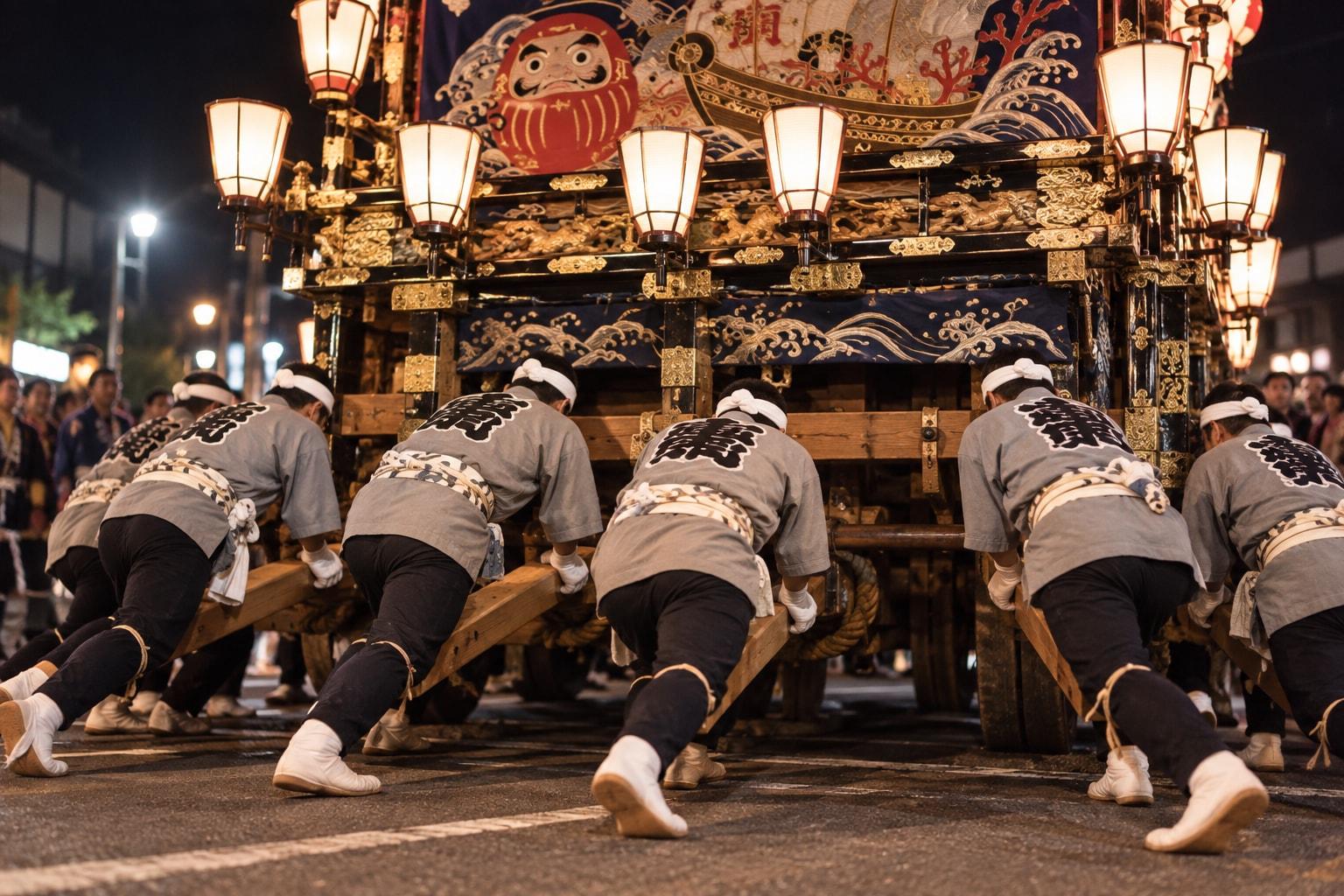
A float's movement is easiest to appreciate at a corner. Its four wheels cannot steer around a junction like those of a car. In the method called giri-mawashi, the ground crew uses long wooden levers to raise the rear, places a pivot beneath the float's centre of gravity and turns the structure before removing the pivot and moving forward again. Kamimachi uses a different device known as a kirin. The city's explanation of the manoeuvre makes clear that changing direction is a planned operation, not merely a harder pull on the ropes.
The physical problem gives the street corner its drama. The float must first be made temporarily capable of a movement that its ordinary wheel arrangement does not provide. Watching the crew reveals a different kind of virtuosity from carving or embroidery: the timing and coordination needed to handle a large shared structure.
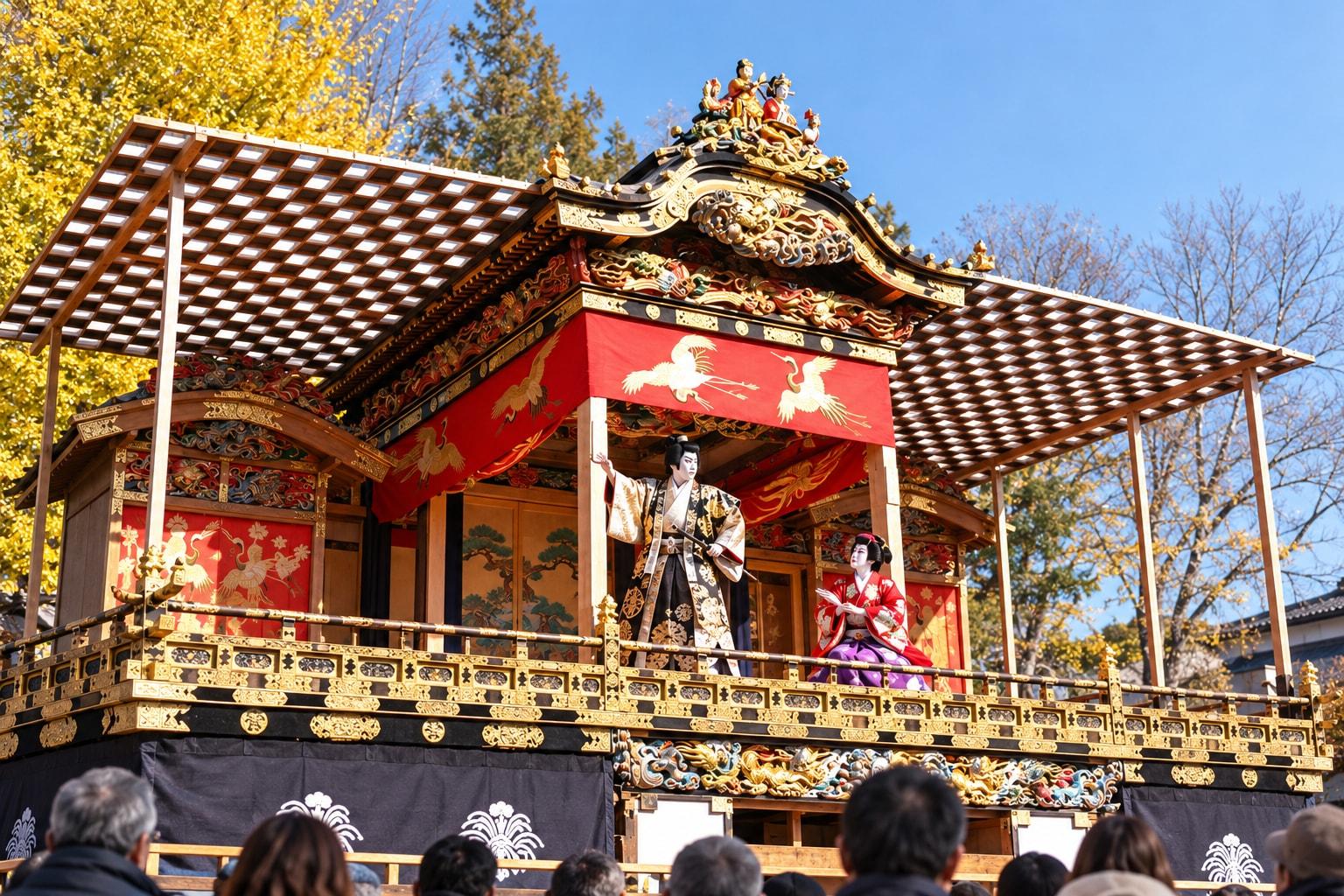
A second transformation happens when a yatai becomes a theatre. The city describes floats built for assembly and disassembly, using traditional joining and rope-fastening methods, and yatai equipped with revolving-stage mechanisms. Additional sections can be fitted at the sides for performance. What appears on the road as a compact building can therefore acquire a wider theatrical footprint. Chichibu's construction record
The festival museum describes the four yatai neighbourhoods taking turns to host the float kabuki. Side extensions, places for musicians and a hanamichi passage turn the vehicle into a working performance space. The same museum also explains a change in the two kasaboko: their original tall, tiered umbrella structures could no longer travel the route after telephone and electricity wires appeared, and the night procession uses their lower, roofed form. The shape seen today records negotiation with the town's changing infrastructure. Matsuri Kaikan
There is also kagura, sacred performance associated with the shrine, whose lineage and structure the national record distinguishes from the Edo kagura widespread elsewhere in the Kanto region. It belongs to the recognised tradition alongside the floats. A visitor concentrating only on their evening arrival can easily overlook that the festival encompasses forms of performance which do not travel down the street on wheels. Agency for Cultural Affairs
Visiting the public celebration
The public festival takes place around Chichibu Shrine and the central streets of Chichibu. Daytime viewing allows attention to the floats and performances; the main evening brings the journey towards the Otabisho. The usual eve, 2 December, features the four yatai, while the main day brings all six floats. This offers two different kinds of visit rather than simply a shorter and longer version of the same night. Chichibu Tourism Association
The celebrated climb at Dango-zaka is not a viewpoint that an unreserved visitor should count on reaching. The city warns that the area is narrow and viewing is effectively impractical for people without reserved seats. Plan around accessible sections of the route rather than assuming every famous image corresponds to an unrestricted standing place. Official viewing guidance
Wear warm layers for a prolonged December evening outdoors and keep the crews' working space clear. Individual viewing areas may impose their own photography and access rules. A private Dango-zaka seating operator, for example, prohibits tripods, monopods and selfie sticks within its own area; this is a venue-specific rule, not evidence of a blanket ban across the town. Seating operator's guidance
For an introduction at another time of year, Chichibu Matsuri Kaikan, near the shrine, displays floats and historical material and uses projected images and sound to explain the festival. It is a museum experience rather than the December shrine procession, and can be useful precisely because the objects can be examined without the movement of a crowded street. Museum visitor information
When to go
The customary dates are 2 December for the eve and 3 December for the main festival. In 2026 these fall on Wednesday and Thursday. Choose the main day for the six-float gathering; consider the eve if a less concentrated encounter with the yatai better suits your interests. The December night is the climax, but the title “Night Festival” should not obscure its daytime activities.
A private viewing operator is already advertising 3 December 2026, but that does not establish the full official programme. At the time of research, the detailed current-year municipal timetable had not been verified. Consult the official Chichibu visitor site for the 2026 route, performances and access arrangements before finalising the trip. Last year's running times should not be used as this year's schedule.
Around the visit
Chichibu Meisen Museum offers a close companion to the festival's silk history. It occupies the former prefectural industrial testing station, built in 1930, and displays equipment and textiles connected with Chichibu's weaving industry. Its explanation of hogushi printing is particularly useful: patterns are applied to the threads before the final cloth is woven, helping create the large, vivid designs associated with Meisen. Chichibu Meisen Museum
A visit puts machinery, fabric and production processes beside the festival's expensive decoration. The connection is not that every displayed cloth once paid for a float. It is that silk belonged to the working town whose neighbourhoods developed and maintained this celebration. Seeing the museum in daylight gives that town a presence of its own before the lanterns draw attention back to the streets.
Place and region
Chichibu, Saitama
Chichibu City lies in a mountain-ringed basin in western Saitama Prefecture, with the Arakawa River running through it. Its central flatland holds the main urban area, while much of the surrounding city is mountainous and forested. Chichibu Shrine and the streets of the settled town provide the setting for the Night Festival. In the shrine’s account of the winter observance, Mount Buko figures in the sacred story associated with the rite.
From Tokyo
From Ikebukuro, take the Seibu Ikebukuro Line to Seibu-Chichibu Station. Alternatively, travel from Ueno on the JR Takasaki Line to Kumagaya, then transfer to the Chichibu Railway for Chichibu. Service patterns and timetables can change, so check the railway operators before traveling.
Food of this place
- Chichibu soba. A local specialty associated with Chichibu City and the wider Chichibu area.
- Miso potatoes (miso-poteto). A local food of Chichibu, made with potatoes and miso.
- Waraji katsudon. A pork-cutlet rice bowl associated with Chichibu City.
- Pork miso bowl (buta miso-don). A Chichibu specialty featuring pork prepared with miso.
The marker shows the municipality, not an exact event venue. Map data © OpenStreetMap contributors.
Explore more stories from Saitama