Gunma ·
Nedofumi: The Hot Spring Behind a Mountain Craft
In Gunma's Iriyama district, prepared sedge connects warm water, winter work and woven footwear.
Before a plant becomes a thread
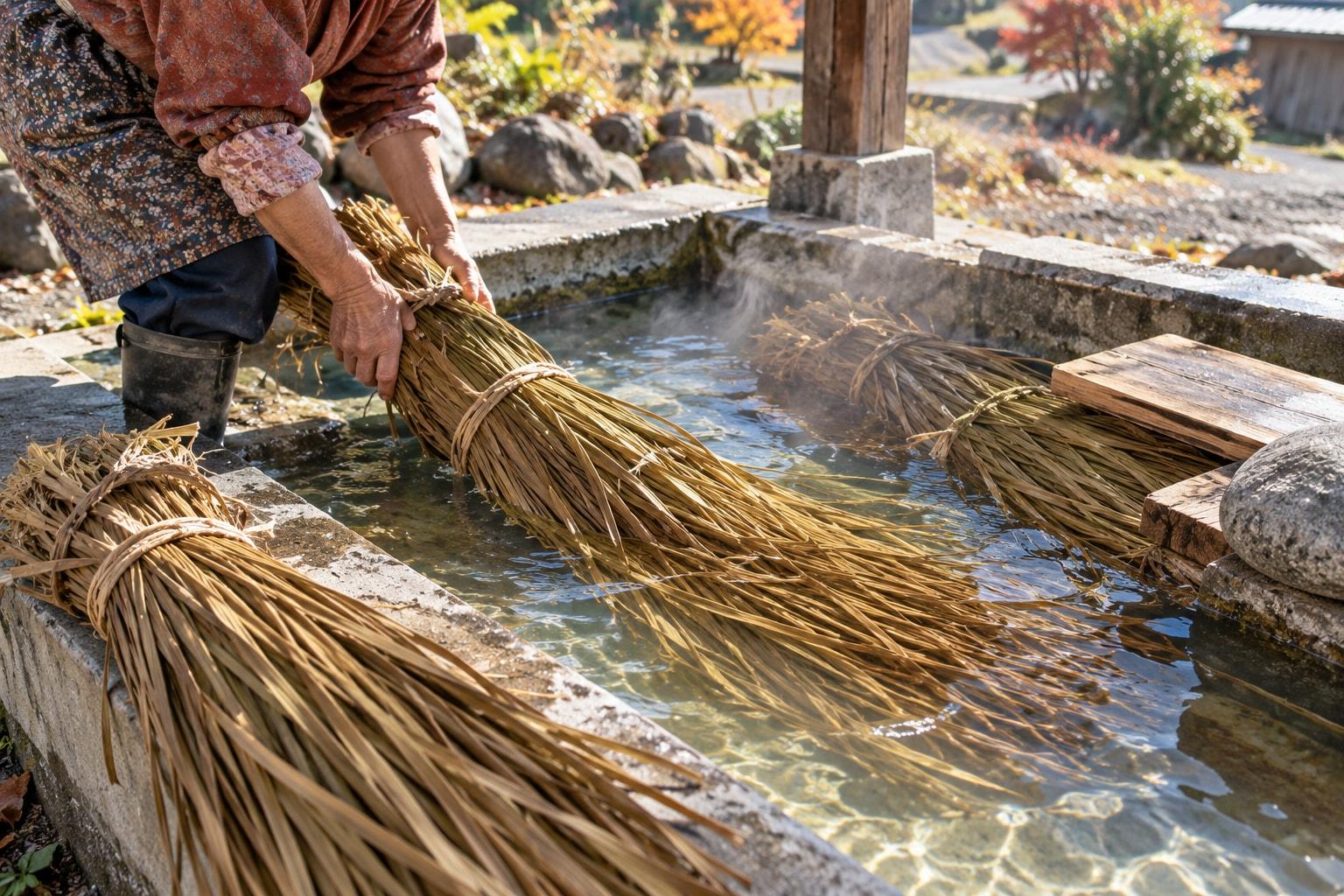
In the Iriyama district of Nakanojo, in the mountains of Gunma, the preparation for weaving can begin in hot-spring water. Bundles of gathered plants are soaked, taken out and dried. Only after this treatment are they made into the ropes and woven goods that people need. The local technique is called nedofumi: a way of making tough plant material workable before the more visible work of making a mat or a pair of shoes begins.
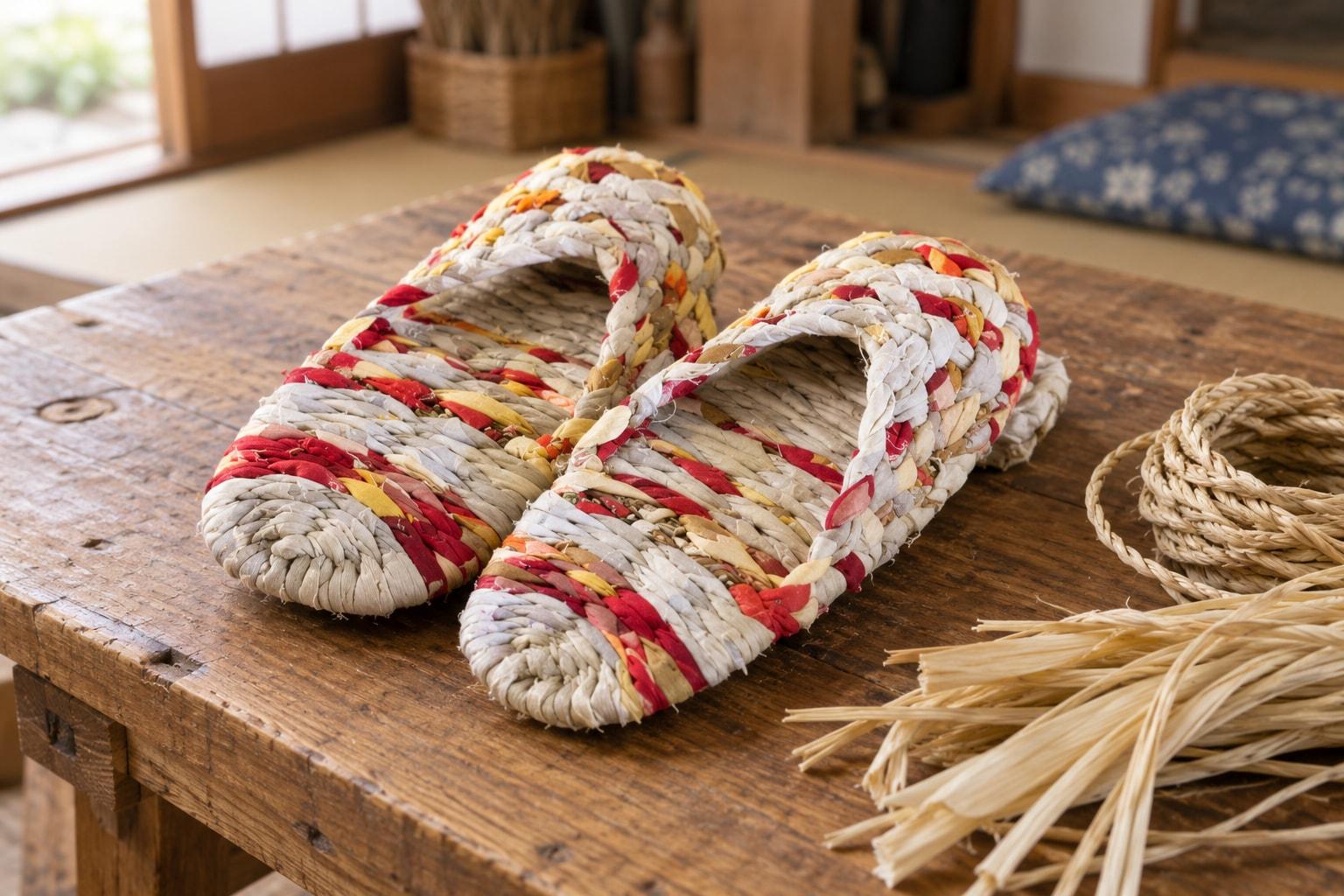
The national heritage record describes sedges and other plants being immersed for roughly ten days to two weeks in alkaline spring water, traditionally inside a stone enclosure made in a riverbed. After drying, the material could be used for winter household production. Two characteristic results are mushiro, woven mats, and konkonzori, substantial woven footwear. The cultural practice includes both this preparation and the skills that follow it. A finished object tells only the last part of the story. Agency for Cultural Affairs
An account of a 2013 workshop in Nehiro makes the soaking stage easier to picture. The group put dried bundles into the small hot-spring footbath at Nedofumi no Sato, a local craft centre. As the bundles floated up, participants pressed them down with their feet. Boards and heavy stones then held them underwater. The river was running too high to use safely that day; the centre's piped spring water provided another place to carry out the process. Workshop account
For someone accustomed to thinking of an onsen as a place to bathe, this is a different relationship with hot water. Here it belongs to the making of everyday things. The significant transformation happens before there is anything resembling a shoe.
A winter livelihood, remembered through its materials
The Agency for Cultural Affairs places the technique in a mountain environment where rice cultivation was difficult and rice straw correspondingly hard to obtain. Locally gathered plants supplied material for household goods. That background matters: the choice of fibre was tied to what people could obtain and process, rather than simply to the appearance of a finished craft. The agency selected the tradition for documentation in 2016. That is a date of recognition, not a claim about when villagers began practising it. Selection documentation
A profile published by the local magazine Nakabito in January 2024 introduces sisters Chiyoko and Tora Nakamura, members of the association carrying on the work. Their recollections give the seasonal routine a human scale. Chiyoko remembered journeys to gather plants around Nozori, sometimes involving several days away. She also described a division of winter work in which men made charcoal while women worked on ropes and sacks. Tora recalled learning to twist rope as a child and helping during winter holidays around the household hearth.
The profile shows Chiyoko making konkonzori and describes the association selling work, demonstrating and teaching. It also records a specific difficulty: mat weaving required two people, while Tora was then the only person able to do that work. This is a more precise picture of continuity than saying simply that an old craft survives. Different parts of a technique can have different prospects, even among people working together. These are the sisters' recollections and the situation reported in 2024, rather than a description of every household today. Nakabito's maker profile
Nor has continuity required keeping every working arrangement unchanged. Makers interviewed during the 2013 workshop described the move from riverbed soaking to the centre's footbath after the facility opened. They valued the smaller pool's safety and steady warmth. Their account also distinguished the colour of plants treated there from those once processed in the river. The useful question is therefore not whether the workshop looks exactly as it did in the past, but which properties of the material the makers are trying to achieve. Makers' accounts recorded in 2013
What the ropes and shoes reveal
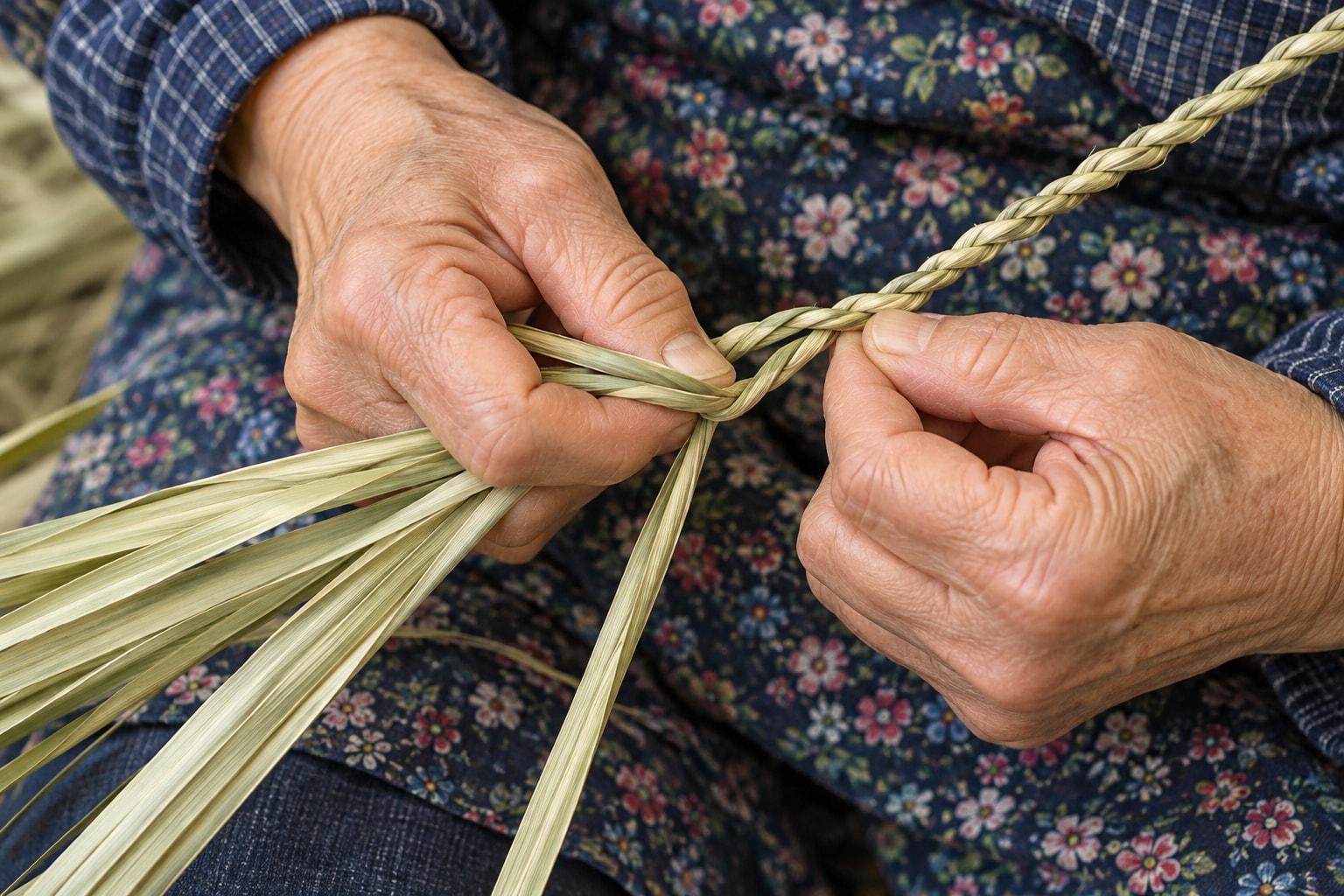
Three details help connect these stages. The first is how much work precedes soaking. In an October 2013 gathering workshop, participants cut clumps of sedge, removed dead leaves, aligned the bases and tied the plants into bundles. Drying required attention too: the bundles were turned so that they would dry evenly. The report records this as a practical lesson near Nehiro, not as a ceremony with a fixed annual date. Gathering workshop
That sequence changes the way a visitor might look at a bundle of grass beside a craftsperson. It represents earlier decisions about gathering, sorting and drying. The material is not an interchangeable supply taken straight from a shop. Even before a pattern is woven, work has gone into making its components usable.
The second detail is the division of materials inside konkonzori. A December 2013 workshop record describes a core of sedge rope, while the strands woven around it were made from rice straw wrapped in strips of cloth. A colourful surface can therefore conceal more than one plant material and more than one preparation technique. The instructor used a wooden foot-shaped form, tightened the weaving and struck the work with a wooden mallet to shape it. The finished footwear encloses the toes; it is not an ordinary flat sandal with a thong. Weaving workshop
The third is the importance of the rope hidden within that surface. The same account describes a beginner's rope breaking during the work. Making rope was not a preliminary exercise that could be forgotten once the colourful weaving began: its strength affected whether the shoe could be completed. The writer also observed small differences between the instructors' ways of shaping their footwear. A shared local practice left room for individual working habits.
Together, these details offer a way to appreciate the craft without reducing it to either a pretty souvenir or a list of endangered techniques. The hot water, prepared fibre, twisted core and shaped surface have distinct jobs. Understanding their relationship makes the finished object more legible. It also gives a demonstration a natural set of questions: what has happened to this material already, what must it do next, and how does the maker know it is ready?
Visiting Nedofumi no Sato
Nedofumi no Sato in Nehiro is the public place to begin. A visitor listing updated in June 2025 describes displays of tools and finished work, a small footbath, and opportunities to experience mat or konkonzori making. This provides a setting for learning about the craft without treating private homes or working river sites as visitor attractions. Japan47Go visitor listing
A display visit and a practical lesson are different experiences. For a lesson, establish in advance which activity is available and how much time it requires. The historical workshop described above spread gathering, preparation and making across separate sessions; it should not be mistaken for an activity that every visitor can complete from raw plant to finished footwear in a brief stop.
The useful expectation is a closer look at materials and work, rather than a guaranteed performance of the entire production cycle. If a maker is present, the relationship between the plain rope and the cloth-covered shoe is especially worth understanding.
When to go
Autumn into winter is an appropriate season in which to read about nedofumi, but this is not a festival with one public performance day. Gathering, preparation and making occupy different stages of work. The documented 2013 course ran from autumn into December; its dates are historical examples, not a current booking calendar.
The detailed visitor listing gives opening hours of 9 a.m. to 4 p.m. on weekends and public holidays, with weekday and winter closures. It does not specify the winter closure boundary. Before planning a November visit, confirm the opening period and any workshop arrangements with the centre through the linked visitor information. A trip should be based on an actual opening day, not on the assumption that the beginning of the traditional work season means unrestricted visitor access.
Around the visit: the old Ōshi railway site
Elsewhere in Nakanojo's Kuni area, the former Ōshi Station offers a different account of work and local resources. It opened in 1945 to serve the Gunma iron mine, later carried passengers, and closed with the line in 1971. Today's public site includes reconstructed railway features and the surviving lower columns of the ore-loading structure. The station building contains historical photographs and objects. Nakanojo Town
The scale is very different from a bundle of sedge: the loading structure once received ore from above and released it into freight wagons below. Seen alongside the craft centre, it broadens a visit beyond a single image of mountain life. Plant gathering, hot water and mineral extraction belonged to different kinds of work in the same wider district.
The town lists the railway site as open from 10 a.m. to 4 p.m., with reduced opening during December through March and a New Year closure. Allow for those seasonal restrictions when combining the two places rather than assuming that both follow the same calendar.
Place and region
Nakanojo Town, Gunma
Nakanojo lies in northwestern Gunma, near the borders with Nagano and Niigata. More than four-fifths of the town is forest, with mountain highlands, river terraces and basin-like areas. Iriyama, where nedofumi is practiced, is in the mountainous north. The local tourism association says makers used nearby plants and hot spring water from Shiri-yaki Onsen to prepare sedge for weaving. Nedofumi no Sato, the craft centre, is in the Nehiro area of Iriyama, not central Nakanojo; the association currently lists it as closed, so confirm its status before planning a visit.
From Tokyo
To reach Nakanojo Station, take a Joetsu or Hokuriku Shinkansen to Takasaki and continue on the JR Agatsuma Line. Alternatively, the Nakanojo tourism association lists the Kusatsu-Shima limited express from Ueno and a highway bus from the Shinjuku Expressway Bus Terminal. Iriyama requires a further leg beyond Nakanojo Station. The town lists a local bus between JR Naganohara-Kusatsuguchi Station and the Hanashiki Onsen–Lake Nozori area, but its published stop list does not identify Nedofumi no Sato. Confirm a suitable stop and onward transport with the town or bus operator; a car or arranged local ride may be more practical. Check current services and connections before travelling.
Food of this place
- Hana-mame (scarlet runner beans). A Nakanojo specialty; the town’s tourism association describes the beans as suited to cold conditions.
- Soba. Nakanojo’s tourism association connects the town’s local buckwheat and mountain water with its soba.
- Yakimanju. A Gunma specialty: skewered buns grilled with sweet miso.
- Konnyaku. Associated with Gunma, a major producer of the crop used to make it.
The marker shows the municipality, not an exact event venue. Map data © OpenStreetMap contributors.
Explore more stories from Gunma