Gunma ·
The People Who Move a Theatre: Kamimiharada's Kabuki Stage
In rural Gunma, a wooden stage survives through the people who know how to make it turn, rise and unfold.
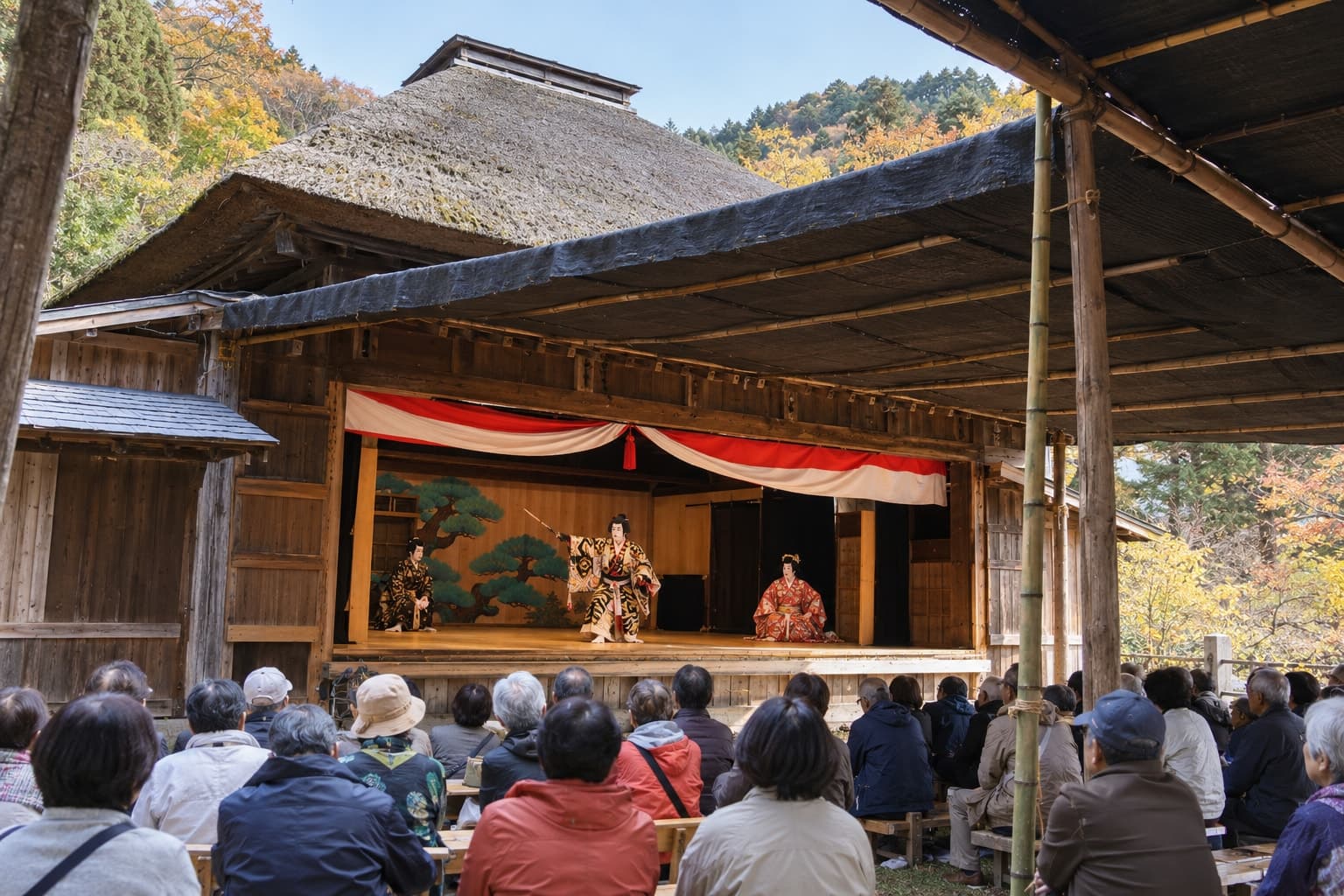
A building that changes shape
At Kamimiharada, in the Akagi district of Shibukawa, a wooden wall can become part of a stage. Boards that normally enclose the building fold outwards, extending the floor. Inside, a circular section turns; a smaller platform can rise from below or descend from above. A modest thatched building becomes a place where people appear, disappear and move between scenes. These are working parts of a rural kabuki theatre, operated together by people who know how its different movements fit. Agency for Cultural Affairs: operating techniques
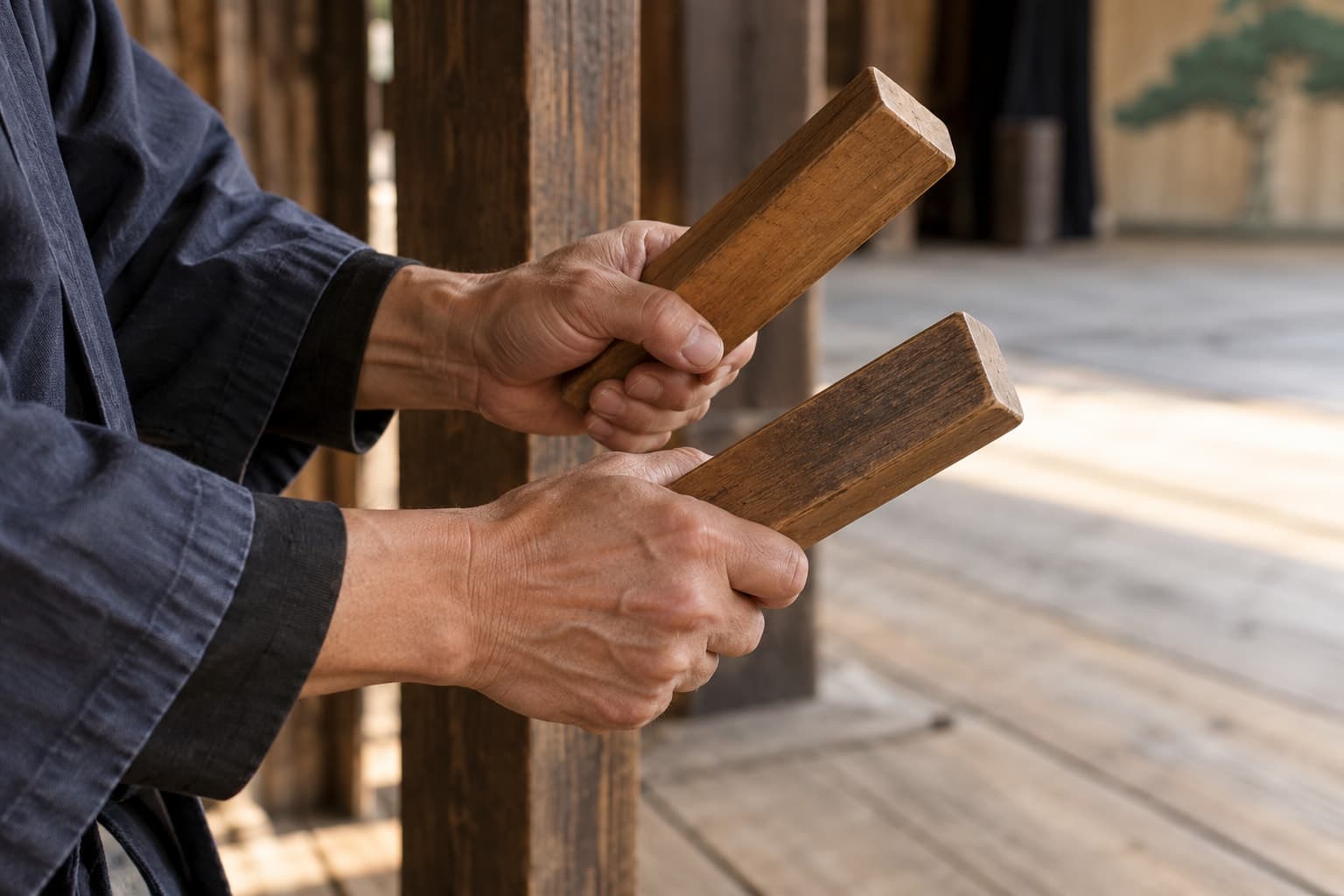
The actors are only some of the people making the performance happen. Operators work beneath the floor, above it and around the stage. In its 2019 account of the community, the Suntory Foundation described roughly eighty people working backstage, coordinating their actions through the sound of wooden clappers. An effect seen in one place depends on people positioned elsewhere. Suntory Foundation
This is the tradition officially recorded as the equipment and operation of Kamimiharada's kabuki stage. The name is unusually useful. It directs attention away from the idea that a theatre is simply a picturesque building containing actors. Here, the knowledge of how to operate the building is itself a cultural inheritance. The national record emphasises coordinated movement, and lists both a 1962 recording project and a later operational handbook. Remembering the performance also requires remembering how it was made. National cultural-property record
Nor does a newcomer need to recognise the plays before finding something to follow. Watch the relationship between a body and the floor supporting it. A character who rises into view, or a scene that turns away to reveal another, is being presented through the work of an entire mechanism. Understanding that much changes the question from “What does this old building look like?” to “What can these people make it do?”
A carpenter's theatre, a community's responsibility
The stage is traditionally dated to 1819. The national account places its first site in the grounds of Tenryūji Temple and records its move to the present location in 1882. It is a compact, single-storey structure with a hipped thatched roof. Its preservation history recognises two related things: the stage was designated an Important Tangible Folk Cultural Property in 1960, while its operating techniques were selected for recording in 1961. Those are different categories, not two interchangeable descriptions of the same object. Agency for Cultural Affairs: the stage
The carpenter remembered as its builder is Nagai Chōjirō. Shibukawa's heritage account relates that he studied his trade in the Kyoto–Osaka region before returning home to build at Kamimiharada. The account presents this as the stage's transmitted history. It gives a local name to the ingenuity of the structure without requiring us to imagine an undocumented moment of invention. Shibukawa's cultural-property guide
The stage's continued existence was not inevitable. According to the Suntory Foundation's award history, post-war pressures and competing entertainments brought a proposal to dismantle it. Recognition of its mechanisms helped turn that decision towards preservation. A local preservation association formed in 1960; in 1994 its name changed to the committee for transmitting stage-operation techniques. The change makes the practical ambition clear: keeping the timber was only part of keeping the theatre. Someone also had to learn the work. Suntory Foundation
One route into that world begins at the local school. Miharada Elementary School's explanation of the stage describes both the machinery and the temporary audience area, including the way the seating rises towards the back. The stage is taught as something that solves practical problems: how to change a scene, bring someone into view and allow an audience to see. That is a different introduction from treating heritage as a list of dates to memorise. Miharada Elementary School
Recent records establish that this is still an active performance setting. The mayor's official report records attendance at the Kamimiharada event on 8 November 2025. The city's announcement for November 2026 again brings together local kabuki groups, the elementary-school club and other performers. A historic machine remains useful because people have occasions on which to operate it, and performers have a stage on which to use its possibilities. 2025 event record, 2026 city announcement
The work behind a changing scene
Three features reward a closer look. The first is the way the theatre makes room. In the gandō mechanism, enclosing boards fold out to become additional floor area. Shibukawa's guide also describes tōmi: opening the rear and placing scenery beyond it to create a view with greater apparent depth. One change supplies usable space; the other helps the audience see a world extending beyond the small building. They solve related problems in different ways. Shibukawa's explanation of the mechanisms
The second is movement within the floor. The local school's guide describes a revolving section about 6.3 metres across, with a rectangular opening for a smaller platform. It explains that preparations for the next scene can take place out of the audience's view. The important relationship is between the part being watched and the part being readied. A scene change is not just an interruption between performances; it can be something the stage has been designed to accomplish. Miharada Elementary School
The national architectural description adds a small but revealing detail: the smaller platform has wheels beneath it, allowing it to be drawn into position. Alongside the revolving floor and lifting arrangements, this gives the operators more than one way to move a scene. For a reader accustomed to thinking of stage scenery as a painted wall, the building offers another idea: a performance space can be assembled, shifted and presented from several directions. National stage description
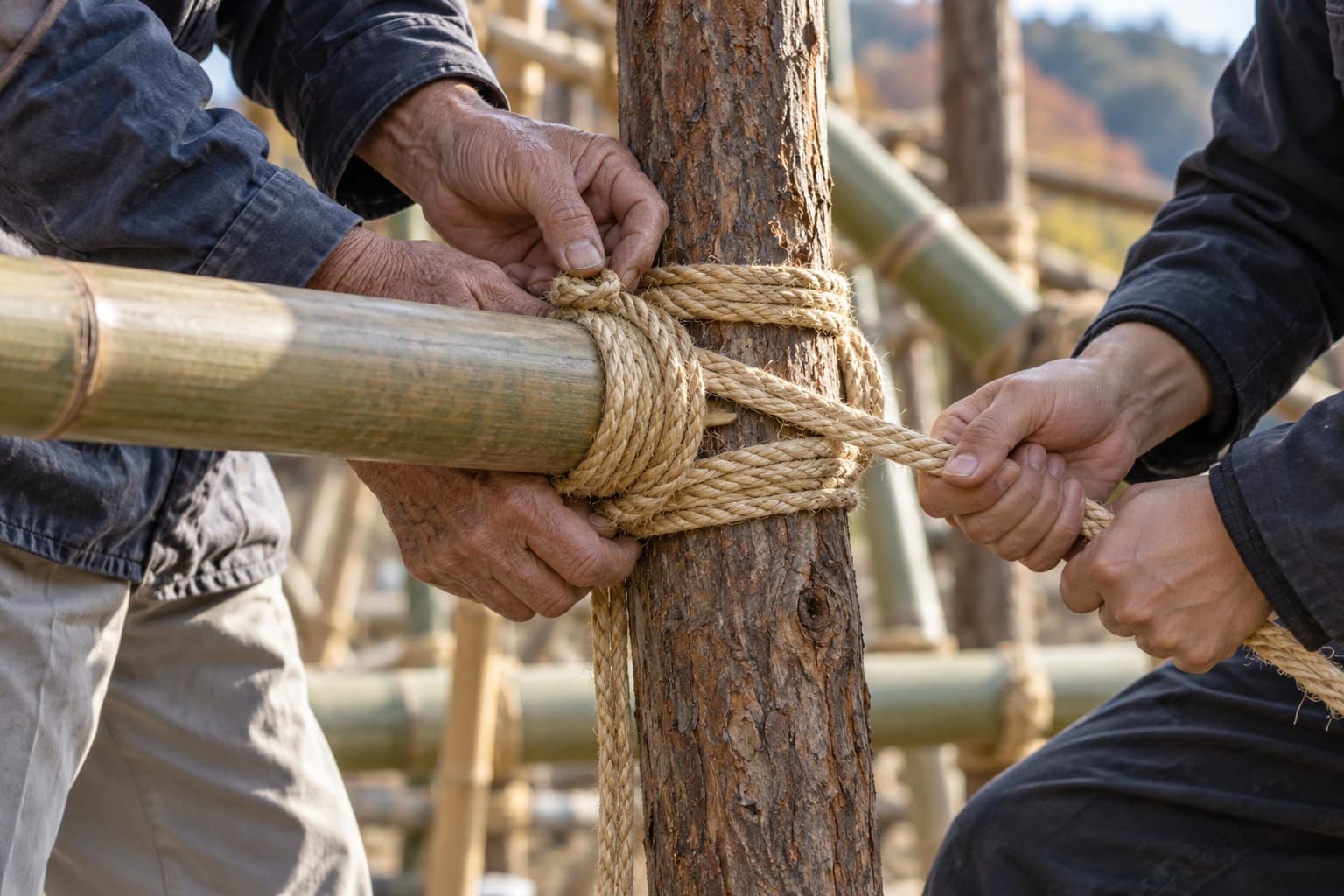
The third feature sits on the audience's side. Residents build a temporary auditorium for major performances. The city's 2019 photographs show timber roof arches, lashed bamboo and partitions made from sericulture baskets. The roof over the spectators is another product of learned decisions about materials and connections. Shibukawa's construction record
Older residents teach younger workers decorative ropework during construction. Transmission becomes visible in a finished binding: the teaching takes place while the venue is being made. 2019 construction photographs and captions
Visiting a working rural stage
The destination is the Kamimiharada kabuki stage, Shibukawa, Gunma. Outside announced performances, apply for a building visit through the Akagi History Museum. Such a visit does not necessarily include a performance or machinery demonstration. Stage location, City visiting information
For background, the Akagi History Museum has a folk-performance exhibition with kabuki and puppet-stage costumes, alongside archaeological and everyday-life collections. It provides another way to place the theatre within the area's wider history. The museum currently opens from 10 a.m. to 4 p.m.; regular closures include Mondays and Tuesdays, with holiday exceptions. Akagi History Museum
During a performance, use the designated audience space and follow the stewards' directions. The machinery is part of a working stage, so watching it does not imply permission to enter below the floor or handle its moving parts. These are practical distinctions for a visitor, not an invitation to seek backstage access. The pleasure of the occasion is available from the audience: once you know what to look for, a change of scene becomes part of the story.
When to go
For 2026, the city has announced performances on Saturday 7 and Sunday 8 November, from 9:30 a.m. until approximately 4 p.m., with free admission. The occasion commemorates the 150th anniversary of the death of the stage's creator. The programme includes kabuki, puppetry and other performing arts; this is a two-day public event, not a promise of daily performances throughout November. Shibukawa, October 2026 bulletin
This is the strongest window for a first visit centred on seeing the stage in use. Within that window, the best arrival time depends on the performances you most want to watch. Consult the city's final programme and any weather-related notices before travelling. The broader customary period is early to mid-November, but that pattern should not replace the dated announcement when planning this year's trip. City event page
Around the visit: a walk on Akagi's western slopes
On a separate morning or another day in Shibukawa, Akagi Nature Park offers a change from the concentration of a performance. Its woodland paths cross three different areas, with bark-covered trails and boardwalks. The park estimates about two hours for a complete circuit, with around 100 metres of elevation difference across the site. Allowing it its own portion of the day is more satisfying than treating it as a quick stop between acts. Akagi Nature Park's visitor map
The same guide asks visitors to remain on paths and rest areas and prohibits collecting plants or animals. There is no restaurant inside, so bring food if needed and eat in the permitted areas. A woodland walk and a rural theatre ask for different kinds of attention, but both repay time spent looking at the materials immediately around you.
Place and region
Shibukawa City, Gunma
Kamimiharada’s kabuki stage is a wooden building in Akagi, a district of Shibukawa City. Its mechanisms are brought to life by their operators, but performances and demonstrations take place irregularly. Check Shibukawa City’s event information before making a special trip.
From Tokyo
By rail, travel to Takasaki and continue on the JR Joetsu Line to Shibukawa Station. By highway bus, Shibukawa City lists services to Shibukawa Station from Tokyo, including the Shima Onsen route from Tokyo Station Yaesu-dori and the Joshu Yumeguri route from Shinjuku and Nerima. The stage is in Akagi, outside central Shibukawa, so arrange the final leg separately and check current transport and event-day access information with the city and operators.
Food of this place
- Mizusawa udon. A firm, smooth noodle associated with Shibukawa City’s Ikaho district and one of the city’s best-known local foods.
- Konnyaku. Shibukawa City highlights konnyaku production, including local handmade products; the crop is also important across Gunma Prefecture.
- Apples. Shibukawa’s local guide notes apple growing across the city and identifies autumn as the harvest season.
- Yaki-manju. Grilled buns brushed with a sweet-salty miso sauce, described by Gunma Prefecture as a widely enjoyed local food.
The marker shows the municipality, not an exact event venue. Map data © OpenStreetMap contributors.
Explore more stories from Gunma