Tochigi ·
Setting a Table for Confucius: Sekiten at Ashikaga Gakko
Offerings, old books and a carefully ordered ceremony reveal how a historic Japanese school remembers its teachers.
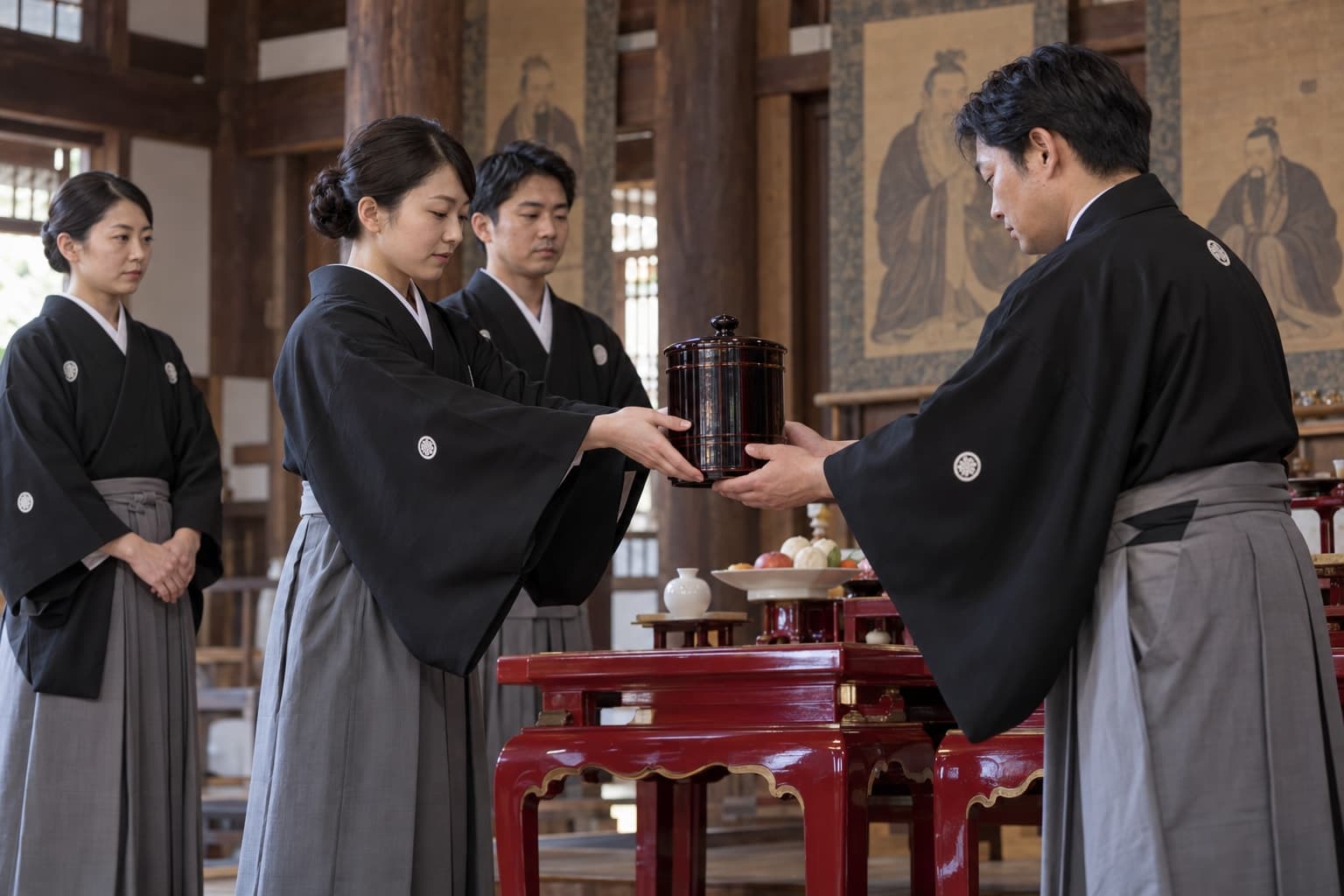
Setting a table for a teacher
In the Confucian hall at Ashikaga Gakko, participants in formal dark robes carry offerings to a table. Rice, vegetables, fish, meat and sake are presented in vessels reserved for the ceremony. A ritual text is read, and those taking part bow before the figures being honoured. The setting is a historic school in Tochigi Prefecture; the principal recipient is Confucius, together with the disciples through whom his teaching was transmitted. Ashikaga's ceremony notice, City photograph of the offerings
The ceremony is called Sekiten. Both characters in its name refer to setting out offerings. That straightforward meaning is a good starting point: the participants give respect a physical form, carrying and placing things rather than only speaking about the importance of learning. The city's account names Confucius, four eminent followers, seventy-two disciples and Ono no Takamura among those honoured. Takamura belongs to one of the traditions about the school's foundation. Ashikaga's explanation of Sekiten
The published order of service makes clear that laying out food is one part of a larger sequence. Participants wash before entering the hall. The rite welcomes those being honoured, proceeds through food and drink offerings, includes incense and the reading of a ceremonial address, and later sends the honoured presences off before the proceedings close. Repeated bows punctuate the sequence. The movement has a beginning and an ending: a prepared encounter, rather than a table of objects left on display. The school's published order of service
It is also an encounter with a particular strand of Japan's intellectual history. A visitor may expect a historic school to explain lessons, teachers and books. Here, an annual ceremony asks them to consider the people to whom learning is owed. The ritual does not deliver a classroom lesson about Confucius. It places him, his followers and the local history of the school in a relationship of acknowledgement.
How Confucius belongs in a Japanese school
Confucianism takes its name from the teachings of Confucius in ancient China and the traditions developed by his successors. In its recent exhibition on the subject, Ashikaga Gakko described how those teachings entered Japanese political and educational life, and how their influence spread through education in the Edo period. This background matters because Sekiten is not simply a local celebration of a famous foreign thinker. It belongs to a history in which Chinese texts became important resources for learning in Japan. Ashikaga Gakko's exhibition account
The school's own beginnings are less certain than its reputation might suggest. The city lists several foundation traditions, including one involving the ninth-century courtier Ono no Takamura. Its better-documented history emerges in the fifteenth century, when Uesugi Norizane supported the school, donated books and brought the Zen monk Kaigen from Kamakura to lead it. Later heads were also Zen monks. Honouring Confucius and studying under Buddhist scholars were parts of the same institution's history, rather than mutually exclusive identities. History of Ashikaga Gakko
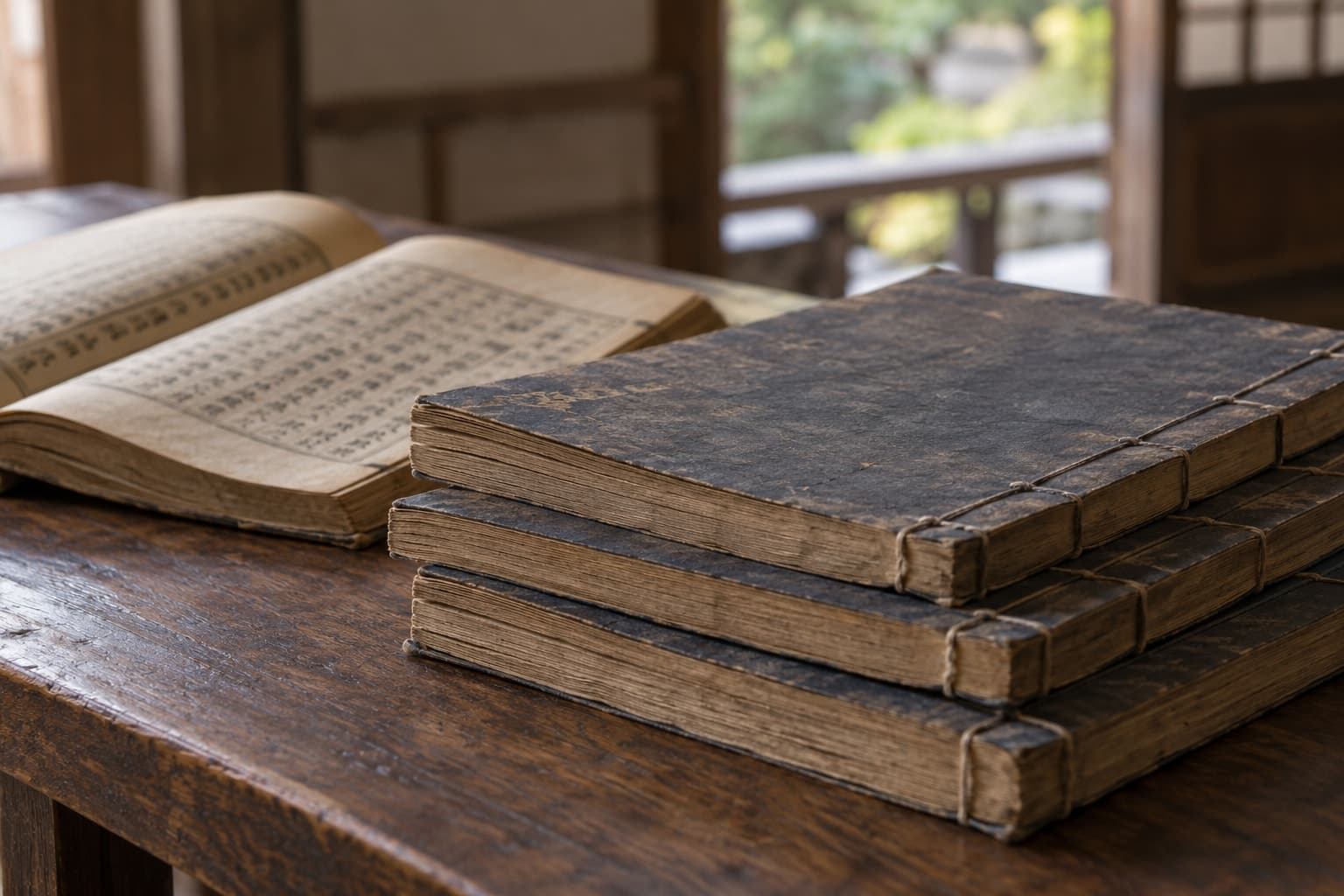
What did people study? The school's account describes Confucian learning, a strong interest in the Yi, or Book of Changes, and, during the age of civil war, military studies. Students worked with Chinese books and copied texts as part of their learning. There was no modern timetable or uniform period of enrolment. Most students were monks; entry conditions changed over time. This was a place with its own rules and forms of study, not a present-day university transported into the past. The school's historical questions and answers
Books make that intellectual connection tangible. Among the school's surviving treasures is a Southern Song edition of the Liji Zhengyi, a commentary on the Book of Rites, donated by Norizane. The city's catalogue describes the underlying classic as addressing conduct and ceremonies, including Sekiten. A book about ritual and the act of carrying out a ritual therefore coexist within the site's inheritance. This does not prove that today's ceremony reproduces every instruction in that volume; it shows why the library and the hall belong in the same story. Ashikaga Gakko's collection catalogue
The present ritual has its own, much later history. The city says the beginning of Sekiten at Ashikaga is uncertain, while the basis of the current order was written by Aiba Tomoatsu in 1907. The ceremony that year took place at the winter solstice. From 1915, the date became 23 November. Keeping those dates separate avoids a misleading picture of an unchanged medieval observance. The inheritance is old; the form in which it is practised today also reflects deliberate decisions made in modern times. History of the school's traditional observances
Vessels, books and the people who carry them
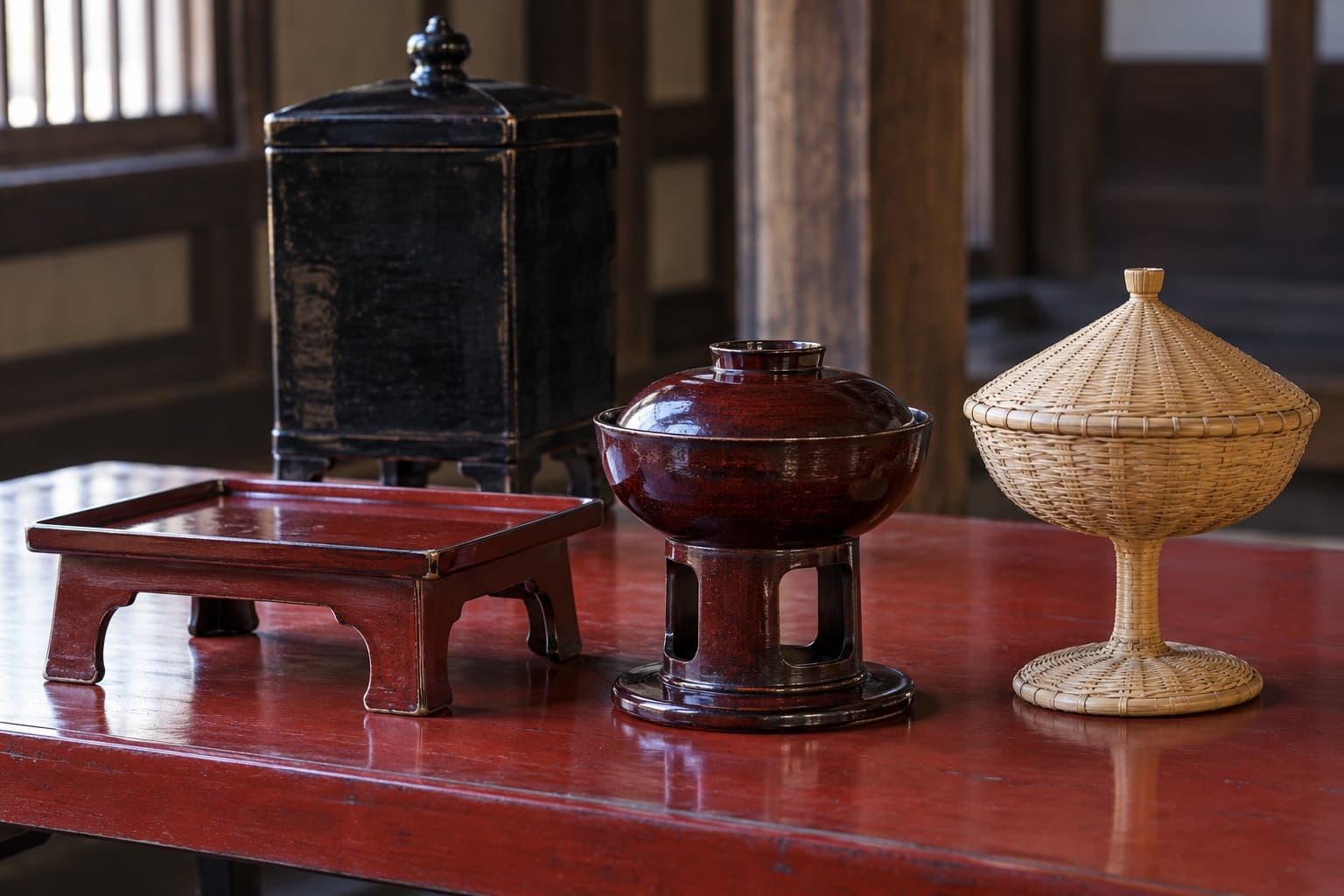
The offering vessels repay close attention because they give different foods different forms of presentation. The city's illustrated guide identifies a low stand for beef or carp, a raised vessel for vegetables, a woven container for sea bream, and separate containers for rice and rice cakes. Sake has its own vessels. The table is organised, not merely abundant: choosing, carrying and placing a particular container helps turn ordinary food into a formal offering. The school's guide to the ritual vessels
These are also historical objects. The city's collection record describes a group of twenty-three implements and twelve hanging scrolls, dating from the Edo and Meiji periods. It associates the implements with the first performance of the current form in 1907, while records concerning the mounting of the images of Confucius's seventy-two disciples go back to 1795. The ceremony brings together materials with different histories; their age is not evidence that every feature of the current service is equally old. The Sekiten collection
The portraits broaden the act of remembrance. Read alongside the offerings to named disciples, they suggest one way to understand the occasion: learning travels through people. The teacher is remembered together with those who carried his teaching onward. Portrait collection
The books offer another kind of continuity. A museum account from Tamagawa University explains that the historic school closed in 1872, and that the buildings reconstructed in 1990 drew on old plans, written records, archaeology and comparisons with surviving architecture. The place a visitor sees is thus partly a carefully researched recovery of an earlier environment. The ritual, the collection and the reconstructed rooms should not be mistaken for three identical forms of survival. Each connects the present to the past differently. Tamagawa University Education Museum
Children now have a route into the ceremony as participants. On 23 September 2025, an exchange involving Ashikaga, Kiryu and Tatebayashi brought children together for a children's Sekiten experience and an accompanying exchange activity. The rite became something they could help perform, as well as something they could learn about. Kiryu City's event record
The distinction between the children's occasion and the November ceremony is worth retaining. They are related opportunities with different arrangements, not two dates for one continuous festival. For children, carrying an offering can introduce the school through a responsibility undertaken with others. For an outside reader, it shows how a formal rite can enter contemporary educational life without needing to become an ordinary classroom lesson.
Visiting the school and the ceremony
The destination is Ashikaga Gakko, in Shōheichō, Ashikaga, Tochigi. Sekiten takes place at its Confucian hall, the Taiseiden. Ordinary admission to the historic site and a place at the ceremony are different arrangements. In 2025, the city required advance applications for public ceremony seats and offered a separate application for the school head's lecture. Those past arrangements establish that public participation can be organised, but they are not the application rules for 2026. The city's 2025 visitor notice
On a normal visit, the ritual implements are usually displayed in the reconstructed kuri building's exhibition room. The hanging portraits of the seventy-two disciples are normally not on public display. Seeing the implements is a useful introduction even when the rite itself is not taking place: their shapes make more sense once you know they have particular jobs at the offering table. Collection display information
There is a significant restriction for this autumn. The city has announced that rethatching of the hōjō is scheduled from 21 August 2026 to 25 March 2027. Its interior and areas including the passage beside the south garden are closed to visitors during the work. This notice concerns the hōjō, a different building from the Taiseiden. Follow the marked routes and keep the ceremony's working space clear. Current site notice
When to go
The customary date is 23 November. For 2026, Tochigi's official tourism listing gives Monday 23 November, starting at 10 a.m. This supplies a current-year date, but the detailed public-seat application procedure is not established by the listing. Check the school's 2026 ceremony notice before making plans specifically to attend the rite. Tochigi's 2026 listing
If the aim is to understand the setting and collections, an ordinary open day allows a less time-specific visit. From October to March, the site accepts admissions from 9 a.m. to 4 p.m. Its usual maintenance closure is the third Wednesday of the month, with a separate annual calendar. Choose the ceremony for the actions; choose a normal visit for time with the place and its objects. Visitor information, Annual closure information
Around the visit: another kind of inheritance
Nearby Bannaji offers a complementary encounter with Ashikaga's history. Associated with the Ashikaga family's former residence, the temple stands within an enclosure of earthworks and a moat. Its main hall is a National Treasure. After a morning considering a school and its teachers, the temple brings the city's warrior-family history into view through a different set of buildings and religious connections. Ashikaga Tourism Association
The grounds are free to enter, while access inside the main hall requires a paid advance reservation. A walk around the precinct and a visit inside a historic building are therefore different choices. Leaving enough time for the grounds makes a straightforward addition to the day without assuming that every important interior is open on arrival.
Place and region
Ashikaga City, Tochigi
Ashikaga lies in southwestern Tochigi Prefecture, where the Watarase River runs through the city between northern mountains and the Kanto Plain. The historic Ashikaga Gakko stands in the older town center, connecting its history of study and ritual with a lived-in urban setting.
From Tokyo
From Tokyo Station, take the Tohoku Shinkansen or Utsunomiya Line to Oyama Station, then change to the JR Ryomo Line for Ashikaga Station. Alternatively, Tobu Railway limited-express services run from Asakusa or Kita-Senju to Ashikagashi Station. Ashikaga Gakko is a short walk from JR Ashikaga Station. Routes and timetables can change; check with the rail operators before traveling.
Food of this place
- Soba. The Ashikaga City Tourism Association lists soba among the area's local dining options.
- Potato yakisoba. Tochigi's tourism site describes this as an Ashikaga food, tracing it to a potato-and-sauce snack that later came to include noodles.
- Strawberries. Strawberries are associated with Tochigi Prefecture, which is known for their production.
The marker shows the municipality, not an exact event venue. Map data © OpenStreetMap contributors.
Explore more stories from Tochigi