Fukushima ·
Kohata’s Banner Festival: A Mountain Journey into Adulthood
In Fukushima, a December procession leads toward mountain shrines—and, for its first-time initiates, through a ritual of rebirth.
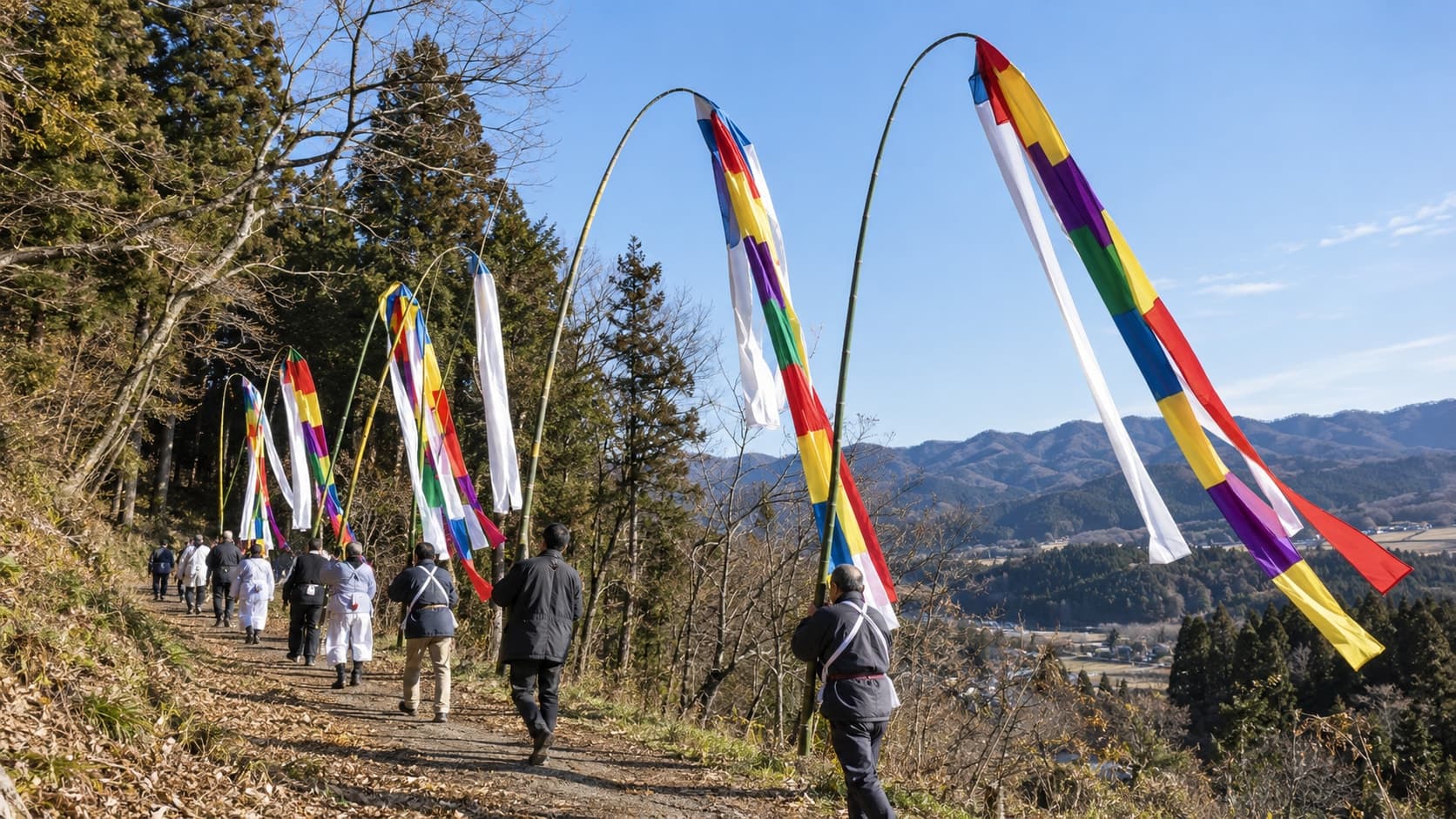
Banners on the way to the mountain
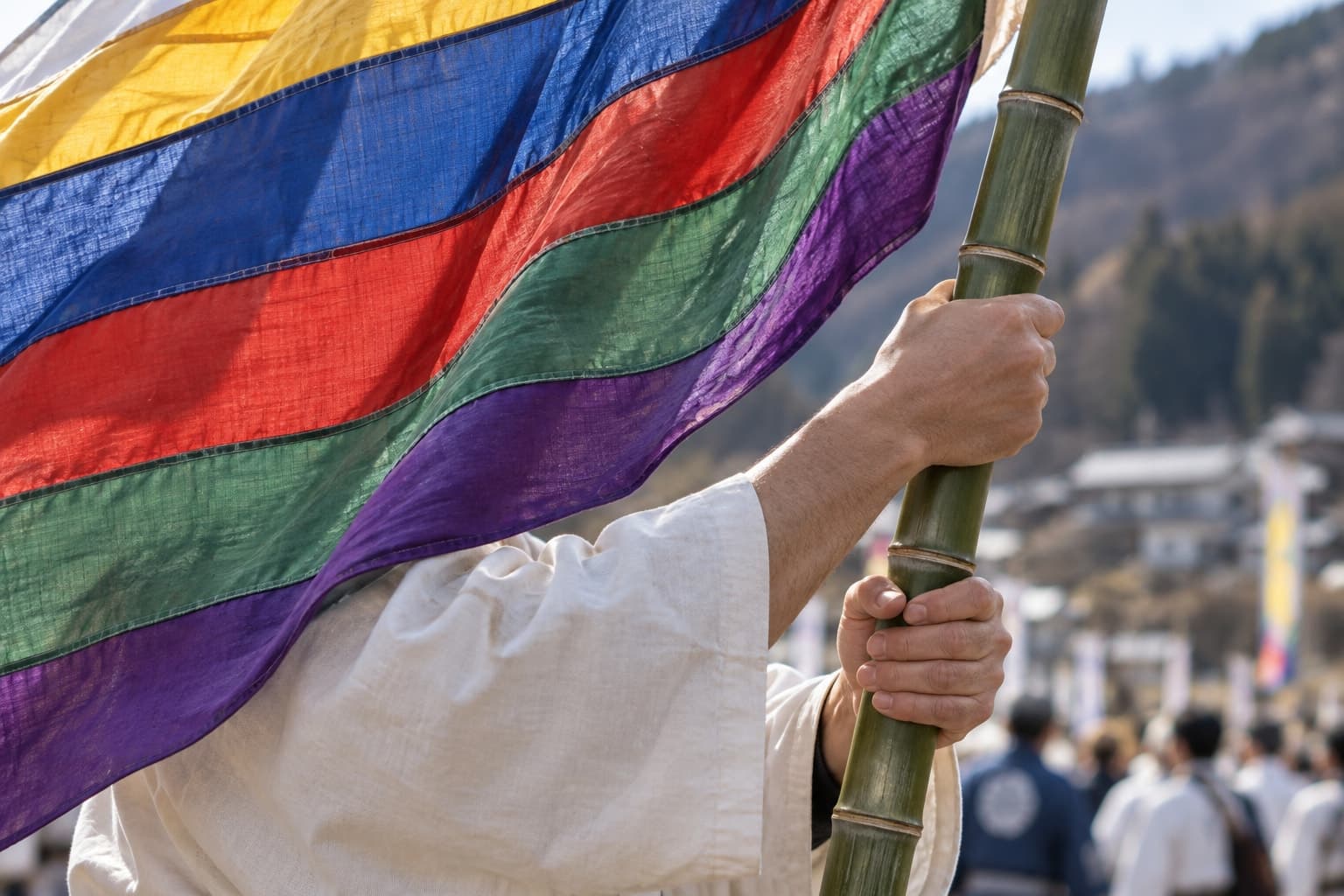
Long strips of coloured cloth hang from bamboo poles, lifting high above the people carrying them. A white banner leads the procession; many-coloured banners follow. In Kohata, part of Nihonmatsu in Fukushima Prefecture, the banner festival takes worshippers along village roads and towards the shrines of Mount Kohata. The city describes a procession of around a hundred banners, accompanied by the sound of a ritual horn. It is a moving pilgrimage rather than a performance on a single stage. Nihonmatsu City
Its Japanese name, Kohata no Hata Matsuri, means Kohata’s banner festival. The national heritage description identifies nine local districts associated with the practice and the shrine communities that sustain it. The banners are carried in worship at Okitsushima and Hayama shrines. Understanding that destination changes the meaning of the procession: the cloth is travelling towards a place of worship, rather than simply decorating a parade. Cultural Heritage Online
Within this collective journey is another, more personal one. Young men making their first ritual participation are known as gondachi. They undertake an initiation involving a passage between rocks, recognition by elders, and ceremonial food. The Fukushima education authority describes the festival as combining the offering of banners with a coming-of-age rite. These are connected parts of the occasion: a community goes to worship, while particular participants enter a new stage within it. Fukushima Prefectural Board of Education
That distinction is worth keeping in mind while following the procession. The banners make the festival visible from a distance. The smaller actions involving the gondachi explain why it is more than an impressive display. Its most revealing movement is not the raising of a pole, but a person passing through a narrow opening in the mountain.
A mountain of worship, a story of white flags
A local origin story takes the festival back to the eleventh century. In the account preserved by the Adachi regional authority, the warriors Minamoto no Yoriyoshi and his son Yoshiie retreat to the mountain during fighting in 1055. After prayer and divine assistance, snow makes the trees appear to bear white banners. Their opponents mistake the landscape for an army and withdraw. The festival’s banners are connected with this deliverance. Adachi regional folktale collection
This is an origin legend, not a securely documented founding date. It nevertheless gives the banners a local narrative: they recall a mountain that sheltered people and a sign that changed their fortunes. It also introduces Yoshiie, whose name returns in the initiation. The story should be read alongside the ritual, without requiring us to believe that every part of today’s festival has continued unchanged since 1055.
The setting has a broader religious history. Mount Kohata rises to 666 metres in the Abukuma uplands. Nihonmatsu’s account describes a landscape associated with Buddhist worship and mountain ascetic traditions, containing shrines, sacred rocks, carved Kannon figures, and other religious remains. The mountain appears in medieval documents. Those records establish a historical religious setting; they do not, by themselves, date the present festival. Nihonmatsu’s guide to Mount Kohata
One surviving structure makes the depth—and the interruptions—of that history tangible. The city traces the mountain’s pagoda to 1472, records repairs in 1674, and explains that a storm in 1902 brought down its upper levels, leaving the first storey. Further repairs followed. The building encountered today is therefore evidence of survival through damage and rebuilding, rather than an untouched medieval scene. Nihonmatsu’s pagoda history
The festival calendar has changed too. Britannica’s Japanese entry records an older date of the eighteenth day of the eleventh lunar month, retained until 1966; the present customary date is the first Sunday in December. National recognition as an Important Intangible Folk Cultural Property followed in 2004. Neither change should be confused with the beginning of the practice itself. Britannica, via Kotobank, Cultural Heritage Online
Recent evidence is more concrete than a heritage label. The city’s photography competition for the 2025 festival received 95 entries and was judged in January 2026. It documents a recent occasion that people attended and photographed, rather than merely repeating an old catalogue description. Nihonmatsu’s 2025 festival photography results
How a first ascent becomes a new beginning
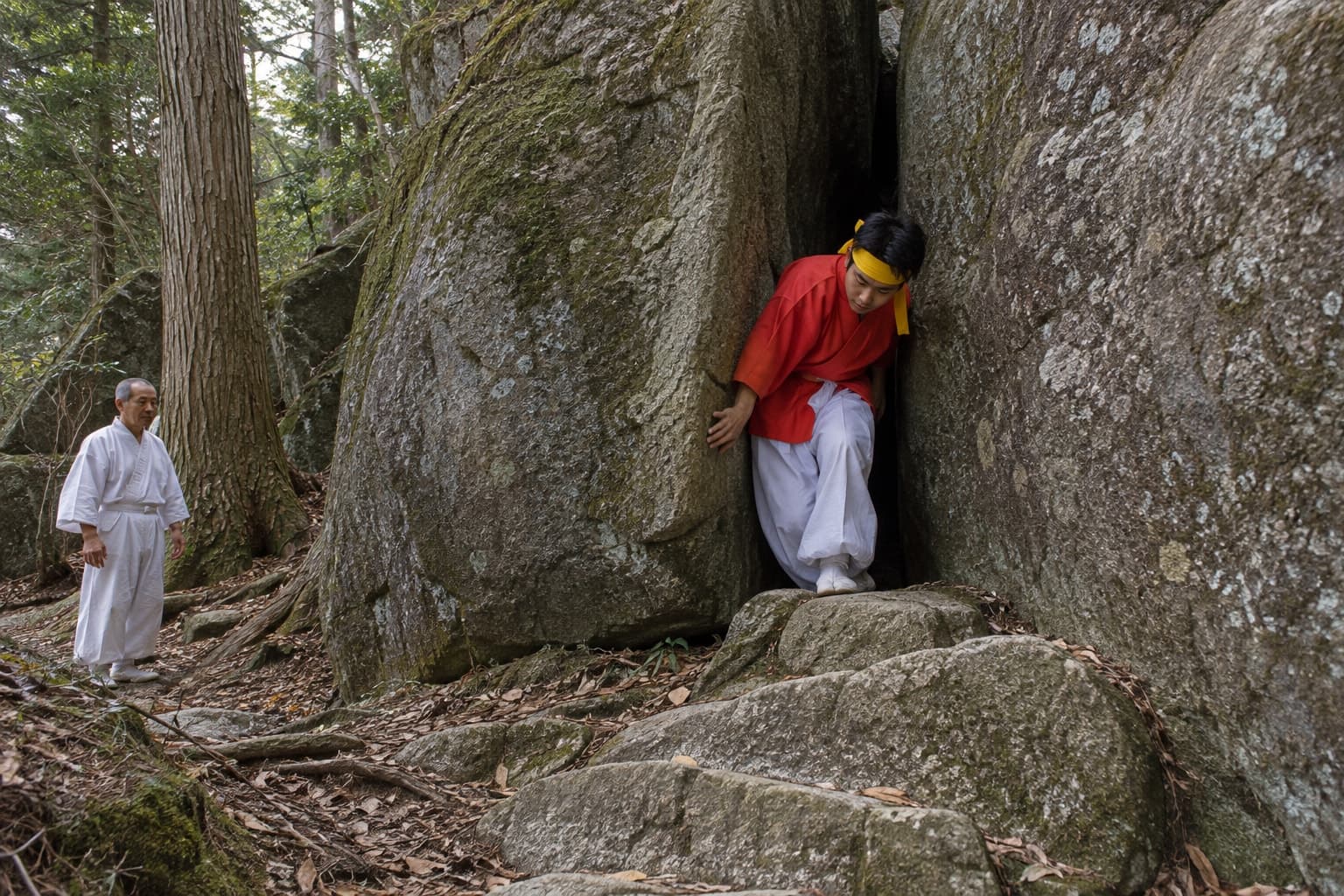
Preparation begins before the banners move. In the city’s account of the preliminary rites, participants gather at their district’s ritual lodging, bringing bedding and provisions. They share food and observe restrictions on meat and fish. Water purification takes place before the festival. This period separates participation from an ordinary morning outing: people prepare together, eat under common rules, and undertake purification before setting out. The account describes inherited practice, rather than a promise that every group follows an identical timetable today. Nihonmatsu’s account of the preparatory rites
The gondachi are recognisable by a different set of objects. The city’s 2025 explanation describes young initiates, commonly aged eighteen to twenty, wearing red under-robes and carrying a wooden sword, with a straw ritual necklace. It explicitly gives the sword a sexual symbolism associated with becoming an adult. These are not simply colourful accessories. The city explains them within the transition the young participants are undergoing. Official festival explanation, 2025
At the rocks, some of that equipment is removed. The initiates take off the sword and necklace before passing individually through a gap described as approximately seventy centimetres wide. This is tainai-kuguri: literally, passing through a womb. A physical passage through the mountain supplies the central action of the rite. Nihonmatsu’s ritual account
Emerging is not the whole transformation. A report by the Japan Festival Network describes an exchange in which elders ask the initiate’s identity. His ordinary name is not the final answer the rite seeks; the exchange leads to the name Hachiman Tarō Yoshiie. The legendary warrior of the mountain’s rescue story thus reappears in a young participant’s ritual identity. The report interprets the passage as rebirth into a new and stronger life. This interpretation belongs to the documented rite; it need not be extended into a claim about the private beliefs of every participant. Japan Festival Network
The significance lies in the relationship between actions. A person goes through a confined space, is addressed by others, and receives recognition through a prescribed exchange. The rite gives the transition a visible form and a social response. Watching only the squeeze between the rocks would miss the conversation that completes its meaning.
Food continues the language of infancy and rebirth. Descriptions record ceremonial red-bean food called “milk.” The city’s recent leaflet notes the use of sekihan, rice with red beans, where older accounts describe porridge. The food is recognisably adult food, but its ritual name places the newly emerged initiate at the beginning of life again. Official festival explanation, 2025, Britannica, via Kotobank
Another revealing detail concerns worship after initiation. The city describes three orientations—back, side, and front—and explains that actions formerly spread across three years are now performed together. This is a specific change in the form of the practice. Its account preserves both the older sequence and the present arrangement, allowing us to see continuity that includes adaptation. Official festival explanation, 2025
These details give the banners a different context. The procession carries a collective offering uphill; the initiation gives certain first-time participants a sequence through which to become adults. The public journey and the intimate ritual illuminate each other without becoming the same thing.
Visiting the procession
For an ordinary visitor, the procession offers the clearest public encounter. The city’s most recent published route starts at the Kohata Residents’ Centre ground and continues towards the mountain. Its map distinguishes the main procession from the gondachi route and marks viewing locations, parking arrangements, and road restrictions. Treat it as a festival that moves through a working landscape: seeing the start does not mean that every later rite happens beside the same road. Official route map, 2025
Plan a manageable part of the route instead of assuming that you can follow every movement. The map’s separate routes are especially relevant to anyone hoping to see the initiation. A public festival is not an invitation to enter whichever narrow path offers the closest view. Follow the event’s marked arrangements and instructions on the day; keep access clear for participants carrying the tall poles.
For people interested in carrying a banner, a tour operator has advertised an organised participation programme for 2026. That is a booked arrangement, not evidence that casual visitors can join every ritual. Its description also makes the physical demands explicit: an uphill journey of roughly five kilometres, with mountain paths. It recommends warm clothing, gloves, and footwear suitable for wet or snowy conditions. Use that as practical preparation for an early-winter outdoor visit, not as a forecast for the day. Autabi’s 2026 programme
When to go
The customary first Sunday in December falls on 6 December in 2026. The preceding day, 5 December, is relevant to preparations and purification. Autabi is advertising a programme across those two dates, so there is already a published 2026 visitor offering. However, the city festival page reviewed for this article still gives the 2025 arrangements. A tour programme and the organiser’s final public timetable are different kinds of information. Autabi, Nihonmatsu City
For the procession, plan around the morning rather than a late-afternoon arrival. In 2025, the opening gathering was at eight and the procession departed at eight-thirty; those are useful indications of the occasion’s rhythm, not confirmed 2026 start times. Before committing travel arrangements, check the city or organiser for the final 2026 timetable, route, and transport notices.
Around the visit: Towa’s farming landscape
For a complementary stop in the same wider area, consider Michi-no-Eki Fukushima Towa, a roadside station selling local produce and foods. Nihonmatsu’s introduction highlights mulberry products and their connection with the area’s history of silk farming. They offer another way to understand the locality: alongside the mountain’s ritual history is a countryside shaped by crops, work, and changing uses for familiar plants. Nihonmatsu’s local market guide
The station’s own information presents it as a place connecting local producers, food, and visitors. Its restaurants operate on daytime hours, so it is better considered as a lunch or shopping stop than assumed to be an evening meal after a long festival day. A modest visit here fits the scale of the journey: time with the banners, time on the mountain, and time with something grown in the surrounding countryside. Michi-no-Eki Fukushima Towa
Place and region
Nihonmatsu, Fukushima
Kohata is in the eastern uplands of Nihonmatsu. The Kohata Banner Festival procession travels along village roads toward the shrines on Mount Kohata, making the route a journey to a place of worship.
From Tokyo
By rail, take the Tōhoku Shinkansen from Tokyo Station to Kōriyama, then transfer to the JR Tōhoku Line for Nihonmatsu Station; Nihonmatsu City lists the journey at about two hours. Alternatively, the Abukuma highway bus connects Busta Shinjuku with the Nihonmatsu bus stop. From Nihonmatsu Station or the bus stop, arrange onward transport to Kohata. Check current rail and bus schedules and local transport options before traveling.
Food of this place
- Zakuzaku. A Nihonmatsu soup of diced vegetables such as taro, carrot, burdock, konjac and daikon, simmered in broth and seasoned with soy sauce. Japan’s agriculture ministry notes that it is served at the Kohata Banner Festival, though availability to visitors in 2026 is not confirmed.
- Tamayōkan. A round yokan—a sweet bean jelly—associated with Nihonmatsu confectioner Tamashimaya.
The marker shows the municipality, not an exact event venue. Map data © OpenStreetMap contributors.
Explore more stories from FukushimaSources and current information
- Nihonmatsu City
- Cultural Heritage Online
- Fukushima Prefectural Board of Education
- Adachi regional folktale collection
- Nihonmatsu’s guide to Mount Kohata
- Nihonmatsu’s pagoda history
- Britannica, via Kotobank
- Nihonmatsu’s 2025 festival photography results
- Nihonmatsu’s ritual account
- Official festival explanation, 2025
- Japan Festival Network
- Official route map, 2025
- Autabi
- Nihonmatsu’s local market guide
- Michi-no-Eki Fukushima Towa