Akita ·
Horowa’s Shimotsuki Kagura: A Night of Water, Dance and Divine Speech
In rural Akita, an overnight gathering of priests and miko gives thanks for the harvest through hot-water rites, an oracle and the mountain-god dance.
A night organised around water
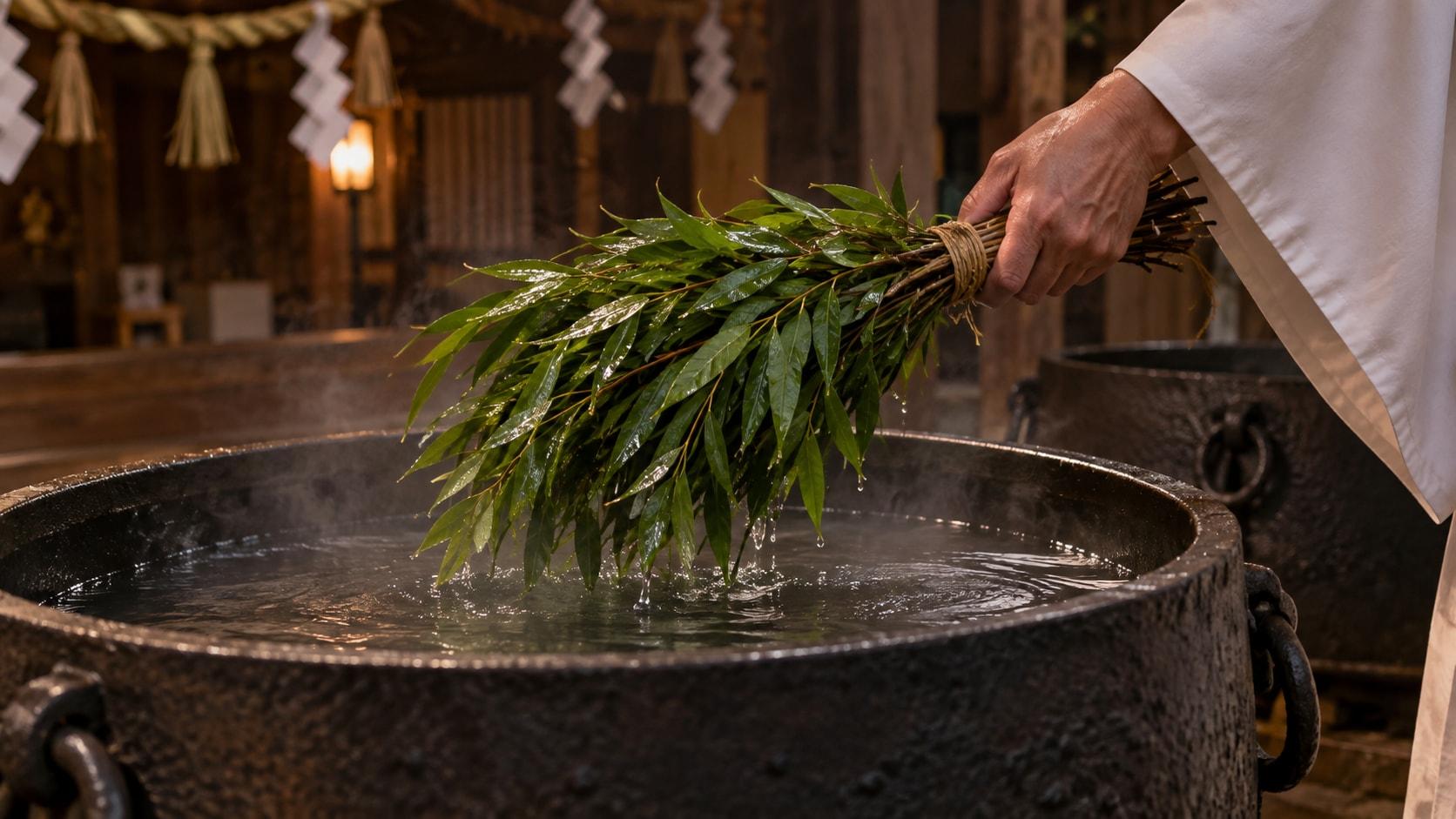
Inside the village shrine hall at the foot of Mount Horowa, two cauldrons stand near the altar. Above them, sacred ropes and cut-paper ornaments mark out the ritual space. Priests and female ritual specialists called miko take turns performing a succession of dances and ceremonies. In one part of the night, bamboo-leaf bundles are dipped into hot water and used to scatter droplets towards the worshippers.
This is Horowa’s Shimotsuki Kagura, held in the Omori district of Yokote, Akita Prefecture. Its setting is intimate: the hall of the Otomo priestly household, which also serves as a place to worship the mountain’s shrine from below. Nearby priests and miko come together there to carry out the observance. The Akita Folk Performing Arts Archives describes a sequence that begins with purification, moves through dances and hot-water rites, and eventually sends the invited deities home.
Before the main dances, the gods are summoned and prayers are recited. The national heritage record identifies three mountain deities among those invited: Horowa, Mitake and Takaoka. The two cauldrons therefore belong to an encounter between a gathering of people and a gathering of gods. They are integral to the ceremony, rather than equipment added to make a performance more dramatic.
As the night unfolds, different kinds of action follow one another. The archive records the mountain-god dance after midnight, then further dances and water ceremonies towards dawn. Offerings, the sharing of food and the departure of the gods lead into a final celebratory sequence. A visitor who sees only one dance is seeing one episode within this longer progression.
Shimotsuki is the traditional name for the eleventh month; kagura refers here to performance offered to the gods. Yokote City describes the purpose in agricultural terms: gratitude for the year’s harvest and prayers for abundant crops in the year ahead. That double orientation—looking back at what has been received and forward to what will be needed—gives the long night its place in the year. Yokote City’s introduction presents the dances as parts of this act of worship.
A mountain shrine, a gathering of ritual specialists
Horowa’s kagura belongs to a religious landscape that extends beyond the room where it is performed. Haushiwake Shrine’s main sanctuary is on Mount Horowa. Akita Prefecture’s account of the shrine places it at the mountain’s 438-metre summit and records a founding tradition dating to 757. It also describes places on the approach associated with earlier pilgrimage and worship. The mountain is thus more than a backdrop to the November observance: it is the location of the shrine to which the village hall is connected.
In a 2019 lecture at the Tohoku History Museum, Nobuo Sasahara relates the shrine’s account of inviting Zao Gongen from Yoshino’s Kinpusen in 757. The account concerns the shrine’s foundation. It does not establish when the present kagura sequence took shape.
Sasahara also records a change of calendar: the observance once fell on the seventh and eighth days of the old eleventh month. It now uses November 7 and 8 in the modern calendar.
Another useful term is yoriai kagura: kagura performed by a gathering of ritual specialists. Akita Prefecture’s introduction emphasises this form, in which priests from neighbouring places assemble at the presiding priest’s hall. It also places the tradition in the Ise-related family of hot-water kagura. These descriptions explain different things. One tells us who comes together to perform; the other identifies a ritual lineage centred on the preparation and use of hot water.
National recognition came in 1977, when the kagura was designated an Important Intangible Folk Cultural Property. The designation is a modern milestone in its recognition, not an origin date. The heritage record particularly notes the scale and organisation of its hot-water kagura form.
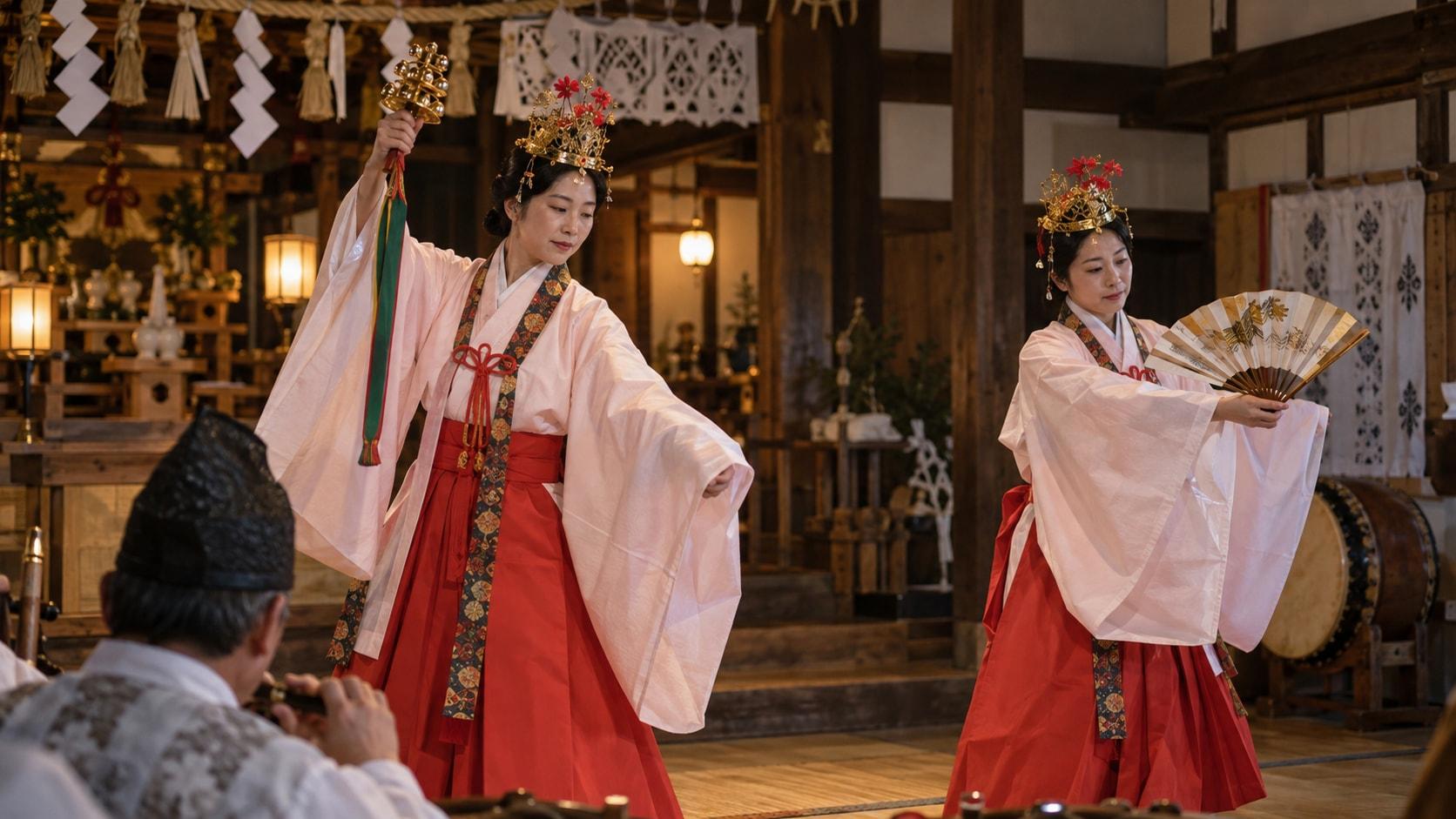
The observance continues to bring performers and worshippers together. Yokote’s December 2023 city newsletter reports that the ceremonies took place from the evening of November 7 into the morning of November 8, with worshippers watching the Horowa and mountain-god dances among the 33 rites. Its photographs show the contrasting costumes of the performers: a priest in a broad-sleeved patterned robe, and a miko in red ceremonial clothing with an elaborate headdress.
Water, a speaking voice and the mountain god
Three details make this kagura especially rewarding to understand. Each changes what a viewer is looking at: water becomes an instrument of purification, a dancer becomes the bearer of a divine message, and a vigorous dance gives form to the mountain god.
The first is yukaji, purification involving hot water. The Japan Arts Council’s account places it at the centre of the 33-part observance. For a newcomer, this is a useful corrective to thinking of the night simply as a programme of separate dances. The preparation and ritual use of water belong to the action that the dancing helps carry forward.
The implements make the process tangible. A yuboki, literally a hot-water broom, is a bundle of bamboo leaves. Dipped into the cauldron, it carries water out towards those gathered around the rite. The repeated appearances of yukaji in the archive’s sequence show that purification recurs throughout the proceedings; it is not confined to a brief opening gesture.
Sasahara’s museum lecture helps explain why the repertoire contains several named dances. It associates them with different recipients of the rites, including the heavenly deity, Ise, the three mountains and the hearth deity. The changing names are therefore more than titles on a programme: they identify different divine presences addressed during the night.
The second detail is the miko’s voice. During the Horowa dance, she delivers a takusen, an utterance understood within the ritual as the words of a god. Yokote’s description singles out this moment. To describe the miko only as a dancer would miss what she is doing: movement leads into speech that has a particular religious status.
Here, the divine message occurs within a named dance in the collective observance. The moment gives the miko a role that extends beyond offering movement to the gods: she also gives voice to words received as theirs. Understanding that shift helps explain why the spoken part belongs within the dance, rather than being a separate announcement.
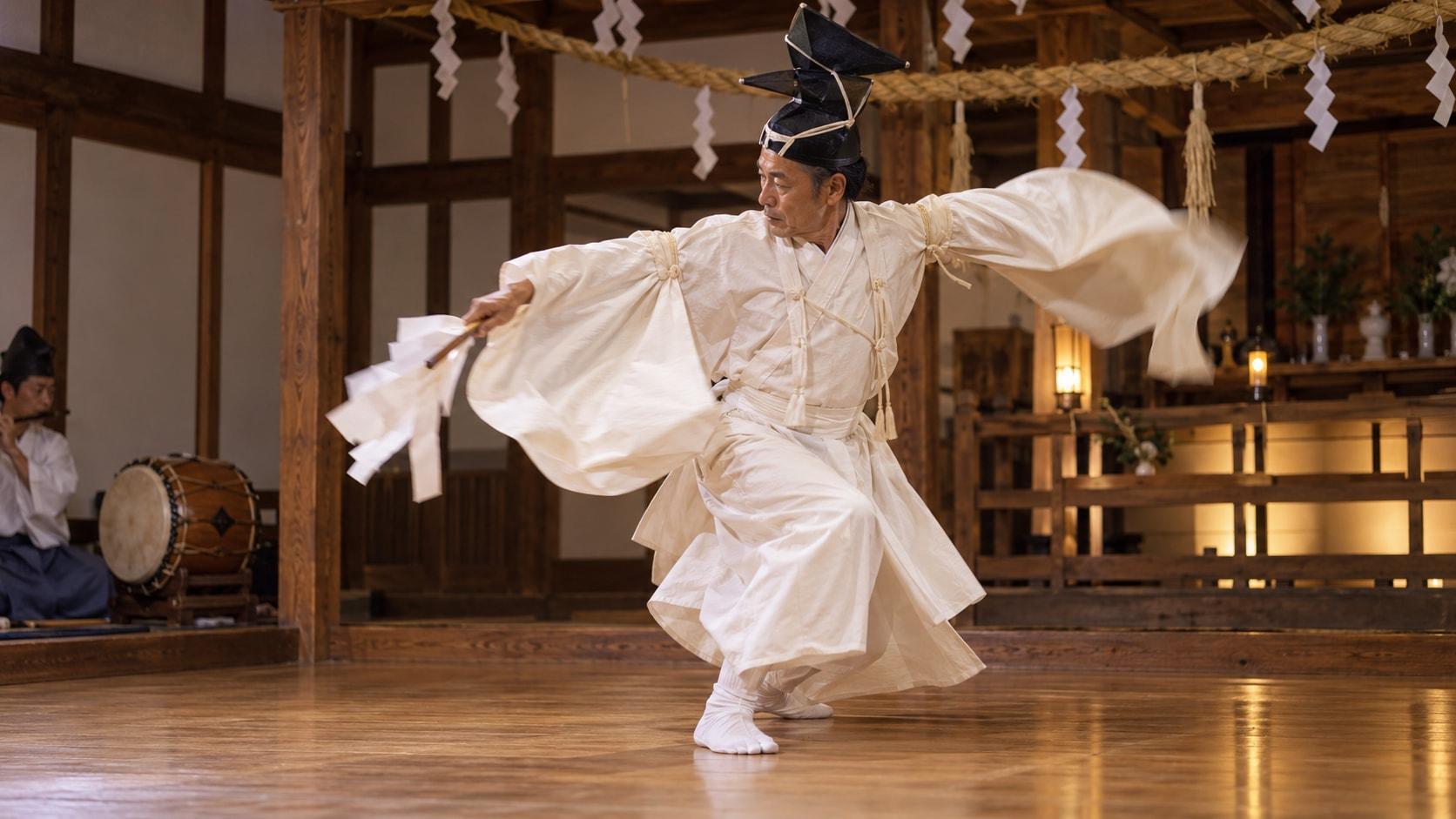
The third detail is the Yama-no-kami dance, the dance of the mountain god. The Arts Council describes the performer’s bird-shaped torikabuto headdress and forceful movements, and identifies the dance as especially important. Its physical character differs from the image of kagura as uniformly slow and restrained.
In its report of a 2018 visit, the Japan Festival Network described the dancer in a white robe with the sleeves secured by cords, moving vigorously. The writer connected the figure with the god who descends from the mountain in spring, brings benefit to the cultivated land and returns in autumn. The report offers an agricultural reading of the dance: the mountain god belongs to the same seasonal relationship between land, crops and divine assistance that the harvest prayers address.
Taken together, these details give a viewer something more precise to follow than costume or spectacle alone. Watch what is carried, who is being addressed, and when a performer changes from movement to speech. The differences between those actions are where much of the ceremony’s meaning becomes legible.
Visiting the village shrine hall
The public can attend the annual observance at Haushiwake Shrine’s Satomiya, the village shrine hall at 200 Kinonesaka, Yasawagi, Omori, Yokote. The destination is the 里宮, not the separately named 神楽殿. This distinction is important when identifying the venue.
Yokote City’s visitor guidance says admission is free, although an offering in an envelope, called hatsuho, is customary. Attendance may be restricted when crowding is expected.
Photography is permitted from designated positions without disturbing others. There is no provision for charging devices. Bring warm clothing even though the hall has stoves, and plan food and rest beforehand: the city notes that there are no shops nearby and no dedicated area for visitors to rest or eat.
The hall is away from bus routes. Arrange transport for the time you intend to leave, particularly if staying late into the night. The opportunity here is to attend the announced shrine observance; the association with a priestly household does not imply access to private living areas.
When to go for the overnight observance
The customary window is November 7 at 7 p.m. through approximately 8 a.m. on November 8, with breaks. These are Japanese local times. For an autumn 2026 trip, the corresponding dates are Saturday, November 7, to Sunday, November 8.
This is the recurring timetable published by Yokote City, not a separately confirmed announcement for the 2026 edition. Before committing to travel, consult the city’s event page or the shrine for the final arrangements.
If you want to understand the progression, arrival near the beginning offers more context than coming only for a single anticipated highlight. The documented sequence places the mountain-god dance after midnight and the later hot-water rites towards dawn, but it should not be treated as a minute-by-minute timetable.
Choose the portion of the night you can attend comfortably. An evening visit and an overnight stay offer different encounters with the same observance; neither is equivalent to a daytime demonstration of the whole sequence.
Around the visit: a daytime view of Omori
For daylight before the kagura, Omori Park offers a different way to see the surrounding area. It occupies a former castle site, and Yokote’s park guide describes views from the former main enclosure across Ogachi, Hiraka and Senboku. The site became a park in 1901, when cherry trees were planted to mark the establishment of the old town. November is not its cherry-blossom season; the reason to include it on this trip is the elevated view and the opportunity to spend part of the day outside.
Sakuraso, also in the Omori district, provides another practical option for the daytime portion of a visit. The city-run facility’s page describes hot-spring bathing, accommodation and views towards the Yokote Basin and the Ou Mountains. Day-use bathing is currently listed from 6–8 a.m. and 10 a.m.–9 p.m., with the intervening period reserved for cleaning.
A bath and a room are separate arrangements from attendance at the kagura. Planning the daytime visit, rest and overnight transport together will make it easier to give the ceremony the unhurried attention its long sequence deserves.
Place and region
Yokote City, Akita
Yokote lies in southeastern Akita Prefecture, in the agricultural Yokote Basin, where winter snow shapes seasonal life and local foodways. Horowa’s Shimotsuki Kagura is held in the Ōmori district; the ceremony links the village hall with the mountain sanctuary of Mount Horowa.
From Tokyo
By rail, take the Akita Shinkansen from Tokyo Station to Ōmagari, then change to the JR Ōu Main Line for Yokote Station. Yokote City lists the journey at about three hours and 40 minutes, including connections. Alternatively, fly from Haneda Airport to Akita Airport, then take a limousine bus to Akita Station and the JR Ōu Main Line to Yokote; the city also lists a road connection from the airport. Yokote City lists the Lake & Port highway bus between Tokyo and Yokote as a date-limited service. The kagura venue is in Ōmori, not at Yokote Station, so arrange the local journey separately and confirm current transport and access before traveling.
Food of this place
- Yokote yakisoba. Yokote’s local style of fried noodles is commonly served with a soft-fried egg and fukujinzuke pickles.
- Iburigakko. A smoked, fermented daikon pickle associated with Yokote. The city notes that the smoking process is especially visible in the Yamauchi area in November and December.
- Yokote apples. Apples are among the city’s agricultural products, grown in a basin with a strong seasonal climate.
- Imonoko-jiru. A taro-based stew listed among Yokote’s local foods.
The marker shows the municipality, not an exact event venue. Map data © OpenStreetMap contributors.
Explore more stories from Akita