Akita ·
Odate Magewappa: A Cedar Board Becomes a Lunch Box
In northern Akita, grain, hot water and cherry-bark stitches shape a container made for everyday use.
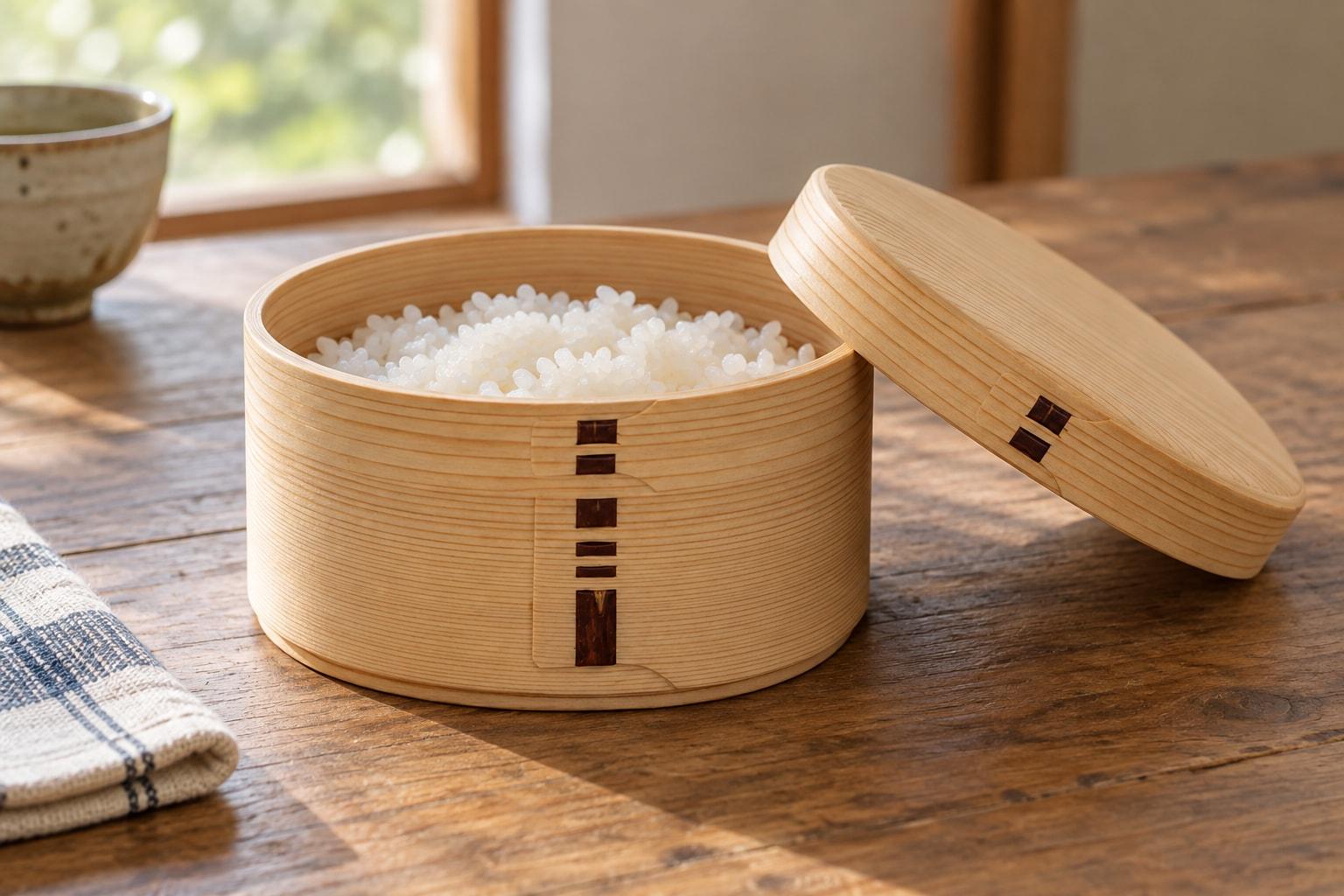
A lunch box made by bending a board
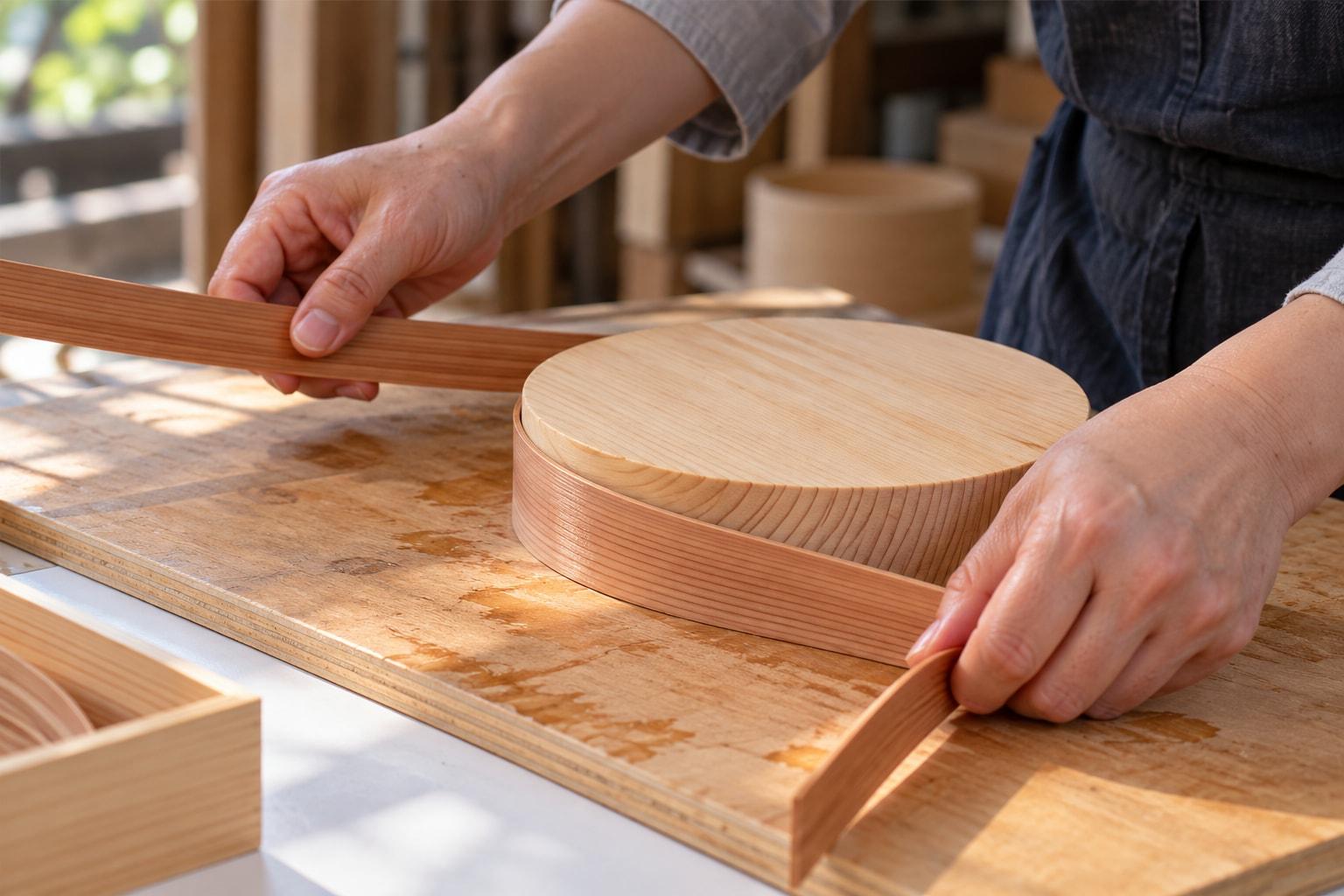
A maker softens a thin strip of cedar in hot water, draws it around a former and holds the resulting curve in place to dry. The overlapping ends are joined; dark strips of cherry bark pass through the seam. A separate wooden base fits inside the curved wall. What began as a flat board has become a container, with the grain still running visibly around its sides.
This is the central transformation in Odate magewappa, the bentwood craft of Odate in northern Akita Prefecture. Its familiar forms include round and oval lunch boxes, but the same family of techniques also makes trays and rice containers. The object is assembled from shaped parts rather than hollowed out of a solid block. Understanding that distinction helps explain both its lightness and the care devoted to the joint. Akita Prefecture's craft introduction
The name brings together the place and the making: mage refers to bending, while wappa names the bentwood container. The curve is an achievement of preparation as much as force. A board must be selected, cut and thinned before it can take the shape the maker intends.
Odate Kogeisha's account of its workshop describes tapering the ends so that the overlap sits neatly. After bending and drying, the joint is glued and laced with wild-cherry bark. The base is fitted, edges are eased and surfaces finished. The company explains that, in its present products, the bark stitching has a stronger decorative role than it once did: adhesive also secures the joint. A visible mark of handwork can retain its place while its practical role changes. Odate Kogeisha's production account, published May 2024
There is no need to imagine the box in a museum to understand its purpose. It is made to be opened, filled, carried and washed. Its cultural interest lies partly in how much knowledge can be contained in such an ordinary sequence.
A woodland craft with changing customers
The local cooperative tells an origin story of woodcutters making containers from straight-grained cedar. It places the development of production in the period when the Satake western branch governed Odate and encouraged warriors to make bentwood as supplementary work. Its account also describes logs being brought from the mountains and finished goods travelling to Sakata, Niigata and the Kanto region. These are different scales of history: an account of how a useful object began, followed by a regional industry supplying customers elsewhere. Odate Magewappa Cooperative
The cooperative records later disruption as plastic products spread and makers moved into other occupations. That history gives today's carefully presented lunch box a less inevitable background. Wooden containers did not simply remain everybody's default choice. They had to find a place among other ways of storing and carrying food.
Nor does present production depend on repeating every earlier arrangement. Akita Prefecture describes new forms, including coffee cups, alongside lunch boxes and trays. The useful qualities it identifies—lightness, insulation, fragrance and the handling of moisture—can be applied to different objects. A new use can preserve the work of bending without reproducing an old vessel exactly. Akita Prefecture
The source of the wood has changed too. Shibata Yoshinobu Shoten explains that after the end of felling natural Akita cedar in 2013, it began obtaining old natural cedar from neighbouring Aomori and Iwate as well. Its Akita material can include earlier stocks and wind-fallen trees. This is the firm's own sourcing account, not a statement that every Odate maker uses an identical supply. It complicates the appealing idea that a regional craft is always made from trees growing immediately beside the workshop. Shibata Yoshinobu Shoten on its wood
Continuity is visible in contemporary use as well as sales. In July 2026 the cooperative reported donating trays and small towel holders for use by Odate's city council. It also advertised the year's craftsperson examinations. These modest records show work being made, used and assessed in the present, beyond the older histories attached to the craft. Cooperative news
Reading the grain, the seam and the finish
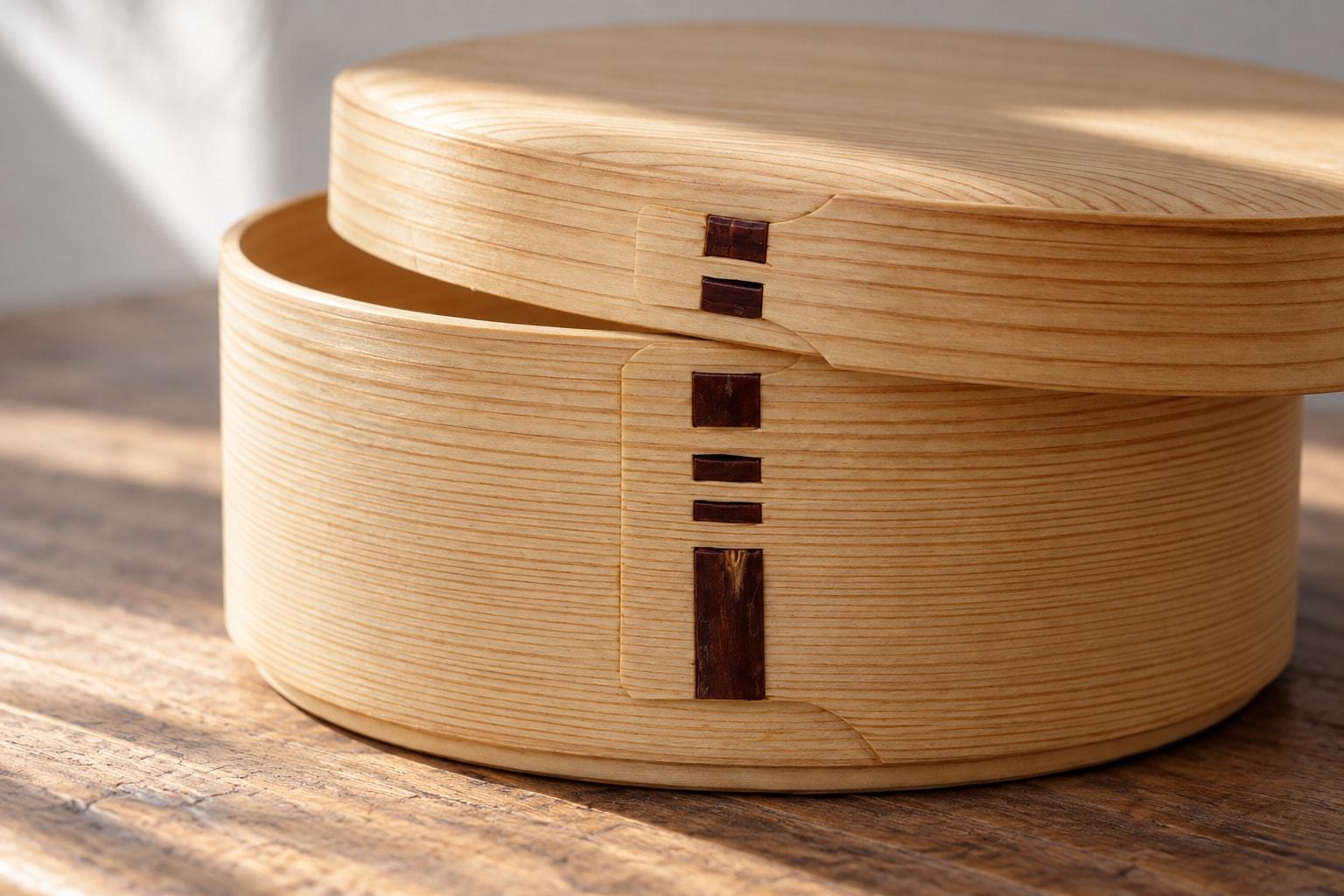
Start with the grain. The craft's technical specification calls for straight-grained cedar boards for the bent walls. In the association's process description, the ends are shaved thin before the board is softened and curved. The smooth outline of a finished box therefore depends on choices that are easy to miss once it has been assembled. Its surface is not a decorative wood pattern applied to another material; the material that supplies the appearance also has to survive being bent. Association for the Promotion of Traditional Craft Industries
Then look at the dark lacing. The term kaba-nui can be misleading to anyone who associates kaba only with birch. The specification identifies the bark used here as cherry. Against pale cedar, the small dark rectangles make the join legible rather than hiding it. You can follow the wall around the container and see where the strip meets itself. This is a good place to notice construction before judging ornament.
Finally, ask about the finish. The pale appearance of a box does not by itself establish that its wood is uncoated. Odate Kogeisha describes using urethane on its lunch boxes to improve resistance to oil and dirt, while leaving products such as some rice containers in plain wood. Its explanation acknowledges a trade-off: coating reduces the moisture-handling effect of uncoated cedar while making cleaning easier. The maker's finishing account
Shibata's plain-wood approach places more emphasis on the material remaining exposed. The company connects its choice of dense-grained cedar and the thickness of its components with how the object will be used and cleaned. These are working decisions, not simply two competing appearances. A maker's care instructions belong to the particular finish and construction of the piece; there is no single rule that can safely be inferred from the word magewappa. Shibata's material explanation
There is also a useful way to broaden the comparison. Shibata's collection of bentwood objects includes Japanese containers and examples from other countries, with different woods and ways of joining them. It describes these surviving objects as teachers for its founder's own work. Odate's achievement becomes more interesting when placed within this wider problem of making a container from thin wood, rather than being presented as an inexplicable technique found nowhere else. World Magemono Museum
Visiting the makers in Odate
Two public workshop settings offer different introductions. At Shibata Yoshinobu Shoten's Wappa Building Store, a prepared kit lets participants try bending, cherry-bark lacing, fitting the base and sanding. The experience uses real woodworking tools, but it is a guided encounter with selected stages, not a promise to turn a log into a completed box in one session. The maker asks visitors to wear clothing suitable for work; an apron is useful. Workshop information
Odate Kogeisha combines a factory visit with an instructed making session. Its own page notes that the operations visible depend on that day's work. This makes a factory visit different from a demonstration arranged to show every stage in order. Book the public programme rather than assuming that an operating workshop can receive unannounced visitors. Odate Kogeisha's studio programme
The Wappa Building also houses the bentwood collection mentioned above. Looking at an older container before handling a new one can make the relationship between shape and use much clearer. A lid, a broad base or a carefully placed seam becomes an answer to a practical problem, rather than a detail included only for visual effect.
When to go
Magewappa has no single public festival day on which the craft becomes visible. For a making visit, the important calendar is the workshop's. Shibata currently describes sessions on eligible weekdays and the fourth Saturday, excluding its Tuesday closure and other listed exceptions. It recommends arranging a place roughly two weeks to a month ahead.
Odate Kogeisha publishes individual workshop dates rather than offering every day. For an autumn trip, secure a session first and build the rest of the visit around it. Confirm the current date, activity and booking arrangements with the chosen maker through the linked workshop page; neither a shop being open nor a general craft listing guarantees a place at a workbench.
Around the visit: Odate's Akita dogs
Akita Inu no Sato provides a separate introduction to another part of Odate's identity. Its museum explains the breed's background, while a distinct viewing area presents dogs belonging to members of the preservation society. The city's information makes an important distinction: this is viewing through glass, not a petting activity. Odate City's visitor information
The museum and dog-viewing area do not have identical calendars. The dog room normally closes on Mondays, moving the closure to the next weekday when Monday is a holiday; the wider facility has its own opening arrangements. This is worth accounting for when combining a craft booking with a visit there. Both places reward attention to what is actually offered on the day, rather than treating a regional name as a promise of an encounter.
Place and region
Odate City, Akita
Odate lies in a northern inland basin surrounded by forested mountains. Rivers run through the basin toward the Yoneshiro River, while flatter land has supported settlements and rice fields. The Odate Magewappa Cooperative recounts an origin for the local bentwood craft in which woodcutters made containers from straight-grained cedar. Cedar work remains part of the craft’s story, although makers may now source wood from beyond the prefecture.
From Tokyo
From Tokyo Station, take the Akita Shinkansen toward Akita and connect to JR’s Ōu Main Line for Odate. Alternatively, take the Shinkansen to Morioka and continue by highway bus. Flights from Tokyo Haneda Airport to Odate-Noshiro Airport are another option, followed by a limousine bus or car to Odate. A night-bus route is also listed from Ikebukuro and Omiya. Confirm current schedules and connections with the relevant rail, bus, airport, or airline operators before travel.
Food of this place
- Kiritanpo. An Odate-associated dish made from pounded rice, often served in a hot pot. The city connects it with forest workers and notes that it is also served to welcome guests and on ceremonial occasions.
- Hinai-jidori chicken. Associated with Odate’s kiritanpo hot pot; the city’s recipe uses the chicken in both the soup stock and the dish.
- Iburigakko. A smoked daikon pickle associated with Akita Prefecture. The Ministry of Agriculture, Forestry and Fisheries describes it as a prefectural food now made across Akita.
The marker shows the municipality, not an exact event venue. Map data © OpenStreetMap contributors.
Explore more stories from Akita