Aichi ·
Arimatsu Shibori: The Work Hidden Inside a Pattern
In Nagoya's old textile district, tying, folding and finishing turn cloth into a shared work of many hands.
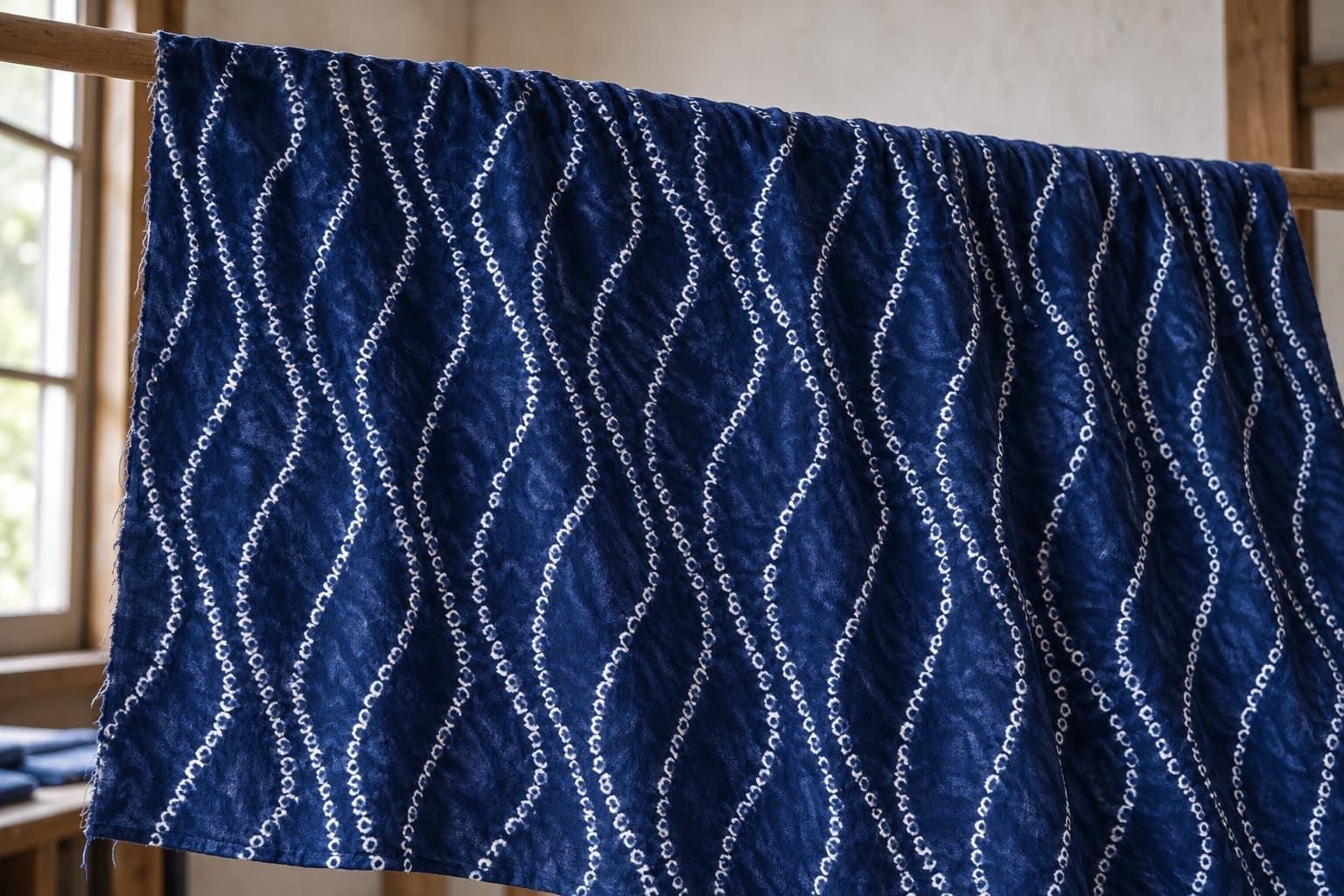
The pattern begins before the dye
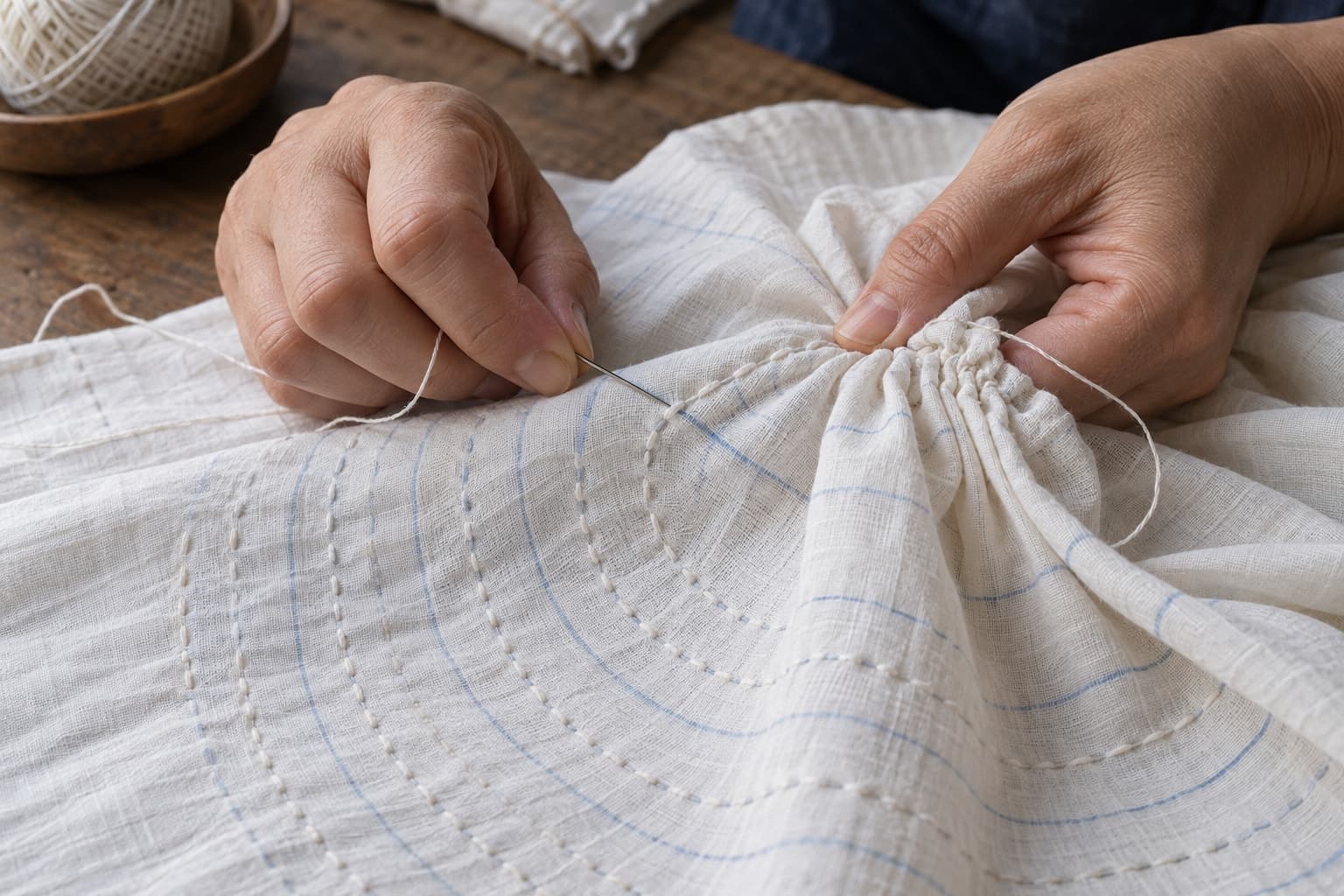
Before an Arimatsu shibori cloth enters a dye bath, much of its pattern is already being decided. A maker gathers small portions of fabric and binds them tightly with thread. Another technique begins with rows of running stitches, pulled to compress the cloth. Elsewhere, a folded length is pressed between boards. The dye reaches the exposed fabric more readily than the protected portions; releasing the bindings reveals the difference.
Shibori is often translated as tie-dye, but tying is only part of this family of resist-dyeing methods. In Arimatsu and neighbouring Narumi, now in Nagoya's Midori Ward, different ways of compressing cloth have become a remarkably varied craft. A small change in preparation can alter the scale, rhythm and edge of the resulting pattern. Arimatsu Textile's technique guide
For patterned yardage, the sequence may begin with a design transferred through a cut stencil using aobana, a temporary blue guide. The cloth goes to specialists who carry out the necessary binding, then to a dyer. After dyeing, the threads must be removed without damaging the fabric. The local museum's process account notes that thread removal alone can take several days for a length of cloth. The moment when a pattern appears is therefore the result of work both before and after immersion. Arimatsu–Narumi Shibori Museum
Look closely at a finished piece and its surface supplies another clue. The gathering can leave a dimensional texture, or shibo. Colour and relief belong to the same process: the fabric was physically rearranged while being dyed. It is this relationship between the movement of the hands and the appearance of the cloth that makes a demonstration so revealing.
A town shaped by passing travellers
Local accounts connect Arimatsu's settlement with 1608 and identify Takeda Shokuro as a central figure in the development of its shibori trade. The craft grew beside the Tokaido, the road linking Edo and Kyoto. Cloth could be sold to people already travelling through the district, and patterned hand towels and garments became recognisable souvenirs. Owari domain's protection helped the trade develop. The local cooperative's historical account
That story should not be confused with the invention of resist dyeing itself. The national craft association places Arimatsu–Narumi's development in the early Edo period while describing shibori in Japan as much older. It presents the familiar account of workers from Bungo, in present-day Oita, bringing the technique during Nagoya Castle's construction as something said to have happened, rather than a precisely documented first lesson. Association for the Promotion of Traditional Craft Industries
The road explains a market; the organisation of work helps explain the fabric. The association dates the establishment of a division of labour to the late eighteenth and early nineteenth centuries. A piece could move between stencil cutting, design transfer, binding and dyeing specialists. The finished textile was the outcome of connected skills, not necessarily one person taking every step from blank cloth to completed garment.
Those arrangements have also changed. Suzusan's company history traces its family business from stencil and design work into coordinating production. Its overseas brand began in Düsseldorf in 2008, and it later established an integrated production base in Arimatsu. The company describes moving to its current local premises in 2024 and launching a Japanese clothing brand in 2025. This is one firm's trajectory, but it shows why the older division of labour should not be treated as a rule that every present workshop must follow. Suzusan's history
The same company describes applying shibori to cashmere and alpaca as well as the cotton more readily associated with yukata, the light robes worn in summer. Clothing, cushions, throws and lighting have become settings for the technique. Its account also identifies younger makers working in the Arimatsu studio. The continuity here lies in learning to shape and dye fabric while allowing the fabric, customer and use to change. Suzusan's account of its work
There is recent evidence of that activity. In July 2026, Suzusan described repeated trials in its Arimatsu dyeing workshop for a new collection. That report concerns actual making, not simply an old designation attached to a product. It also offers a useful reminder that a traditional process can involve experiments whose outcome is not known in advance. The maker's July 2026 production announcement
Three ways to understand the cloth
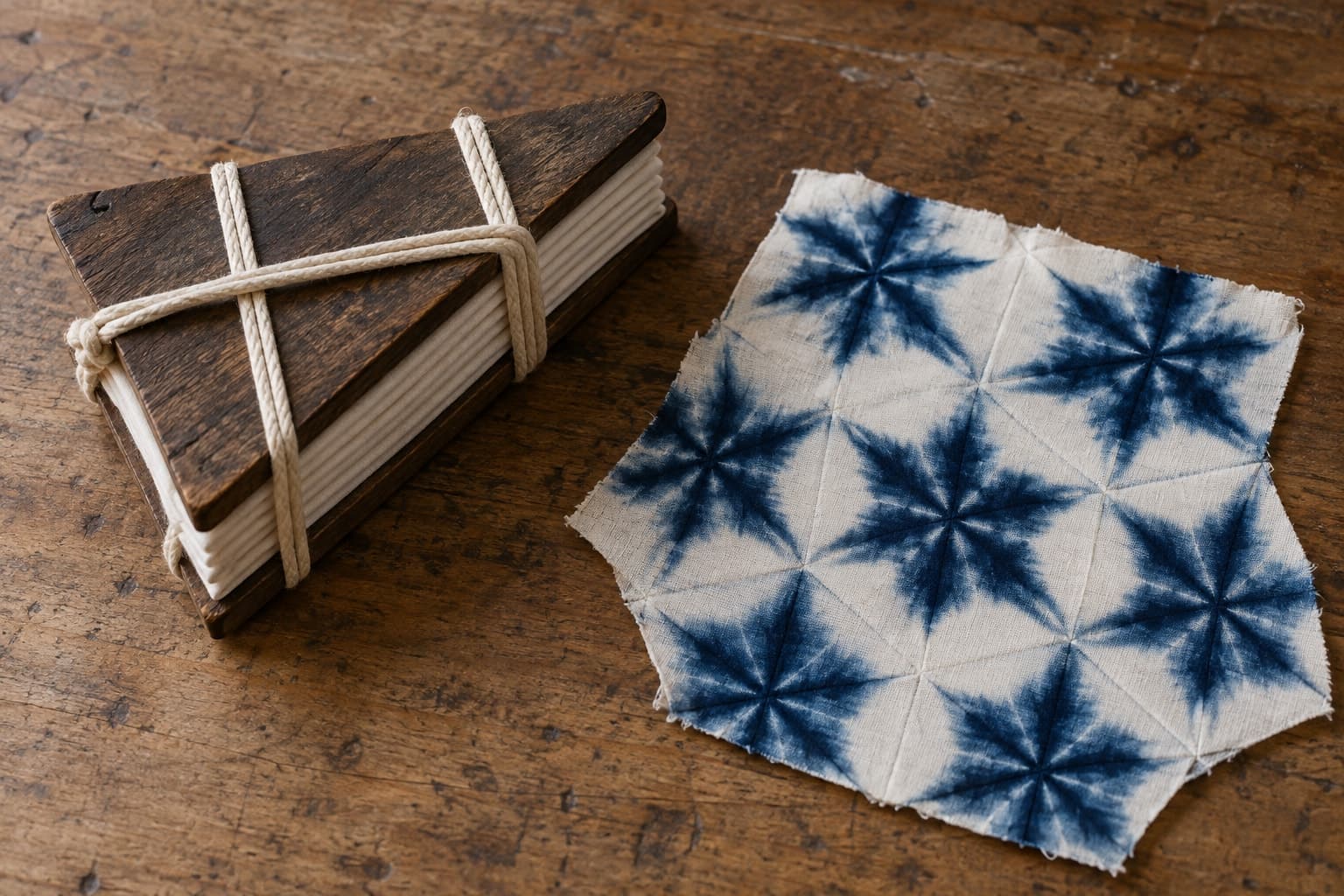
The first distinction is between a pattern that looks regular and a process that is mechanical. In sekka shibori, cloth is folded repeatedly into a triangle and held tightly between plates. When opened, the repeated folds organise the pattern across a much larger surface. The snowflake-like geometry comes from the folding and resistance to dye, rather than from printing the same finished motif over and over. The local textile guide also describes techniques that combine two kinds of binding on a single piece. A pattern can be the product of a sequence, not one gesture. Technique guide
The second is the work of finishing. A local heritage profile visits Haribun, where workers apply steam from below and stretch a full length of cloth together. The maker explains that pressing from above would flatten the texture they want to retain. Width matters because the fabric must later be made into clothing. The finished surface is thus neither an untouched trace of dyeing nor an accidental collection of wrinkles: it has been handled to retain texture while becoming usable yardage. Arimatsu heritage profile
That same profile describes the revival of arashi shibori, which wraps and compresses cloth around a long pole. Maker Yoshihide Hayakawa adapted the equipment, replacing a wooden pole with a more manageable stainless-steel pipe. The pattern-producing principle and the material of the tool are separate things. Keeping one alive can involve changing the other.
The third distinction concerns what a local technique can be used for. Suzusan's account of working with different fibres makes it clear that shibori is not a synonym for blue cotton. The compression, dye and cloth must work together; changing the fibre introduces another set of decisions. An indigo-and-white piece is an excellent introduction, but it is not a complete definition of the craft. Suzusan
These distinctions offer a more useful way of looking than trying to memorise a long list of technique names. Ask how the cloth was held, what prevented the dye from reaching particular areas, and what happened after the bindings came off. Those questions lead from a pleasing pattern back to the hands and decisions that produced it.
Visiting the shibori museum
The Arimatsu–Narumi Shibori Museum provides a public introduction through objects, films and demonstrations by craftspeople. Its workshop programme requires reservations. The distinction between activities matters: the weekday programme can involve work sent away for dyeing and dispatched later, while the listed weekend sekka activity allows participants to dye and take home their cloth that day. An overseas visitor should settle the activity and delivery arrangements when booking. Museum and workshop information
The museum supplies tools and materials. Allow time for the displays as well as the class: its own example suggests roughly two hours for a handkerchief lesson combined with the exhibition and demonstration. Watching an experienced maker before trying the process gives the apparently simple movements a different scale.
Use these advertised public settings for demonstrations and lessons. The workshops described in historical profiles are working premises, and a reported visit by a writer is not an invitation for general visitors to walk into a private production space.
When to go
Shibori can be encountered through the museum outside festival season. It lists opening hours of 9:30 a.m. to 5 p.m., with demonstrations ending at 4:30 p.m.; New Year and occasional temporary closures apply. Confirm the current workshop option and calendar with the museum before choosing a date.
For a larger event, the 2026 Arimatsu Shibori Festival was advertised for June 6–7 along the old Tokaido. Those dates have passed by the publication of this article. They indicate the summer festival setting, not a confirmed date for 2027. An autumn visit can focus on the making itself without waiting for the next festival. 2026 festival information
Around the visit: buildings and festival floats
The streetscape adds another material history. The local account records a major fire in 1784 and subsequent use of plastered construction and tiled roofs for fire protection. Surviving merchant houses make those decisions visible in walls, roofs and storehouses. Their appearance belongs to a history of rebuilding and commercial life, rather than an unchanged town preserved from its first settlement. Arimatsu's historic buildings
For a different kind of craftsmanship, the Arimatsu Dashi Museum displays one of the town's three festival floats on rotation. Decoration and mechanical puppets belong to the local festival tradition, distinct from textile production. The listed public opening is Saturday and Sunday, 10 a.m. to 4 p.m., so it will not automatically fit a weekday shibori booking. Festival floats and their museum
The float procession customarily takes place on the first Sunday of October. By an October 19 visit, that occasion is already past. The museum is the relevant option for seeing a float at other times; a display visit and watching it move through the streets offer different experiences.
Place and region
Nagoya City, Aichi
Arimatsu is in Midori Ward, southeastern Nagoya. The historic settlement grew along the Tōkaidō, the road between Edo and Kyoto, and its position beside passing travellers helped build a market for shibori cloth. Local tourism accounts trace the village’s establishment to 1608, between the post towns of Chiryū and Narumi. Arimatsu’s historic streets still make this connection between the town and its shibori trade visible.
From Tokyo
By rail, take the Tōkaidō Shinkansen from Tokyo Station to Nagoya Station, then transfer at Meitetsu Nagoya Station to the Meitetsu Nagoya Line for Arimatsu Station. The historic townscape is around the station. Highway buses also run from Tokyo-area boarding points to Nagoya; continue from Nagoya by Meitetsu train to Arimatsu. Routes, stops, schedules, and services may vary, so check with the operators before travelling.
Food of this place
- Hitsumabushi. Grilled eel served over rice, commonly eaten with condiments and broth.
- Miso-katsu. Breaded pork cutlet served with a rich miso sauce.
- Tebasaki. Fried chicken wings, typically seasoned with a sweet-and-spicy sauce.
The marker shows the municipality, not an exact event venue. Map data © OpenStreetMap contributors.
Explore more stories from Aichi