Kyoto · Autumn
Kurama Fire Festival: Carrying Fire, Welcoming the Gods
Children’s torches, seven neighborhood groups, and two portable shrines shape an October observance in northern Kyoto.
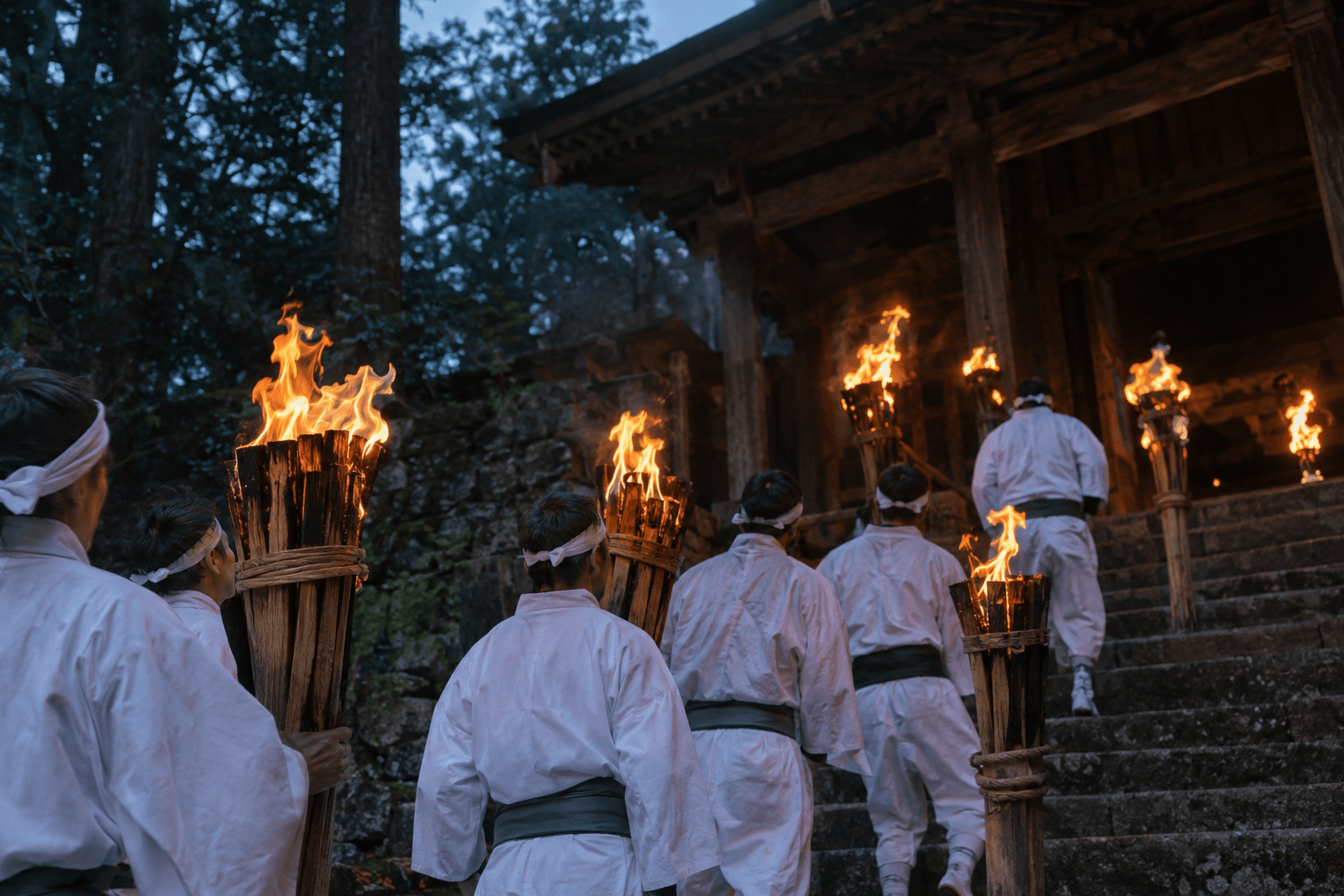
From doorstep fires to the temple steps
At about six in the evening, households in Kurama light the stacked fires known locally as eji. Children carry small torches through the settlement; older participants carry larger ones, calling out “Sairei, sairyo.” The setting is Kurama Honmachi in northern Kyoto, and the occasion is Yuki Shrine’s annual festival. Kyoto’s fire department recorded this progression again on October 22, 2025: household fires first, torchbearers of different ages along the road, and later two portable shrines descending the temple steps.
The young men carrying the large torches wear shoulder pads over otherwise bare upper bodies, black loincloths with hanging cords, dark leggings, and straw sandals. Their clothing and the scale of their torches distinguish them from the children who begin the evening’s procession.
Behind the movement along the street is an organization of seven local groups, called nakama. Each has a yado, a festival base where ceremonial objects are displayed. The cultural foundation’s account accompanying a 1975 documentary describes group leaders approaching Kurama-dera’s gate with ceremonial poles called kenboko, ropes, drums, and torches. They perform formal observances known as shorei along the way. The gathering at the steps is therefore not simply a crowd of people carrying fire: organized groups are coming to receive the portable shrines.
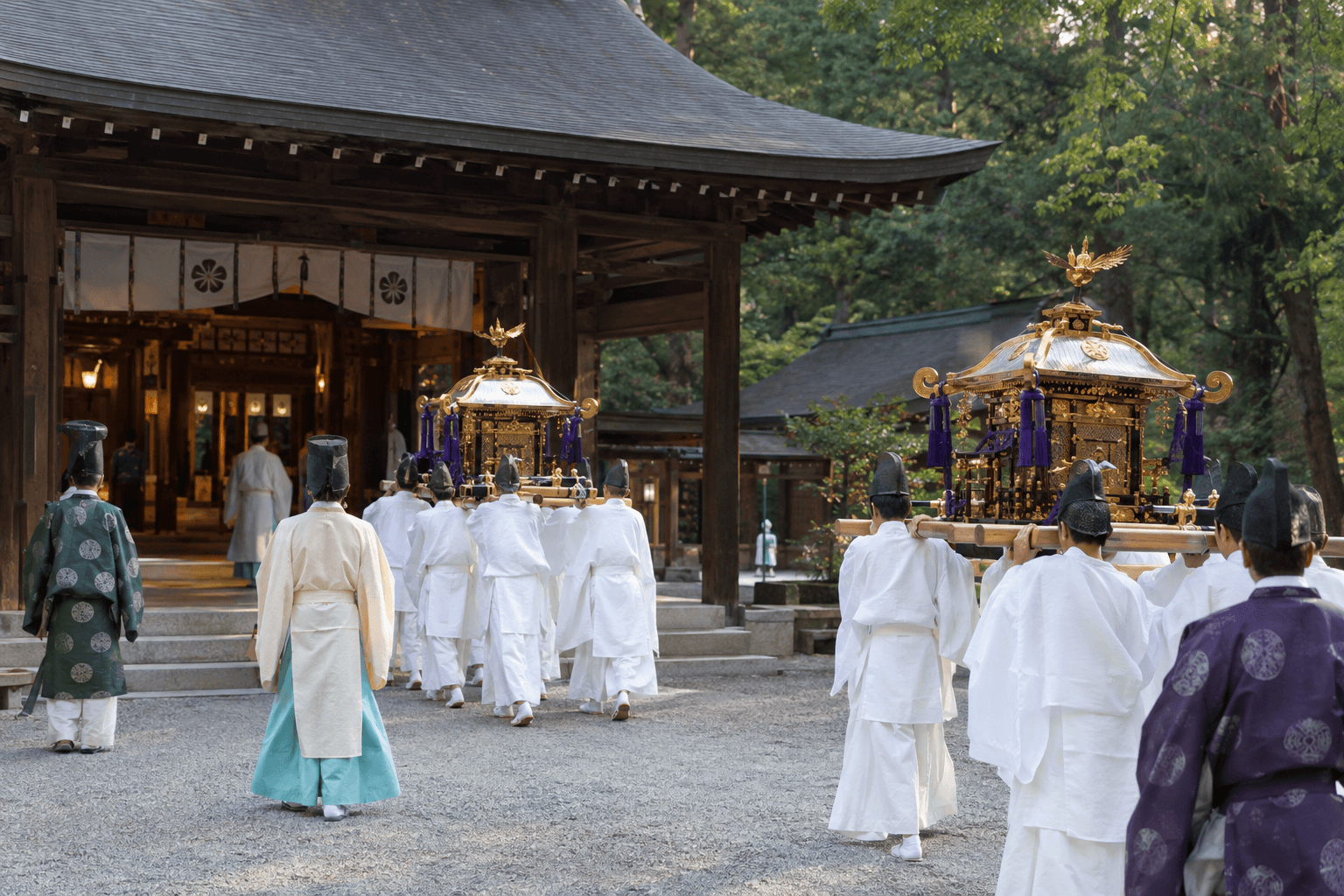
The torchbearers assemble before the temple gate. A sacred rope is cut, and the evening moves into the procession of the two mikoshi—portable shrines carried on poles. They descend the stone steps and travel through the settlement to the otabisho, the deities’ temporary resting place. In the fire department’s 2025 account, the gathering and rope-cutting took place at about nine in the evening.
At the otabisho, sacred performance is offered and four large kagura torches are carried around the precinct. The shrine’s customary sequence ends with the mikoshi returning to the main sanctuary on the morning of October 23. The familiar name, Kurama no Hi-Matsuri, means Kurama Fire Festival, but the fire accompanies a longer movement of the deities out into the community and home again.
Whom the village is welcoming
The two mikoshi have distinct religious identities. They serve Yuki Daimyojin and Hassho Myojin, whom Kyoto’s cultural-heritage account describes as the local land deity. Before the evening procession, Yuki Shrine holds morning rites in which the deities are understood to move from the sanctuary into their portable shrines. From that religious perspective, these are not empty ceremonial vehicles: their journey brings the deities through the community.
The shrine connects the festival with the transfer of Yuki Daimyojin from the imperial palace to Kurama in 940. In its account, torches and roadside fires accompanied the transfer, and residents passed down the memory of that reception. This is the festival’s origin tradition, not a securely demonstrated starting date for every practice seen today. Kyoto City’s heritage commentary explicitly questions whether the torch-welcome story can be accepted as historical fact.
Documented history offers a different kind of foothold. A city historical-landscape report identifies an Edo-period account, the Kurama-mura Shinji Genkyuki, as a detailed description of the ceremonies. Much later, Kyoto City commissioned the documentary completed in December 1975, whose accompanying description records the seven groups, their approach to the gate, the mikoshi procession, and offerings at the otabisho. These sources establish earlier forms of the observance without proving an unchanged line back to the tenth century.
Even the balance of attention may have changed. The city’s heritage commentary suggests that the mikoshi and kenboko once occupied a more prominent place, while the torches were less central than their present fame implies. That is an interpretation rather than a dated turning point. It nevertheless offers a useful way to understand the evening: the most photographed objects are not the whole religious event.
Preparation also reaches beyond the night itself. The historical-landscape report describes meetings beginning months ahead, with the priest and festival officers planning the proceedings. As the date approaches, households remove and clean their wooden latticework; repairs to roofs and walls may be timed to the festival. Responsibilities are carried out by groups and districts. In this account, preparing the settlement and preparing the procession are parts of the same communal undertaking.
Contemporary organization includes practical coordination around the fire. In 2025, festival officers reported the start of the rites to the fire-service headquarters and returned to report their conclusion. The fire department’s account records both the procession and its protective work. It is a concrete example of religious observance proceeding alongside an organized safety operation, rather than evidence that the festival has become merely a show for visitors.
Three details that explain the work
A torch for each stage of growing up
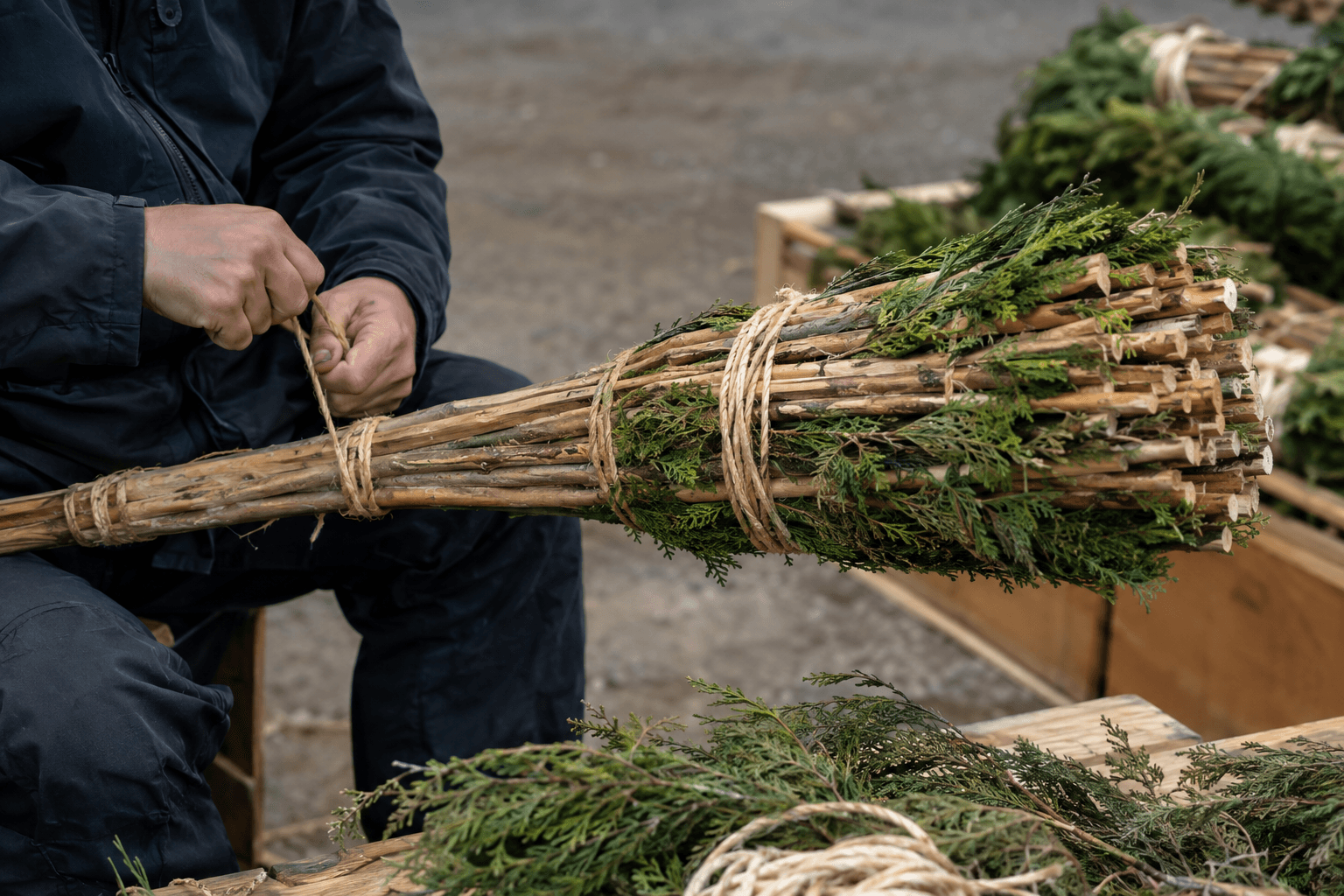
Torch sizes correspond to stages of childhood and youth. Kyoto Prefecture’s account assigns the small torches to elementary-school children, medium ones to junior-high students, and large ones to participants of high-school age and above. Younger children carry the small type called tokkuri, accompanied by parents.
A Sakyo Ward festival booklet gives this progression a family perspective. In its published interview with a father and son from the Yamamoto family, learning to carry and make torches is described as something absorbed from childhood by watching family members, rather than only through formal instruction. The booklet also notes that a child’s first carrying experience can be especially meaningful to the parents. This is one family’s account, but it helps explain why the smallest torches belong in the story alongside the largest: they mark an early place in an activity that adults already know well.
The wood has to be right
A torch is not an arbitrary bundle of branches. Kyoto Prefecture describes the use of resin-rich red-pine wood, known as jin, together with suitable brushwood. Wisteria vines used for binding are valued because they resist burning and hold without readily loosening. The account also records a religious understanding of the pine’s fragrance: its burning scent is said to invite the deities. Material choice thus has both practical and attributed religious significance.
Obtaining that material is a continuing task. A study published in 2021 examined thirteen former brushwood-harvesting sites, assessing not just how much wood they could supply but whether it would be suitable for the festival. Sites with greater red-pine dominance tended to offer better prospects. The researchers’ distinction between quantity and quality matters: a wooded hillside does not automatically provide the kinds of stems torchmakers need.
The prefecture’s 2026 account describes the preservation association working with universities and companies on woodland regeneration, including monitoring and deer fencing. The work behind the flames therefore extends into the places where their materials grow.
A descent with more than one meaning
The mikoshi descent includes the choppen rite: two young men hang upside down from the carrying poles with their legs spread. It is described as a surviving element of Kurama’s coming-of-age customs. Meanwhile, young women pull ropes attached behind the mikoshi to control their descent down the steep approach. Pulling these ropes is also traditionally associated with a blessing for easier childbirth. The actions should not be reduced to acrobatics and crowd excitement. In the published explanations, the descent combines demanding physical roles with ideas about adulthood and family life. The childbirth blessing is a belief attached to participation, not a medical claim.
Visiting the procession
The public occasion is the festival in Kurama itself, centered on Yuki Shrine and the road through the settlement. Watching along the public route does not mean unrestricted access to every ritual location. The current official visitor notice says the area before the mountain gate is regulated as sacred space before the evening rites, with access above the gate restricted. Remain within the designated visitor areas; household festival bases are not invitations to enter private homes.
Expect your movement to be managed. A firsthand report by MK Travel staff from the 2025 festival describes one-way circulation through the main area and instructions to keep moving when crowded. That report concerns 2025, not a guaranteed map for a later year. Its practical lesson is still useful: do not build a visit around securing a fixed position at the steps or assume that you can retrace your route. Follow police and festival staff directions, including when taking photographs.
For a quieter introduction, Kurama-dera’s Reihoden, also called the Kurama Mountain Museum, provides another way to learn. The temple’s description of its second-floor galleries includes Fire Festival materials alongside temple art, crafts, and archaeological objects. This is a museum operated by Kurama-dera, not Yuki Shrine, and an exhibition is different from a live torch procession. The museum’s natural-history displays can also place the festival’s materials within the wider setting of the mountain.
When to go
October 22 is the customary festival date. The 2025 observance took place on Wednesday, October 22, 2025, as confirmed by Kyoto’s fire department after the event. For the next edition, Kyoto City’s official tourism listing announces Thursday, October 22, 2026, from 6 p.m. until after midnight. These are separate annual occasions, not a continuous visiting period.
Choose the evening festival if your purpose is to see the torches and procession. Allow for a late finish, but do not assume that every stage will follow a precise spectator timetable. The official notice asks visitors to use public transport: general vehicle restrictions begin at 3 p.m., and local parking lots are closed for the occasion. Consult the shrine’s and transport operators’ current notices before departure for final arrangements and the return journey.
For the museum, plan a daytime visit instead. Its published ordinary hours are 9 a.m.–4 p.m.; it closes on Tuesdays, or the following day when Tuesday is a public holiday, and from December 12 through the end of February. Those are museum opening arrangements, not additional dates on which the Fire Festival is performed.
Around the visit: water worship in Kibune
Kifune Shrine, beside the river in neighboring Kibune, makes a worthwhile separate daytime visit. The shrine identifies its principal deity with the provision of water. Its grounds comprise the main shrine, the rear shrine, and Yui no Yashiro; at the main shrine, writing appears on special fortune slips when they are floated on the sacred spring water. This offers another concrete way to encounter religious practice in the northern Kyoto mountains without treating it as an extension of the Fire Festival. Allow for stone steps: the shrine’s visitor guidance warns that its stairways prevent access by wheelchair or stroller.
Place and region
Kyoto, Kyoto
Kurama Honmachi is a mountain settlement in northern Kyoto City, beyond the city’s central basin. The settlement’s streets and the stone steps leading down from Yuki Shrine on Mount Kurama form part of the festival route: torch processions pass through local streets before the portable shrines descend.
From Tokyo
Take the Tokaido Shinkansen from Tokyo to Kyoto. From Kyoto Station, take the JR Nara Line to Tofukuji, transfer to the Keihan Railway for Demachiyanagi, then take the Eizan Railway’s Kurama Line to Kurama Station. Check railway operators for current timetables and service information before traveling.
Food of this place
- Kyoto vegetables (Kyo-yasai). Varieties include Kujo leeks, Kamo eggplant, and Shogoin daikon.
- Kyoto pickles (Kyo-tsukemono). Senmaizuke, suguki, and shibazuke are among the varieties associated with Kyoto’s food culture.
- Kyoto sweets (Kyo-gashi). Traditional varieties include seasonal sweets and sweets associated with the tea ceremony.
The marker shows Yuki Shrine. Map data © OpenStreetMap contributors.
Explore more stories from Kyoto